
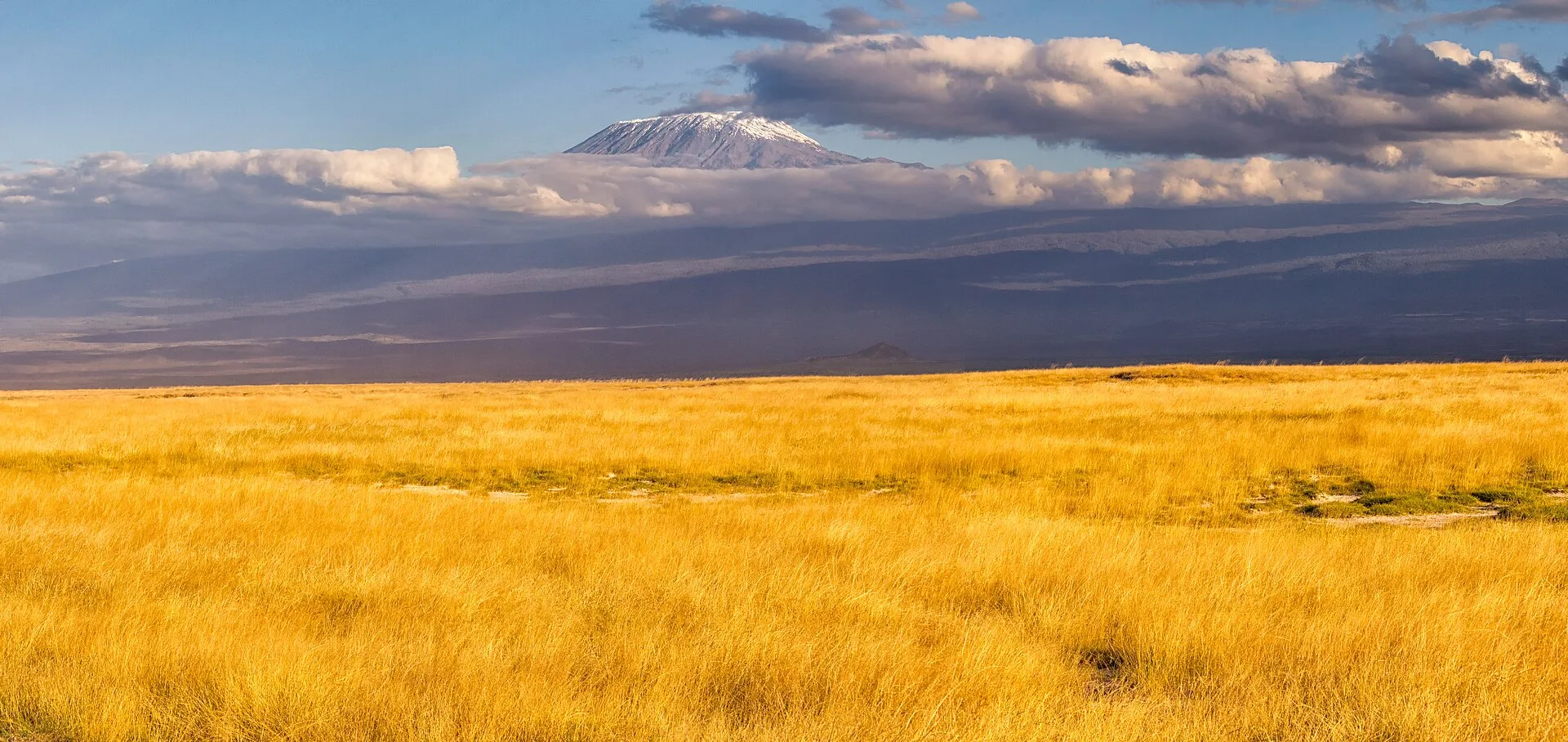
Kilimanjaro rises alone from the plains of northern Tanzania to 5,895 meters, the highest point in Africa, with three volcanic cones: the extinct Shira and Mawenzi and the dormant, ice-capped Kibo. Its southern and eastern slopes, watered by the mountain and terraced with bananas and coffee, are the homeland of the Chagga, who have lived in sight of the summit for centuries and whose religion is bound up with it. The mountain’s reputation as a place of spirits is older than any European account of it, and it has grown a modern layer, repeated on tour-company websites, of a gateway to the underworld somewhere on its flanks.
What the Chagga believed
The standard ethnography remains Charles Dundas’s Kilimanjaro and Its People of 1924, written while he was a colonial administrator in the district, and the anthropologist Päivi Hasu’s fieldwork from the 1990s shows how much of it survives. The supreme being is Ruwa, or Iruva in the western chiefdoms, a name that also means sun. He is a provider and liberator rather than a creator, lives in the sky with the moon, and in some tellings sits on Kibo itself, which makes the summit sacred. Sacrifices to him are made at noon. But day-to-day religion concerns the ancestors, who take a far closer interest in the living than the gods do, and who are kept close to home.
Historically the Chagga practiced double burial. A man was interred inside his hut; a year later the skull was lifted and reburied in the family banana grove, the kihamba, under a planted dracaena, with a goat sacrificed at the first stage and cattle at the second. A Leipzig missionary who visited the chief of Mwika in November 1910 was shown the skulls of the chief’s forebears under stones among the bananas, and his father’s in a covered pot. The corpse was laid facing Kibo and the skull groves face Kibo. An ox was slaughtered so that the chief of the other world would admit the newcomer, a world pictured as a mirror of this one, with its own chiefs and cattle. The childless, who would have no one to feed them, were left in the bush and did not become ancestors at all. Hasu found that educated, Christian Chagga still travel home at Christmas to carry out these sacrifices, and that the banana grove remains the place where a Chagga expects to be buried.
Spirits on the mountain
The first European account of Kilimanjaro is also the first record of its guardians. At the coast in the 1840s the missionaries Johann Krapf and Johannes Rebmann heard of a vast mountain of gold and silver in the interior whose approaches were guarded by evil spirits that killed those who tried to climb it. On May 11, 1848 Rebmann saw its summit shining white and asked his guide what it was; the man said only that it was cold, and Rebmann understood that the silver was snow. His report, printed in the Church Missionary Intelligencer in 1849, was disbelieved in London for years. The warnings persisted. Hans Meyer, who turned back at the foot of Kibo’s ice in 1887 and was captured and ransomed during the Abushiri revolt in 1888, returned in 1889 with the Austrian alpinist Ludwig Purtscheller and the young Chagga guide Yohani Kinyala Lauwo. They got close to the crater rim on October 3, retreated, and on October 6, Purtscheller’s fortieth birthday, stood on the southern rim at the highest point, which Meyer named Kaiser-Wilhelm-Spitze and Tanzania has called Uhuru Peak since independence. The spirits sent no storm; what Meyer brought home was a book and the news that the summit was a crater.
The underworld
The entrance to the underworld is harder to trace. Travel writing about Kilimanjaro describes the Wakonyingo, a race of dwarfs said to live in caves beneath the slopes, who guard the mountain’s purity and punish climbers with bad intentions, and some versions make their caves the way down to the land of the dead. Chagga oral tradition does speak of the Wakonyingo, or Koningo, as small people who once crossed the mountain from east to west, and anthropologists have wondered whether they preserve a memory of earlier inhabitants. But the ethnographic literature places the Chagga dead in the grove beside the house and in a spirit world like this one, not in a cavern on the mountain, and gives the afterlife no door. The gateway version, with its guardian dwarfs and ring of fire, cannot be traced further back than the tour operators who tell it.
Where it stands
Kilimanjaro is a sacred mountain in a living religion: its summit is the seat of Ruwa, the dead are buried facing it, and the ancestors are fed under its slopes every Christmas. That is a documented spiritual geography, and climbers who treat the mountain lightly are still told by their guides that it answers back. The underworld entrance is a different kind of story, assembled in recent decades from the Wakonyingo, the old warnings about evil spirits and a general sense that a mountain this large ought to hide something. It belongs to the legends of Kilimanjaro rather than to the beliefs of the people who live on it.