
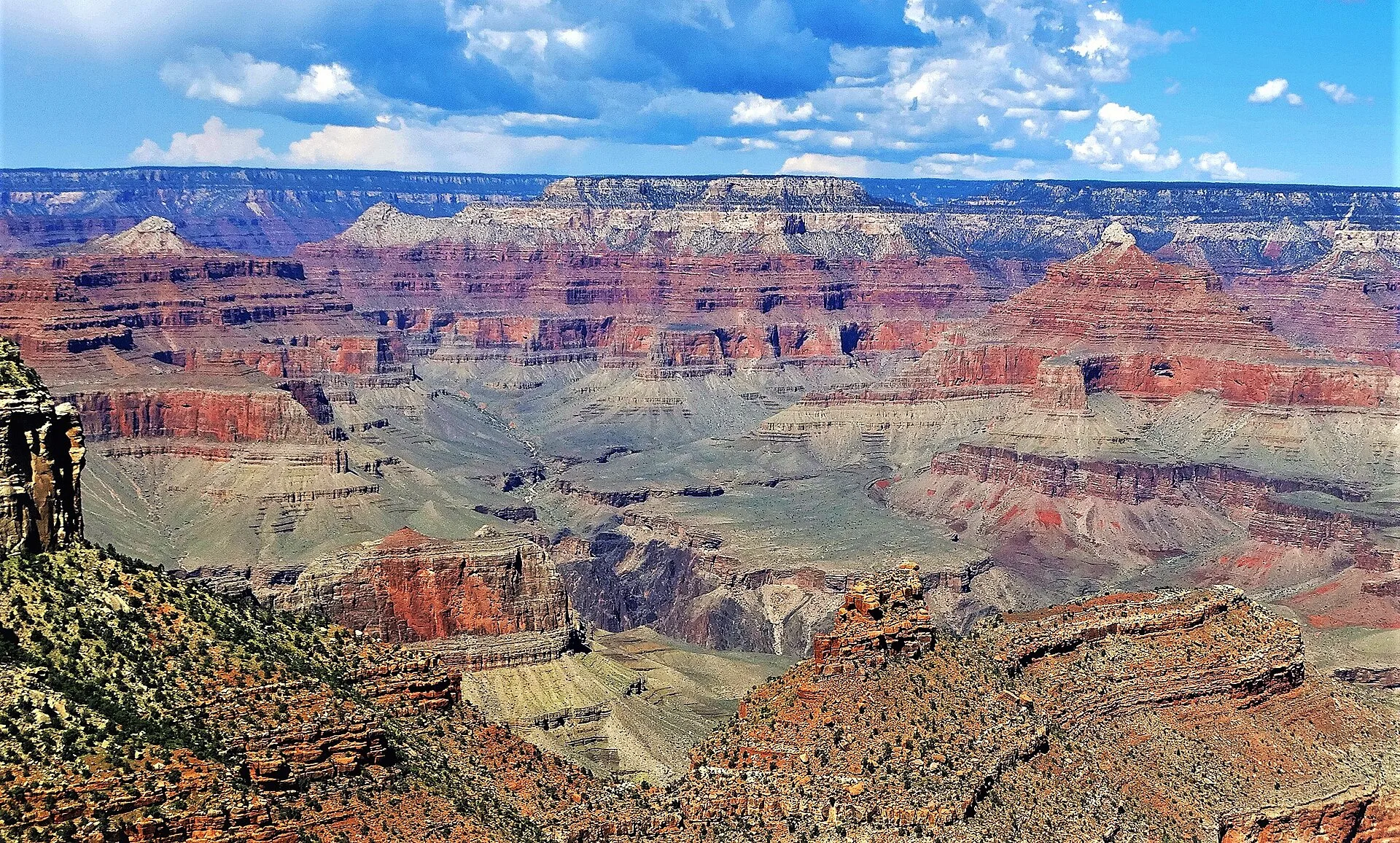
On the evening of April 5, 1909 readers of the Arizona Gazette in Phoenix found a sensational story across the front page. Under a stack of headlines promising the mysteries of an immense, rich cavern, it reported that a Smithsonian man had found the remains of an ancient people deep in the Grand Canyon, and that their culture appeared to have come from the Orient.
What the story said
The hero was G. E. Kinkaid, later usually spelled Kincaid, said to have spent decades in the Smithsonian’s employ and to be traveling alone by boat down the length of the Colorado River. He had spotted a cave mouth high on a cliff, some 2,000 feet over the river and forty-two miles upstream of a place the paper called El Tovar Crystal Canyon, with steps cut into the rock beneath it. Inside, the story went, a main passage led to hundreds of straight-walled rooms, granaries, a vast dining hall, copper tools hard as steel, gold and copper urns, a cross-legged idol resembling the Buddha, tablets carved with hieroglyphs and mummified bodies. A Professor S. A. Jordan of the Smithsonian had arrived to string electric lights and lead a growing team, and believed the builders might have been Egyptians. The site, readers were told, was on government land and closed to sightseers. The Gazette had carried a brief item about Kinkaid’s river trip in March, with no mention of any cave.
The investigation
Nobody has found Kinkaid, Jordan or the expedition in any record. When asked, the Smithsonian’s Department of Anthropology has replied that its files contain no mention of either man or of any Egyptian finds in Arizona; the article even calls it the Smithsonian Institute, a name the institution never used. Brian Dunning of Skeptoid pointed out that the article’s own claim, that the cave mouth once sat at river level 2,000 feet above today’s channel, would place its builders long before modern humans existed.
The most thorough look at the story’s origins came from the writer Don Lago in the Grand Canyon Historical Society’s journal, The Ol’ Pioneer, in 2009. He checked more than a dozen Arizona newspapers of the time. Only one, the Jerome Mining News, reprinted the article, without comment. Only one commented: on April 16 the Coconino Sun in Flagstaff ran a short front-page item headed “Looks Like a Mulhatton Story.” Joe Mulhatton was a traveling hardware salesman who had become nationally famous in the 1870s and 1880s for planting invented news, especially tales of enormous caves full of mummies resembling those of Egypt, and who had been living in Arizona since 1893, telling tall stories to small-town editors. Lago does not claim to prove Mulhatton wrote the cave piece, but readers in 1909 knew the genre. The Gazette never returned to the subject.
How it came back
The article sat forgotten until 1962, when it was reprinted in Arizona Cavalcade, a collection of old territorial newspaper stories. There it caught the eye of David Hatcher Childress, whose 1992 book Lost Cities of North and Central America presented it as a real discovery. Childress noticed that buttes in the canyon carry names such as Isis Temple and Tower of Ra, and argued that the Smithsonian and the National Park Service were hiding the cave in a restricted zone. The names have a duller origin: the geologist Clarence Dutton and those who followed him in the 1880s gave the canyon’s landforms names from mythologies around the world, which is also why it has a Shiva Temple, a Buddha Temple and a Guinevere Castle.
Where it stands
Since then the cave has spread through websites, a History Channel series and podcasts, with search parties checking caves and promising that the real entrance has been dynamited shut. Grand Canyon historians point out that the cliffs would have made it nearly impossible to haul tons of artifacts out unseen, and that the tale erases the Native peoples who actually lived in the canyon. The story is a single unsigned newspaper piece in an era that enjoyed newspaper hoaxes, and there is nothing behind it.