
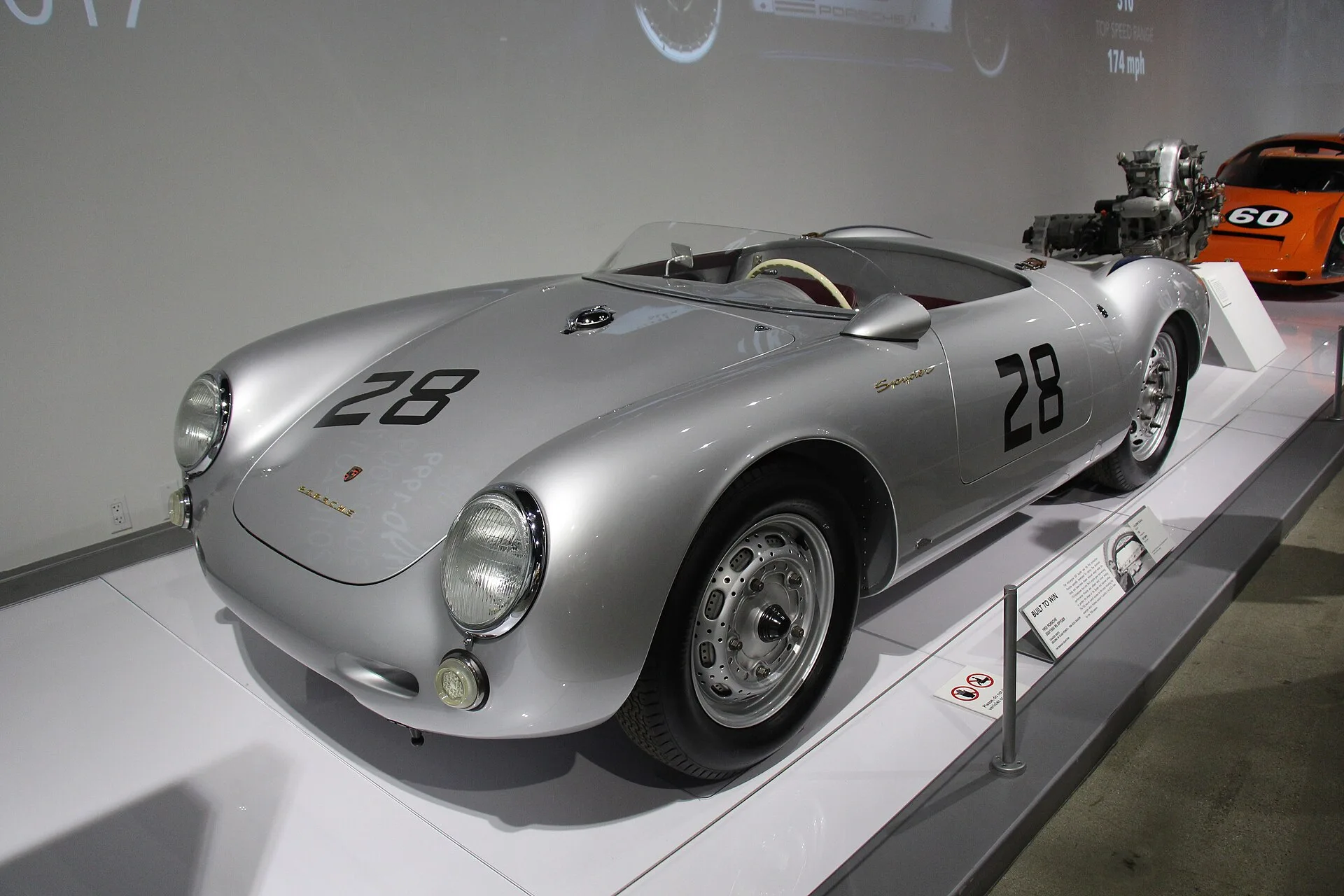
James Dean had made only three films when he died, and the car he died in has had a longer public life than he did. The silver Porsche 550 Spyder he nicknamed Little Bastard is routinely described as the most cursed car in history, blamed for a chain of deaths, injuries and accidents after the crash. Almost all of that chain traces back to one man who owned the wreck and told stories about it for decades.
What happened
Dean bought the Spyder, a light, low racing car, on September 21, 1955, trading in his Porsche Speedster. He had “130” painted on it as his racing number and “Little Bastard” lettered across the tail. On September 30 he set out from Hollywood to drive it to a sports car race in Salinas, with his Porsche mechanic, Rolf Wütherich, in the passenger seat and friends following with a station wagon and trailer. Late that afternoon, at the junction of Routes 466 and 41 near Cholame in San Luis Obispo County, a 1950 Ford sedan driven by a college student named Donald Turnupseed turned left across his path. The two cars hit almost head-on. Dean, 24, died of a broken neck and other injuries; Wütherich was thrown out and badly hurt; Turnupseed was bruised. A coroner’s jury ruled the death accidental and found no criminal fault.
The wreck was declared a total loss. The engine went to a Burbank physician and amateur racer, William Eschrich, who put it in his own car, and other parts were lent to his friend Troy McHenry. The crushed body ended up with George Barris, the Hollywood car customizer, who lent it out from 1956 as a highway-safety exhibit at car shows and theaters.
The investigation
The curse began as fan talk and grew in print. In October 1956, at a race in Pomona, McHenry was killed when his car went out of control; Eschrich was also involved in an incident in the same event. Fans called it a jinx, and a reporter covering Dean’s devotees wrote it up. Eschrich told the press that McHenry’s car carried some rear suspension parts from the Spyder, not its transmission, and that the borrowed parts had nothing to do with the crash. McHenry is the only death that can be firmly tied to the car’s components.
In March 1959 the shell, stored in a Fresno garage before a show, was scorched by a small fire that burned two tires and some paint. In 1960, on the way back from a safety display in Florida, it disappeared. Barris told the vanishing story several ways, sometimes as a sealed truck and sometimes as a sealed railroad boxcar, and never produced paperwork for the shipment.
The full curse appeared in 1974, in Barris’s book Cars of the Stars. It added a truck driver killed when the car fell off its trailer, a teenager whose hip was crushed when it slipped from a display stand, a car that split in half in transit and parts that injured other drivers. The writer Jason Colavito, who checked contemporary newspapers, found no record of these incidents, and the Porsche historian Lee Raskin has written that many of the curse claims rest on Barris’s book alone. A 1990 magazine article attributed to a “Ron Smith” layered on more inventions, including a link to the car in which Archduke Franz Ferdinand was shot. Alec Guinness’s famous warning to Dean that he would be dead within a week first appeared in print decades later, in his 1985 memoir.
The explanations
The crash itself needs no curse. A tiny aluminum car met a heavy sedan making a left turn at dusk, in an era before seat belts or roll bars were standard. The investigating officers’ estimate put Dean’s speed at around 55 miles per hour, far below the figures in early press reports. The later misfortunes are either documented and ordinary, like a racing death in an era of unsafe circuits and a minor garage fire, or undocumented and convenient to a man who earned money and publicity from the exhibit. Raskin has suggested that Barris let the shell slip away once its drawing power faded and kept the mystery alive at anniversaries.
Where it stands
Pieces of the car are real and still turn up. In 2005, for the 50th anniversary, the Volo Auto Museum in Illinois displayed what it said was a door from the car, and a million-dollar reward for the rest went unclaimed. In 2020 the transaxle, numbered 10046, surfaced from a Massachusetts collector’s crate, with its provenance confirmed by Raskin. It sold at auction in 2021 for about $387,000 to the paranormal television host Zak Bagans, who displays it in his Las Vegas museum as a cursed relic. The body of Little Bastard has never been found, and the curse has never been more than a story.