
The schoolyard rhyme gives Lizzie Borden an axe and eighty-one blows. The record gives a hatchet, if that, and twenty-nine. On Thursday August 4, 1892, a hot morning in the mill city of Fall River, Massachusetts, someone killed Andrew Jackson Borden, a wealthy and famously frugal property owner, and his second wife, Abby, inside their narrow house at 92 Second Street. The killer was never identified in law. Andrew’s younger daughter, Lizzie, was tried for both murders and acquitted, and the question of whether the jury got it right has outlived everyone involved.
What happened
Five people were in the house the night before: Andrew, Abby, Lizzie, the Irish maid Bridget Sullivan, and John Morse, the brother of Andrew’s first wife, who had come on business. Lizzie’s older sister, Emma, was away visiting friends. Andrew and Abby had been ill with vomiting the day before, and Abby had told the family doctor she feared poison. After breakfast Morse went out, Andrew walked downtown, and Sullivan, who had been sick in the yard, was sent to wash the windows. Some time after half past nine Abby went up to make the bed in the guest room. She was struck from behind about nineteen times.
Andrew came home late in the morning, around half past ten, and was let in by Sullivan, who later testified that she heard Lizzie laugh at the top of the stairs as she fumbled with the stiff front lock. Lizzie told her father that Abby had gone out to visit a sick friend after receiving a note. Andrew lay down on the sitting-room sofa and Sullivan went up to her attic room to rest. A few minutes after eleven Lizzie called up to her that someone had come in and killed her father. He had been hit about ten times in the head as he lay there. A neighbor, Adelaide Churchill, found Abby’s body upstairs; it was already cooling, while Andrew’s was warm, which put the two deaths roughly ninety minutes apart.
The investigation
Police found no sign of a break-in, nothing stolen and, puzzlingly, no blood on anyone in the house. Lizzie said she had been in the barn loft looking for fishing sinkers, but an officer reported the loft was stifling and its dusty floor undisturbed. A druggist, Eli Bence, said she had tried to buy prussic acid the day before. In the cellar officers found a hatchet head with a freshly broken handle and what looked like ash rubbed on it. No note to Abby was ever found. On the Sunday after the murders the family friend Alice Russell watched Lizzie push a dress into the kitchen stove; Lizzie said it was ruined with paint. At the inquest Lizzie, sedated with morphine by the family doctor, gave muddled and contradictory answers, and on August 11 she was arrested. A grand jury indicted her after hearing Russell’s account of the dress.
The trial
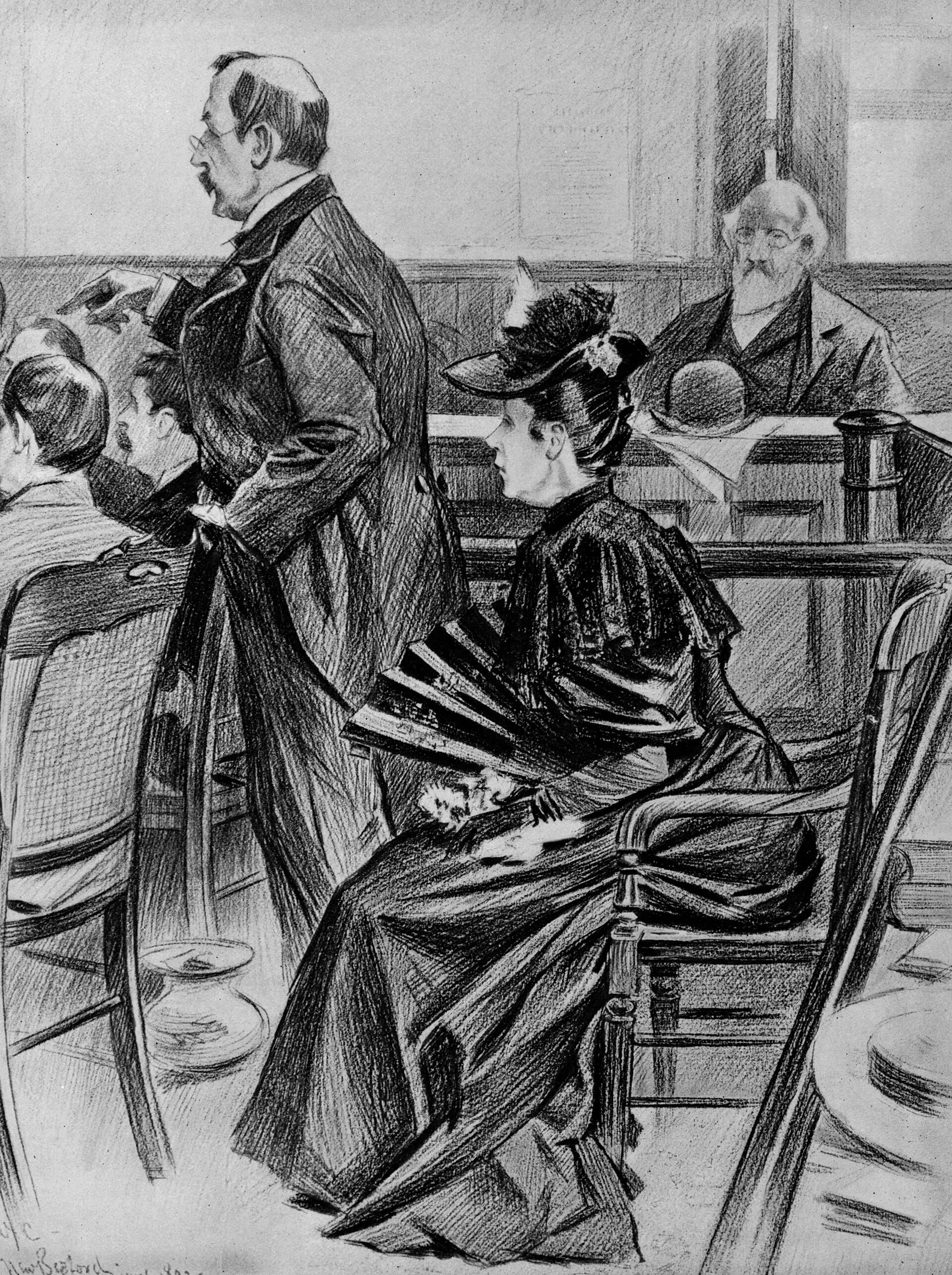
The trial opened at the New Bedford courthouse on June 5, 1893 before three judges. District Attorney Hosea Knowlton and William Moody, a future Supreme Court justice, prosecuted; Andrew Jennings, the family lawyer, and George Robinson, a former governor of Massachusetts, defended. Two rulings hurt the state badly. The judges excluded Lizzie’s inquest testimony because she had effectively been a prisoner when she gave it, without counsel or a warning of her rights, and they kept Bence’s prussic-acid story from the jury. The prosecution could not show that the handleless hatchet was the weapon. The defense stressed the short window for the second killing, the absence of blood on Lizzie, and sightings of strangers near the house. Justice Justin Dewey’s charge to the jury was so favorable to the accused that newspapers called it a plea for the defense. On June 20 the twelve men deliberated about an hour and a half and returned a verdict of not guilty.
The explanations
Most writers on the case believe Lizzie did it, citing her resentment of a stepmother she refused to call mother, a dispute over property Andrew had given Abby’s family, the dress, and the lack of any plausible outsider. The novelist Victoria Lincoln, who grew up in Fall River, argued in 1967 that Lizzie may have killed in an altered state linked to a seizure disorder. Others have pointed at Bridget Sullivan, at John Morse and his unusually precise alibi, or at a supposed illegitimate son of Andrew’s named William Borden, a theory later researchers disproved.
Where it stands
After the trial the sisters bought a large house on the Hill, which Lizzie named Maplecroft, and she took to calling herself Lizbeth. Shunned by much of local society, she died there in June 1927; Emma, long estranged, died about a week later. They are buried with their father and stepmother in Oak Grove Cemetery. Lizzie Borden was found not guilty, no one else was charged, and the double murder remains formally unsolved.