
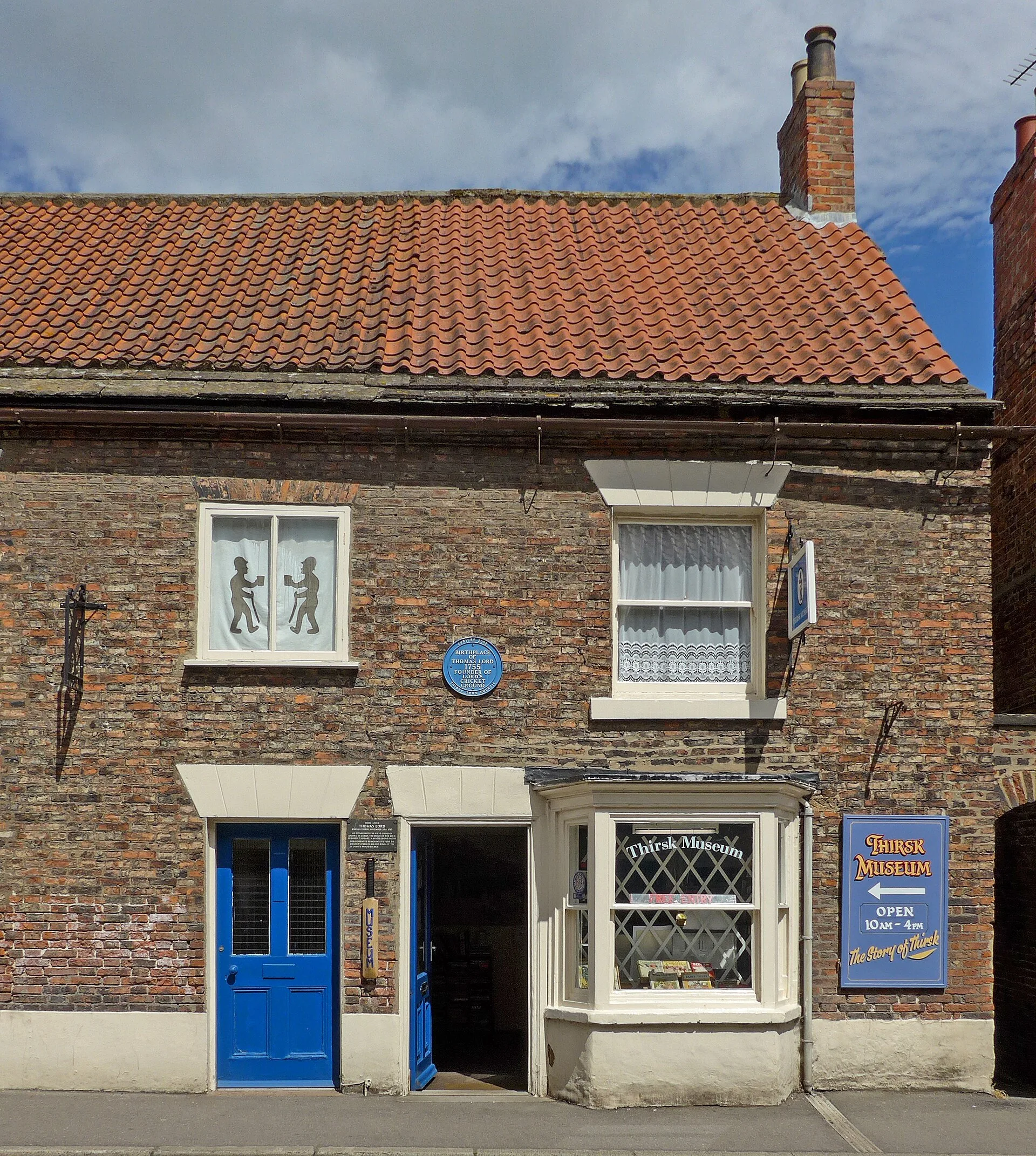
Thirsk Museum occupies the house on Kirkgate where Thomas Lord, founder of Lord’s Cricket Ground, was born in 1755. Among its farm tools, toys and wartime plaques is an oak armchair suspended well above the floor, out of reach. Visitors are told it is the Busby Stoop chair, sometimes called the Dead Man’s Chair, and that anyone who sits in it dies. It has been kept off the floor since it arrived from a roadside pub in 1978.
The legend
The story begins with a real crime. In 1702 a man named Thomas Busby murdered his father-in-law, Daniel Auty, near Thirsk. Auty, who lived at a farm later known as Dannoty Hall, was suspected of making counterfeit coin. Busby had married his daughter, joined the business and, by local tradition, wanted it for himself. They quarreled, and Busby killed him. He was tried, condemned and hung in chains on a gibbet post at the crossroads west of Thirsk, where the road from Ripon meets the old route between Topcliffe and Northallerton. The antiquary Ralph Thoresby rode past in May 1703 and recorded in his diary the grim sight of Busby’s body in its chains, within view of Auty’s own house. A stoop is a post, and the inn that stood at the junction took the name Busby Stoop.
The chair is a later addition. In the version told at the pub, Busby was drinking in his favorite seat when the constables came for him, and as he was taken away he swore that death would come to anyone else who sat there. Another version moves the curse to his last journey to the gallows. Either way the chair stayed in the bar for generations, and its reputation grew with each retelling. During the Second World War, the story goes, young Canadian airmen from the bomber base at nearby Skipton-on-Swale dared each other to sit in it and did not come back from their next missions over Europe. In the 1970s local people connected a series of fatal accidents with recent sitters. In 1978 the landlord gave the chair to Thirsk Museum, which hung it from the ceiling so that no one, not even staff, could use it.
The investigation
Two kinds of evidence test the legend, and neither supports it. The first is documentary. William Grainge’s history of Thirsk and the Vale of Mowbray, published in 1859, tells the Busby murder in detail, names the inn, describes the gibbet and quotes Thoresby, and says nothing about a chair. A cursed seat in the bar of the very inn he was describing is the sort of thing a Victorian local historian collecting folklore would have been glad to record.
The second is the chair itself. A furniture historian who examined it found spindles turned on a powered lathe, a technique that came into use long after Busby’s time; chairs of the early eighteenth century were turned by hand on a pole lathe. On that basis the chair was dated to around 1840, well over a century after the murder. Whatever the drinkers at the Busby Stoop were sitting on, it was not a seat Thomas Busby could have used.
The explanations
The deaths are the kind that attach easily to a legend. The bomber crews of No. 433 Squadron of the Royal Canadian Air Force, stationed around Thirsk from 1943, flew night bombing raids over France and Germany, dangerous work from which many crews never returned, whether or not they had sat anywhere in particular. The road accidents of the 1970s are not documented with names and dates in the accounts that repeat them, and the total of victims attributed to the chair varies enormously between retellings. A chair that could be dared over a pint may well have been good for business, and a pub with a hanged murderer for a name had every reason to keep the story going.
Where it stands
The murder of Daniel Auty and the gibbeting of Thomas Busby are real events, recorded within a year by a respected diarist. The cursed chair is not part of that record. It appears to be a nineteenth-century piece of furniture that collected a story in a pub, and its fame today rests on its unusual display rather than on any proven death. The museum, which is free to enter, presents it as a legend and calls it one of the town’s most intriguing objects.