
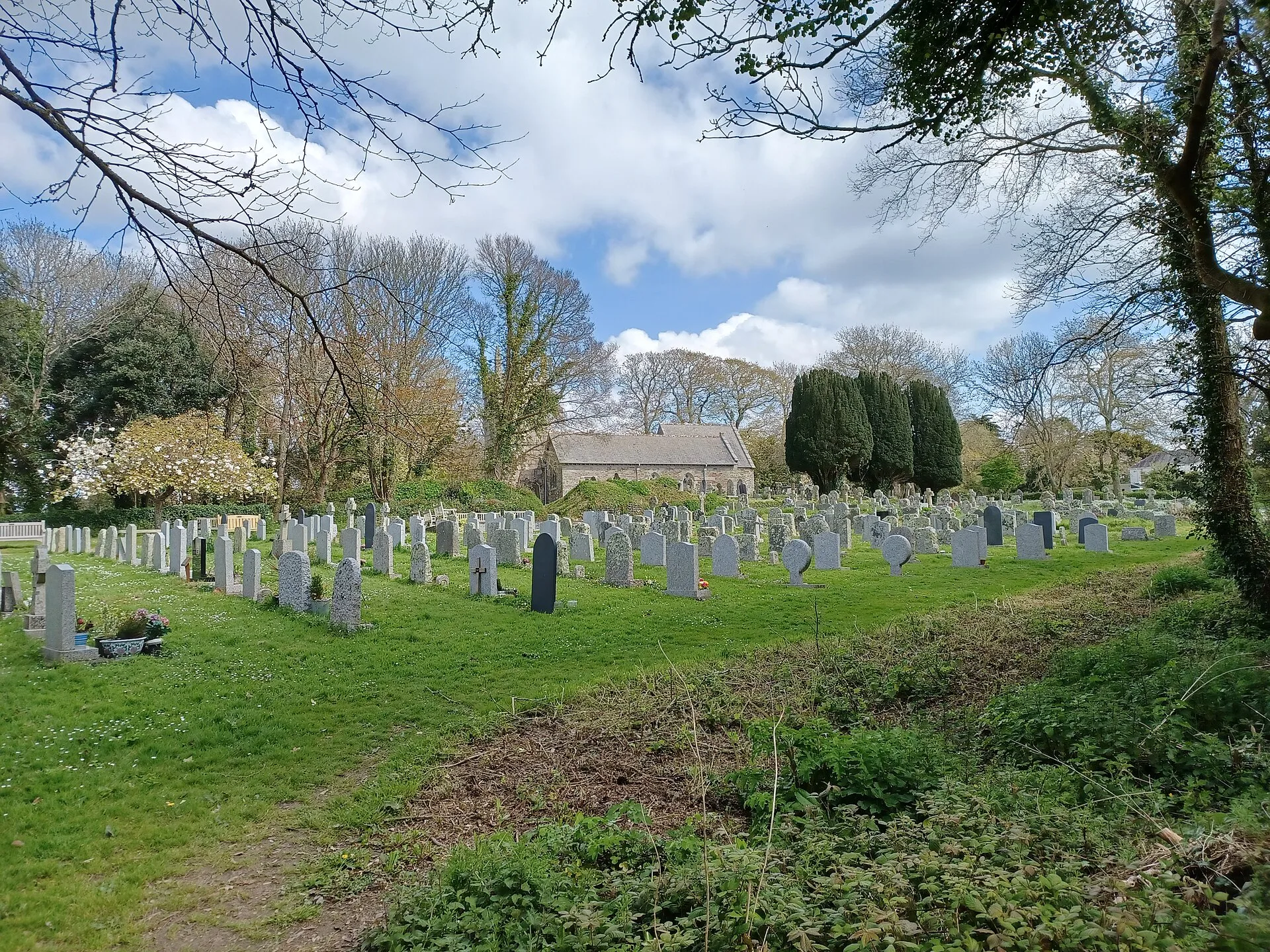
The parish church of St Mawnan and St Stephen stands at the end of a narrow lane on a wooded headland above the mouth of the Helford River in south Cornwall. Its chancel dates from the thirteenth century and its churchyard is thought to have been a sacred site long before that. Since 1976 the church and the woods around it have been linked with one of Britain’s stranger modern monsters, a winged figure with the face of an owl.
What happened
The first report concerns two sisters, June and Vicky Melling, who were on holiday in the area with their family. On April 17, 1976, the Saturday of the Easter weekend, the girls were said to have been walking in the woods near the church when they saw a large feathered creature, something like a man with wings, hovering above the church tower. Their father, Don Melling, was reportedly so disturbed that he cut the holiday short. One of the girls drew what she had seen.
On July 3 that year two fourteen-year-olds, Sally Chapman and Barbara Perry, said they were camping near the church when they saw a figure like a huge owl, as big as a man, with pointed ears, glowing eyes and pincer-like claws. Further reports from the same area were dated to 1978, 1979, 1989 and 1995. A 2026 Countryfile magazine article counts about a dozen witnesses, all but one of them girls or young women and most under sixteen, and summarizes the creature as about five feet tall with red eyes, silvery feathers and claws like a crab’s.
The man behind the story
Almost everything known about the 1976 sightings came through one person. Don Melling took his daughters’ story to Tony ‘Doc’ Shiels, a Cornish entertainer and conjuror who wrote about staging psychic effects for audiences. Shiels gave the creature the name Owlman, supplied the drawings, and reported the second sighting. He was already the central figure in Cornwall’s other monster of 1976, Morgawr, a sea serpent said to haunt Falmouth Bay. That year his wife and daughters took part in a ritual on the shore to summon it, and two blurry photographs of Morgawr, sent in by an anonymous ‘Mary F.’, were printed in the Falmouth Packet in March. Shiels is also the source of a widely mocked photograph of the Loch Ness Monster.
The writer Gareth Medway, reviewing the Cornish wave in the journal Magonia in 2001, found that nearly all of the Morgawr reports came from Shiels, his friends and family, or people who wrote to newspapers and were never interviewed, and that the Owlman witnesses followed a similar pattern: adolescent girls on holiday who met Shiels, told their story, and could not be traced afterward. He noted that the girls’ drawings were unusually accomplished for their ages, that letters attributed to Sally Chapman and Barbara Perry appeared to be in near-identical handwriting, and that Shiels openly admired the American writer John Keel, whose Mothman book had appeared the year before. The cryptozoologist Jonathan Downes, who later investigated the case for his book The Owlman and Others, also turned up leads that could not be verified.
The explanations
If anything real was seen, an owl is the obvious candidate. Barn owls commonly roost in church towers and look ghostly white in poor light, a point made by the investigator Joe Nickell. The writer Lionel Fanthorpe suggested an escaped Eurasian eagle owl, a bird with ear tufts, orange eyes and a wingspan approaching two meters, which would look startlingly large to a child. The other explanation, which the Museum of Hoaxes and Medway both lean toward, is that the original sightings were invented or staged as part of Shiels’s long-running performance art around Cornish monsters.
Where it stands
None of the 1976 witnesses is known to have told their story publicly except through Shiels, and no photograph or physical trace of the Owlman exists. The creature lives on in books and websites on Cornish folklore. It is best treated as a legend that grew from one showman’s stories.