
Point Pleasant sits where the Kanawha meets the Ohio River in Mason County, West Virginia. A few miles north of town lies the former West Virginia Ordnance Works, a Second World War explosives plant whose concrete igloos and generator buildings had been left to the woods and were known locally as the TNT Area. It was there, late on November 15, 1966, that two young married couples, Roger and Linda Scarberry and Steve and Mary Mallette, saw something they could not name.
What happened
By their account they were driving past the old generator plant when they noticed two red lights in the shadows by a gate, and then the thing the lights belonged to: a gray figure, bigger than a man, with large wings folded against its back. They sped toward town and said it followed them along Route 62, keeping pace with the car at high speed before veering away. They went straight to the Mason County courthouse, where a deputy who knew them took them seriously enough to drive back out and look. He found nothing. The Point Pleasant Register ran the story the next morning under the headline “Couples See Man-Sized Bird… Creature… Something,” and the Associated Press carried it across the country.
Over the following year the West Virginia Encyclopedia counts about 26 reported sightings, most in or near Point Pleasant and many around the TNT Area, which quickly filled with carloads of teenagers hoping for a look. Witnesses described a creature six or seven feet tall with a wingspan of ten feet, no obvious head, and eyes that glowed red in headlights. The press christened it Mothman. Alongside it came reports of lights in the sky, malfunctioning televisions and car engines, and strange visitors asking questions, much of it gathered by a New York writer, John Keel, who spent months in town.
The investigation
The only official investigation was the deputy’s drive out to the plant. Explanations arrived within weeks. On December 1, 1966 an AP story reported the ornithologist Robert L. Smith’s suggestion that the creature was a sandhill crane, a bird standing over four feet tall with a seven-foot wingspan and a patch of red skin around the eye, straying well east of its normal range. A teenage Breece D’J Pancake, later a noted short-story writer, wrote to a Huntington paper proposing a California condor. Nobody produced a feather.
Then came the bridge. At about five in the evening on December 15, 1967 the Silver Bridge, a 1928 eyebar-chain suspension bridge carrying US 35 across the Ohio between Point Pleasant and Gallipolis, collapsed in rush-hour traffic, dropping some thirty vehicles into the river and killing 46 people. The National Transportation Safety Board traced the failure to a cleavage fracture in a single eyebar, caused by stress corrosion over forty years and undetectable without taking the joint apart. The sightings fell away. When Keel published The Mothman Prophecies in 1975 he presented the year of visitations as a build-up to the disaster, and after the 2002 film with Richard Gere the idea that Mothman had been an omen became the accepted version.
The explanations
The skeptical investigator Joe Nickell went to Point Pleasant expecting a barn owl, having identified one behind the 1952 Flatwoods Monster, and came away convinced of a barred owl instead. Barred owls are common in what is now the McClintic Wildlife Management Area, fly silently, show a striking red eyeshine in headlights, and like the sandhill crane and the great blue heron have the rounded, neckless silhouette the witnesses described. Size is the weak point of every account: people are poor judges of scale in the dark, and a 2010 experiment in which volunteers tried to estimate the size of plywood Mothman cutouts found they could not. A large bird startled from a gatepost, flying alongside a car for a stretch of road, covers most of what the Scarberrys and Mallettes reported.
The omen requires more. Nothing in the 1966–67 reports mentions the bridge; the connection was made in retrospect, and the bridge fell for a reason engineers can name. Local tradition folds both into an older story, the curse of the Shawnee chief Cornstalk, murdered at the fort there in 1777.
Where it stands
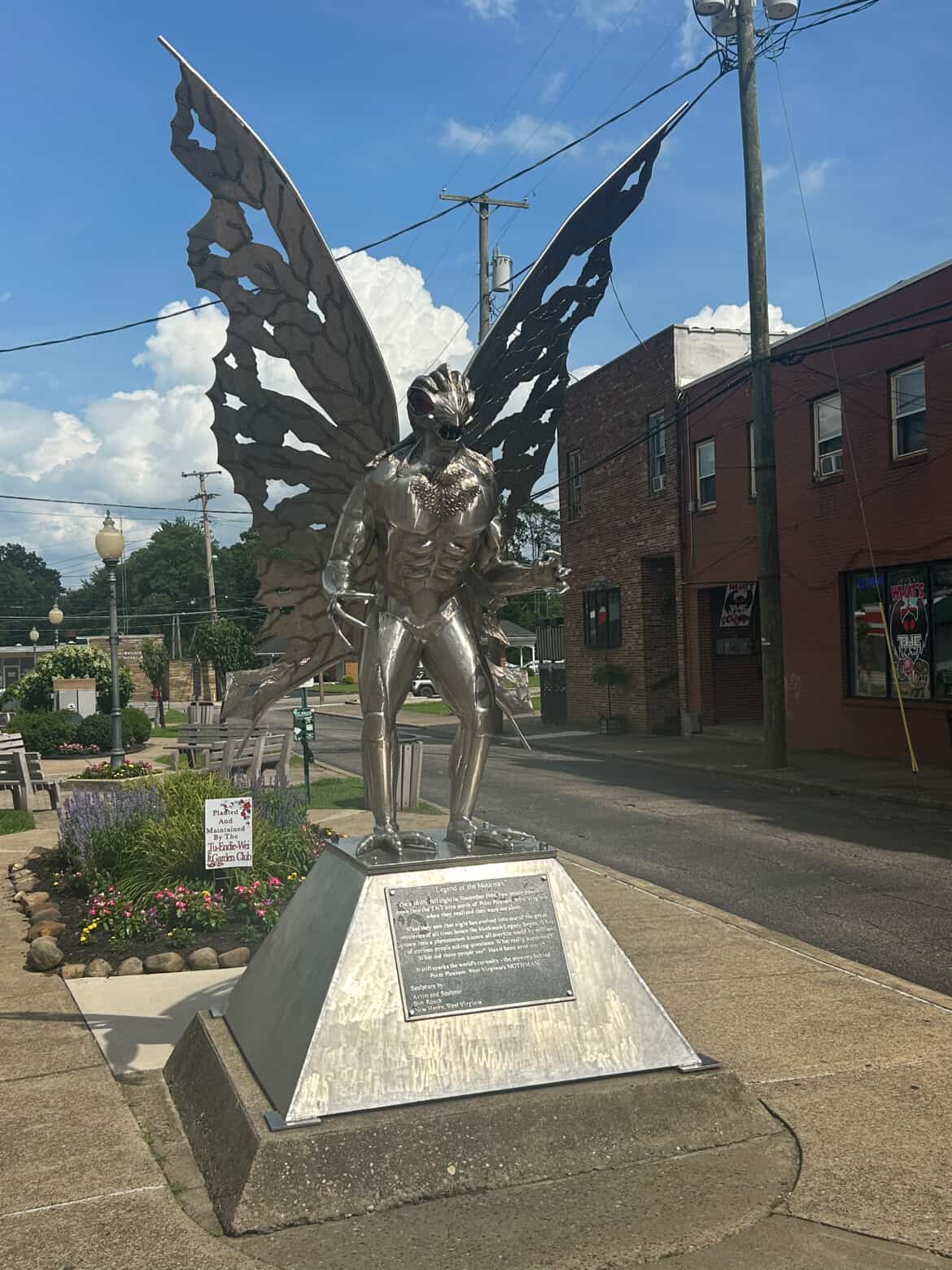
Point Pleasant unveiled a twelve-foot stainless-steel Mothman in 2003 and holds a festival every September that draws thousands. Reports of a similar figure have come from Chicago since 2011. As an event, the sightings are documented; as a creature, Mothman is a legend built from a frightening night, a flock of imitators and one very good book.