
For roughly four hundred years, popes, kings and mapmakers in Latin Europe believed that somewhere beyond the Muslim world sat a Christian monarch of immense wealth who could be persuaded to attack Islam from the rear. They called him Prester John, “John the priest,” because he was supposed to be both a king and a cleric. He was never found, and the reasons he was believed in say more about medieval Europe than about Asia or Africa.
The first rumor
The earliest written trace comes from the German bishop and chronicler Otto of Freising. In his chronicle, finished around 1145, Otto reported a conversation with Hugh, bishop of Jabala on the Syrian coast, who had come west to seek help for the crusader states. Hugh told of a Nestorian priest-king named John, descended from the Magi, who ruled far to the east, had crushed the kings of the Persians in a three-day battle, and had then set out to relieve Jerusalem, only to be stopped by a river he could not cross.
Historians, among them the Orientalist Charles Beckingham, have tied this story to a real event. In 1141 the Seljuk sultan Sanjar lost a huge army near Samarkand to the forces of the Qara Khitai, a people from northern China led by the ruler the sources call the Gurkhan. A defeat of a Muslim power by an eastern ruler would have been welcome news in the crusader East, and the details could easily have been garbled on the way. The Qara Khitai leader, however, was not a Christian.
The letter
Around 1165 a far more elaborate document began to circulate. Written in Latin and addressed to the Byzantine emperor Manuel I Komnenos, it claimed to come from Prester John himself, “lord of lords,” who said he surpassed every ruler under heaven in power and riches. Seventy-two kings paid him tribute. His realm spread across three Indias and held the tomb of the apostle Thomas. It reached toward the ruins of Babylon and the Tower of Babel, and its population included horned men, one-eyed men, giants, the phoenix and the nations of Gog and Magog, shut away by Alexander the Great. Later copies described a palace of ebony and precious stones where tens of thousands dined each day.
No Greek version of the letter has ever been found, and its material draws heavily on Western favorites, including the romance of Alexander and the legend of Thomas’s mission to India. Scholars regard it as a forgery by an unknown Western writer, perhaps meant as a fantasy, a sermon or a jab at Byzantine pride. Copyists kept adding to it, and translations spread it into most of Europe’s languages.
Europe took it seriously. In 1177 Pope Alexander III wrote a reply, gently rebuking the king’s boasting while proposing friendship, and sent it east with his physician Philip. Nothing more is known of Philip or of any answer.
The search moves
When the Mongols burst into the Islamic world in the thirteenth century, some in Europe hoped Prester John or his heirs had arrived at last. There were in fact Nestorian Christians among the steppe peoples, and Marco Polo identified Prester John with Unc Khan, a Keraite ruler who was defeated by Genghis Khan. The Mongols, though, proved no one’s crusading allies, and attention shifted south.
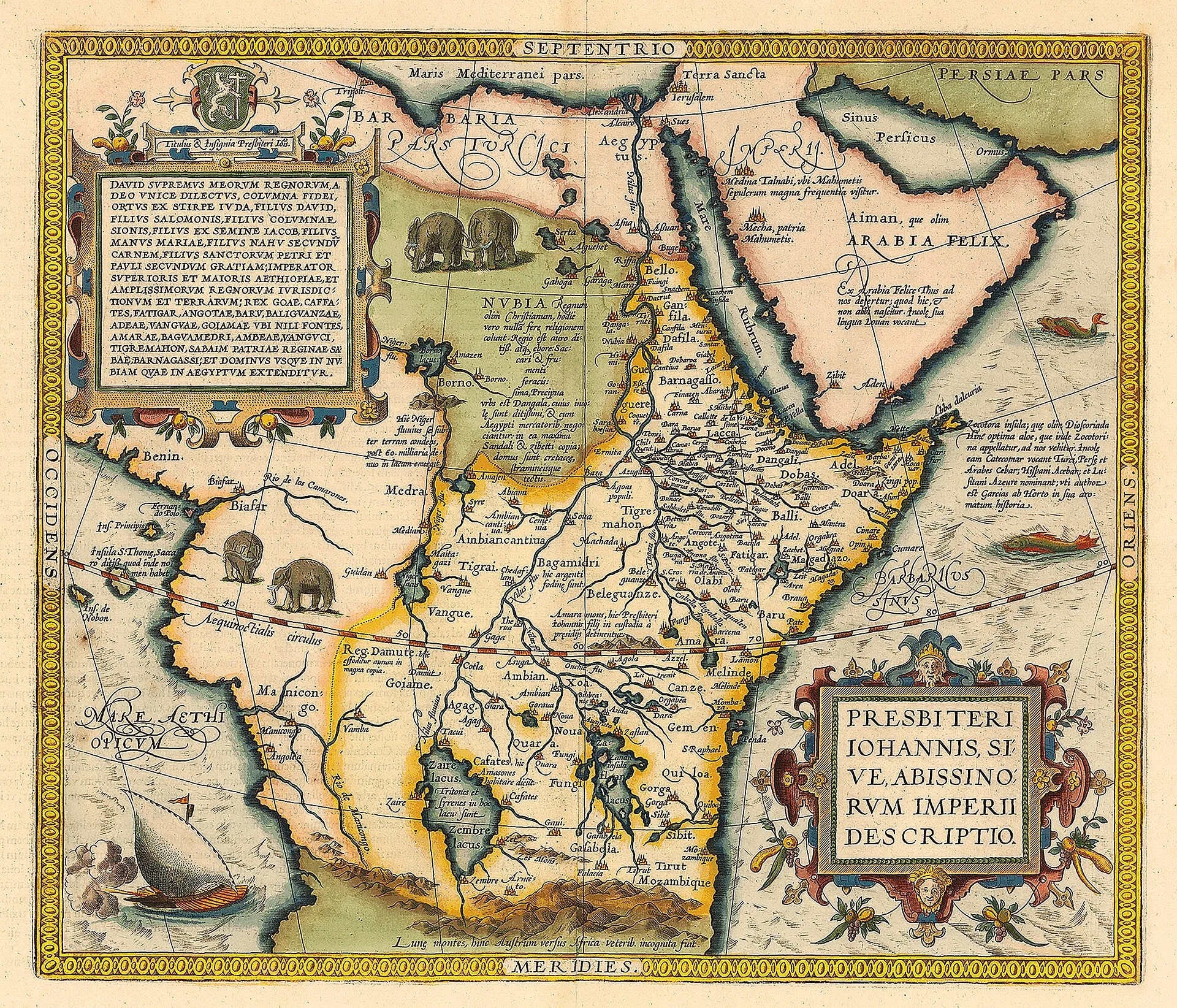
From about 1300 the title attached more and more to the Christian emperor of Ethiopia. The historian Miranda Kaufmann notes that Ethiopian envoys were reaching European courts from the early fourteenth century, and that a Majorcan chart of 1339 is the oldest surviving map to show Prester John. Portuguese expansion along the African coast was driven partly by the hope of finding him. In 1520 a Portuguese embassy reached the court of the Ethiopian emperor Lebna Dengel, and its chaplain, Francisco Álvares, spent six years there. His account, printed at Lisbon in 1540, described a real Christian kingdom that was neither as vast nor as rich as the letter promised, and whose rulers had never called themselves Prester John.
Where it stands
The letter is a twelfth-century fabrication, and the king it describes did not exist. What existed were several real Christian communities on the far side of Islam, including Nestorian Turks and Mongols and the Ethiopian church, onto which Europeans projected the figure they wanted. The name survived on maps into the seventeenth century, long after Álvares had shown what lay behind it.