
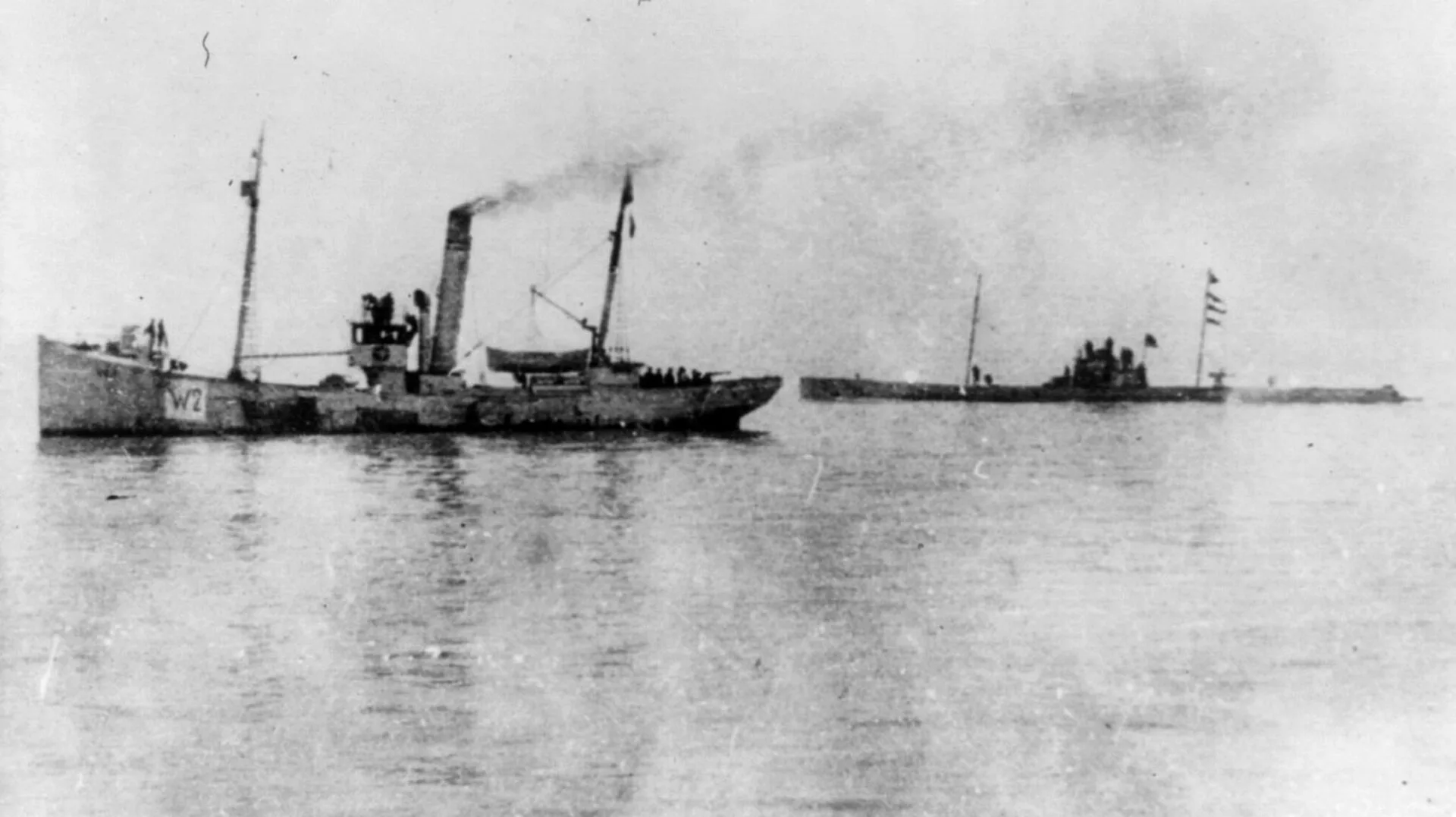
Sea-serpent literature is full of sightings by sailors, but very few come from the crew of a warship in the middle of a documented action, with the ship’s commander as the named witness. That pedigree is what made the U-28 story a staple of cryptozoology books for decades. The problem lies in the gap between the event and the telling.
The sinking
SM U-28 was one of the Imperial German Navy’s early ocean-going submarines, commanded from the outbreak of war until June 1916 by Kapitänleutnant Georg-Günther von Forstner, a baron. Under him it sank a long list of merchant ships. One was the Iberian, a 5,223-ton steamer of Frederick Leyland and Company, built at Sunderland in 1900, carrying general cargo from Manchester to Boston. On July 30, 1915 U-28 torpedoed and sank her about nine miles south by west of the Fastnet Rock, off the southwest tip of Ireland. Seven of her crew died; the survivors reached Ireland and told their story to the press. All of that is in the war’s shipping-loss records.
The monster
Eighteen years later, on December 19, 1933, the German newspaper Deutsche Allgemeine Zeitung printed von Forstner’s recollection under a headline claiming that U-28 had seen the Scottish sea monster first. His account, later translated by the Belgian-French zoologist Bernard Heuvelmans in In the Wake of the Sea-Serpents, says the Iberian sank stern first within seconds, and about 25 seconds later something exploded deep below. Wreckage burst from the water, and with it a huge animal, thrashing, thrown sixty to a hundred feet into the air. Von Forstner said he and five others in the conning tower, the helmsman, the navigator, the chief engineer and the watch officers, all saw it for ten or fifteen seconds before it fell back. It was about sixty feet long, shaped like a crocodile, with four limbs ending in large webbed feet and a long, pointed tail. They had no time for a photograph and could find nothing like it in their reference books, so they called it the underwater crocodile.
The problems
The first is physics. Heuvelmans, who was sympathetic to sea-serpent reports, pointed out that the wreck could not have reached anything like the depth von Forstner implied in 25 seconds, and that no explosion at depth would throw a sixty-foot animal and debris that high. If anything happened, he suggested, a creature near the surface was startled into leaping. Later authors have been less charitable.
The second is silence. Von Forstner published a book about his U-boat war in 1916, Als U-Boots-Kommandant gegen England, translated into English the next year. It covers the summer patrol off the south coast of Ireland, including ships sunk days after the Iberian, and says nothing about the Iberian or any animal. On the MonsterTalk podcast in 2026, the paleontologist Darren Naish noted that newspapers interviewed the Iberian’s survivors in 1915 and none mentioned a monster, and that the creature does not appear in any record until 1933.
The third is timing. In 1933 the Loch Ness Monster was front-page news across Europe, and German papers were keen on a German claim to the story. Willy Ley, writing about the case later, suggested the monster craze is what prompted von Forstner to tell it. Naish adds that von Forstner wrote introductory material for the German edition of Rupert Gould’s Loch Ness book, placing him squarely inside that publicity. Naish also criticizes the well-known drawing of the animal, made for a 1935 German book on sea monsters, as looking more like a stuffed young crocodile than anything described by a witness.
Where it stands
The Iberian was sunk, and an explosion as she went down is plausible enough. The underwater crocodile, though, rests entirely on one man’s memory published eighteen years after the fact, contradicted by his own earlier silence and by the survivors, and timed to the biggest monster story of the century. Cryptozoologists have proposed surviving marine reptiles to explain it. The simpler reading is that it was a good story told at a good moment.