
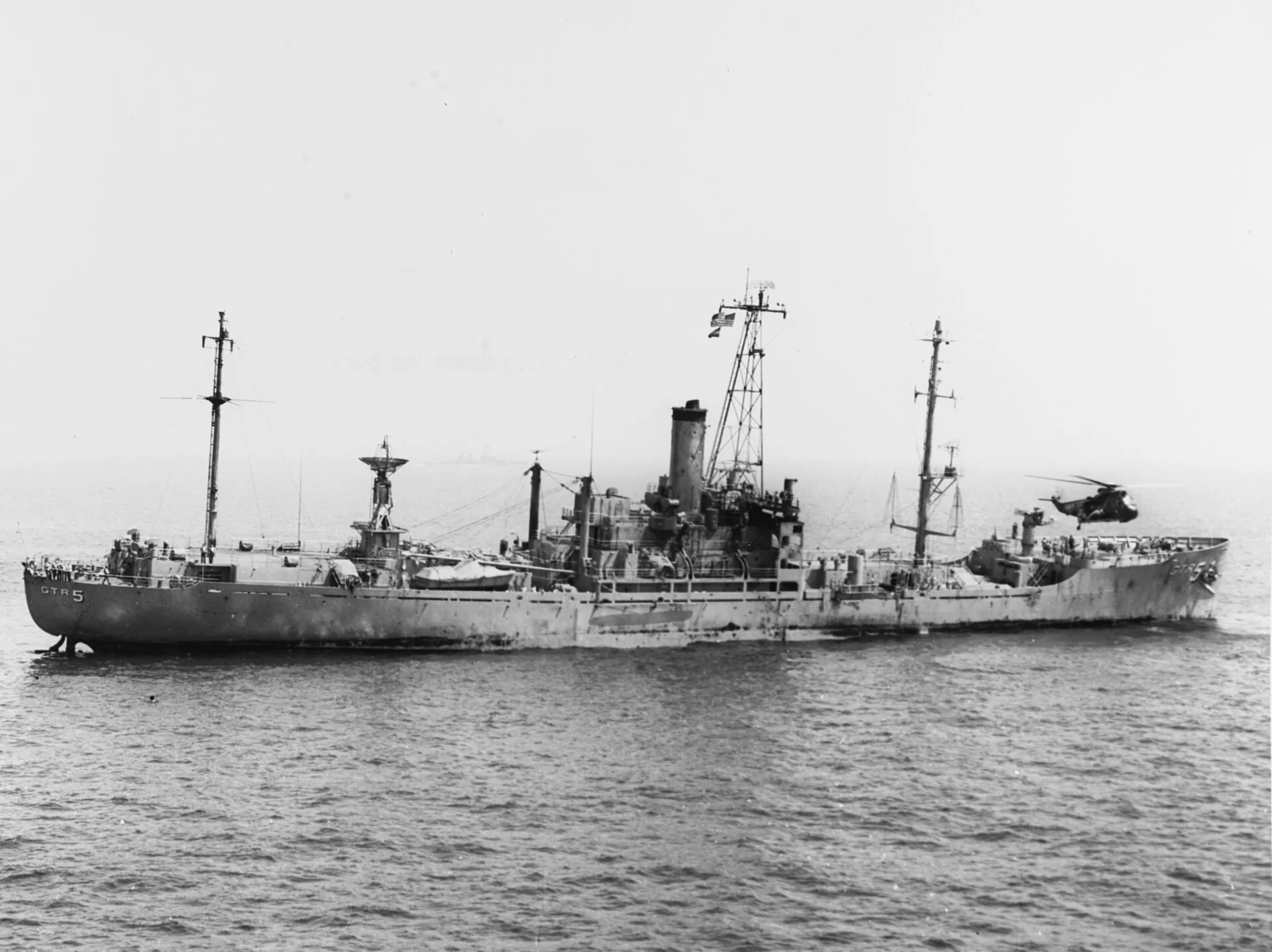
On the fourth day of the Six-Day War, June 8, 1967, the USS Liberty was steaming slowly off the coast of Sinai, in international waters north of El Arish. She was a converted Second World War cargo ship, bristling with antennas and carrying a team of Navy and National Security Agency specialists whose job was to listen to the region’s military communications. Shortly before two in the afternoon Israeli jets attacked her with cannon fire and napalm; about half an hour later three Israeli motor torpedo boats fired torpedoes and machine guns. The ship stayed afloat, but 34 Americans were killed and more than 170 wounded. Israel apologized within hours and said it had mistaken the Liberty for an Egyptian vessel. A large share of the survivors, and a number of senior American officials, have never accepted that.
What happened
According to the account published by the Naval History and Heritage Command for the 50th anniversary, the trigger was a report that Egyptian forces were shelling El Arish from the sea. An Israeli torpedo boat officer, tracking the Liberty by radar, calculated her speed at 30 knots, double her real speed and fast enough under Israeli rules to mark her as a warship. Fighters sent to identify her reported a gray warship with no visible markings and were cleared to attack. Two Mirages raked the superstructure, followed by two Mystères that dropped napalm. On one pass a pilot read part of the hull number and the strikes were halted. When the torpedo boats arrived the ship was burning, and their commanders identified her as an old Egyptian transport. A brief burst of fire from the Liberty’s guns preceded the boats’ torpedo run; one torpedo hit, tearing a hole nearly 40 feet across. The boats’ attack killed 25 men, many of them in the intelligence spaces where the torpedo struck. The Israelis realized their error when they pulled a US Navy life raft from the water. Commander William McGonagle, wounded on the bridge, kept the ship moving and later received the Medal of Honor.
The investigations
A Navy Court of Inquiry convened within days and had about a week to take evidence. It praised the crew and did not attempt to decide whether Israel had attacked knowingly. A review for President Johnson led by Clark Clifford in July 1967 found no evidence of premeditation but called the attack an act of gross negligence for which Israel should be held fully responsible. Two Israeli inquiries the same summer found error rather than intent, and Israel eventually paid compensation to the families, the wounded and the US government. A complication for everyone was that the Pentagon’s first statements about the ship were false, to protect her intelligence mission, and much of the record stayed classified for decades.
The dispute
The case for a deliberate attack rests on several points made by survivors and their supporters. Crew members say the American flag was flying in clear weather and that Israeli aircraft had looked the ship over repeatedly that morning. Some former intelligence officials have said they read intercepts showing that the attackers knew the ship was American; the Chicago Tribune reported in 2007 that those recollections cast doubt on the agency’s long-standing denial that it had picked up the pilots’ transmissions. In October 2003 a panel led by Admiral Thomas Moorer, a former chairman of the Joint Chiefs, declared the attack deliberate and accused the Johnson administration of recalling Sixth Fleet aircraft and covering it up. At the same event Captain Ward Boston, the court of inquiry’s senior counsel, released an affidavit saying the court’s president had told him Johnson and Defense Secretary Robert McNamara ordered a finding of mistaken identity. Critics, led by the judge and former naval aviator A. Jay Cristol, reply that Boston’s claim is secondhand and contradicts the record he helped create.
The case for error points to the Israeli radio transcripts released in 2003, which show confusion over whether the ship was Egyptian, Soviet or American; to the four torpedoes that missed; and to the absence of a convincing motive. The most common one offered, that Israel wanted to hide its coming assault on the Golan Heights, sits poorly with the fact that Israel had already told American officials of that plan before the attack.
Where it stands
No US government finding has ever concluded that Israel attacked knowingly, and no inquiry has proved that it did. The Navy’s historians call it a mistaken attack while acknowledging that most survivors disagree. With key participants dead and some records still classified, the question of what the attackers knew remains unresolved.