
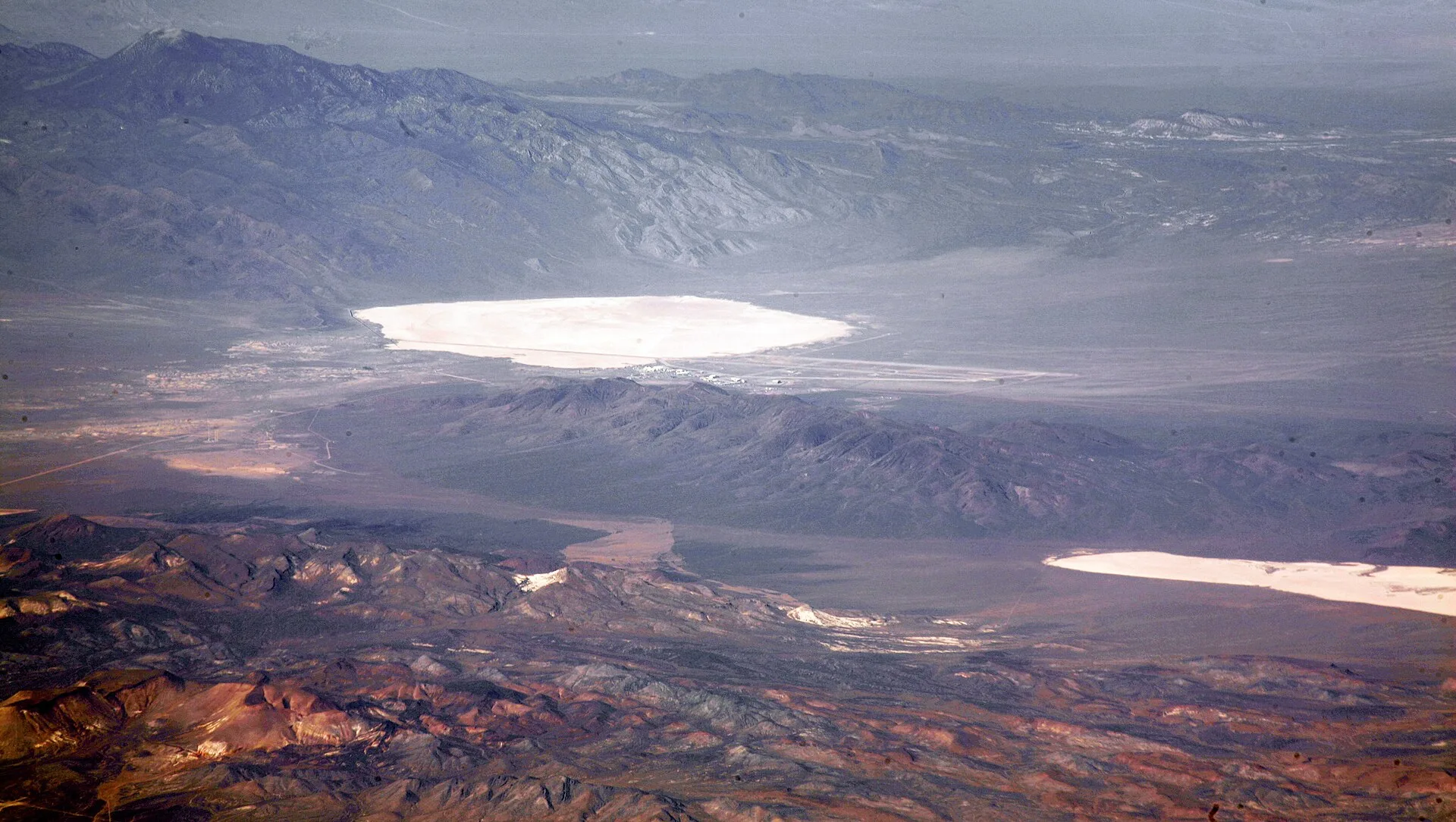
In 1989 the Air Force flight-test center at Groom Lake in the Nevada desert, known to aviation watchers as Area 51, did not officially exist. That spring the Las Vegas television station KLAS aired an interview with a man filmed in shadow and identified only as Dennis, who said he had worked on flying saucers a few miles south of it.
What happened
The first interview went out in May 1989. Dennis said he had worked on and off at a site called S-4, beside Papoose dry lake south of the main Groom Lake base, where nine hangars had been built into a mountainside behind doors disguised to match the desert. Inside, he said, were nine flying saucers of extraterrestrial origin, and he was one of the scientists taking them apart to learn how their propulsion worked, a program he said the Navy controlled. On November 10 KLAS named him as Bob Lazar and showed his face in a series titled UFOs: The Best Evidence, which the reporter, George Knapp, later called the most-watched local news program the station had ever made.
Lazar went on to say the craft flew by gravity propulsion driven by a reactor that used element 115, then an undiscovered superheavy element, in a stable form. He said he had read briefing papers on alien involvement in human history, that his job ran from about December 1988 into the spring of 1989 with only a handful of visits to the site, and that he had been put forward for it by the physicist Edward Teller, whom he said he had met at Los Alamos. He took friends, including the pilot John Lear and the appraiser Gene Huff, into the desert on evenings when he said test flights were scheduled, and they reported a glowing object rising over the mountains.
The investigation
Lazar said he held two master’s degrees, one from MIT in physics and one from Caltech in engineering, and that before S-4 he had been a physicist at Los Alamos National Laboratory. The degrees were the first thing checked. Neither university had any record of him. The physicist and UFO researcher Stanton Friedman, among others, found no professors or classmates who remembered him, and found instead that he had taken classes at Pierce Junior College in Los Angeles. Lazar’s answer was that his records had been erased; at a 1993 UFO conference he was still telling audiences that his history at Caltech, MIT and the Nellis range had been wiped.
Knapp’s reporting produced a more mixed picture at Los Alamos. The laboratory told him it had no record of Lazar at all. Yet a lab telephone directory listed him, and a 1982 front-page article in the Los Alamos Monitor described him as a physicist at the Los Alamos Meson Physics Facility. The 1982 directory entry marks him as working for Kirk-Mayer, a contractor that supplied technicians to the lab, and he is missing from the edition published in early 1983. Knapp also found that Lazar knew how hiring for Groom Lake worked, through the contractor EG&G, and named a real background investigator who had interviewed him. One polygraph test was inconclusive; Knapp reported that a second examiner found no sign of deception.
In 1990 Lazar pleaded guilty to a felony pandering charge in Nevada, linked to a prostitution operation.
The explanations
The record supports parts of Lazar’s background and none of the extraordinary part. He did spend some months of 1982 at Los Alamos, apparently as a contract technician rather than a staff physicist. Area 51 is real and has since been acknowledged by the CIA, and workers really were flown in and vetted much as he described. A Nellis public affairs officer once told Knapp that S-4 was a location where the Air Force tested equipment. None of that shows a saucer program, and no document, colleague or physical trace has placed Lazar at S-4.
Element 115 offers a direct test. Scientists from the Joint Institute for Nuclear Research in Dubna and Lawrence Livermore National Laboratory announced its creation in 2004; it was certified in 2016 and named moscovium. Only about a hundred atoms have ever been made, and they decay within a fraction of a second. Nothing resembling a stable, usable supply has been found. Defenders argue that a recruit to a deeply classified program would leave no ordinary paper trail; skeptics treat the missing academic record, which rests on Lazar’s own claims, as central to judging the rest of his account.
Where it stands
Lazar went on to run a scientific supply business and has said he prefers that people disbelieve him, while insisting that what he saw was real. Knapp, his most persistent champion, wrote in 2014 that he had come to accept he would never be able to prove the story. The verifiable parts of the record do not support the central claim, and several of Lazar’s own statements about his past are false.