
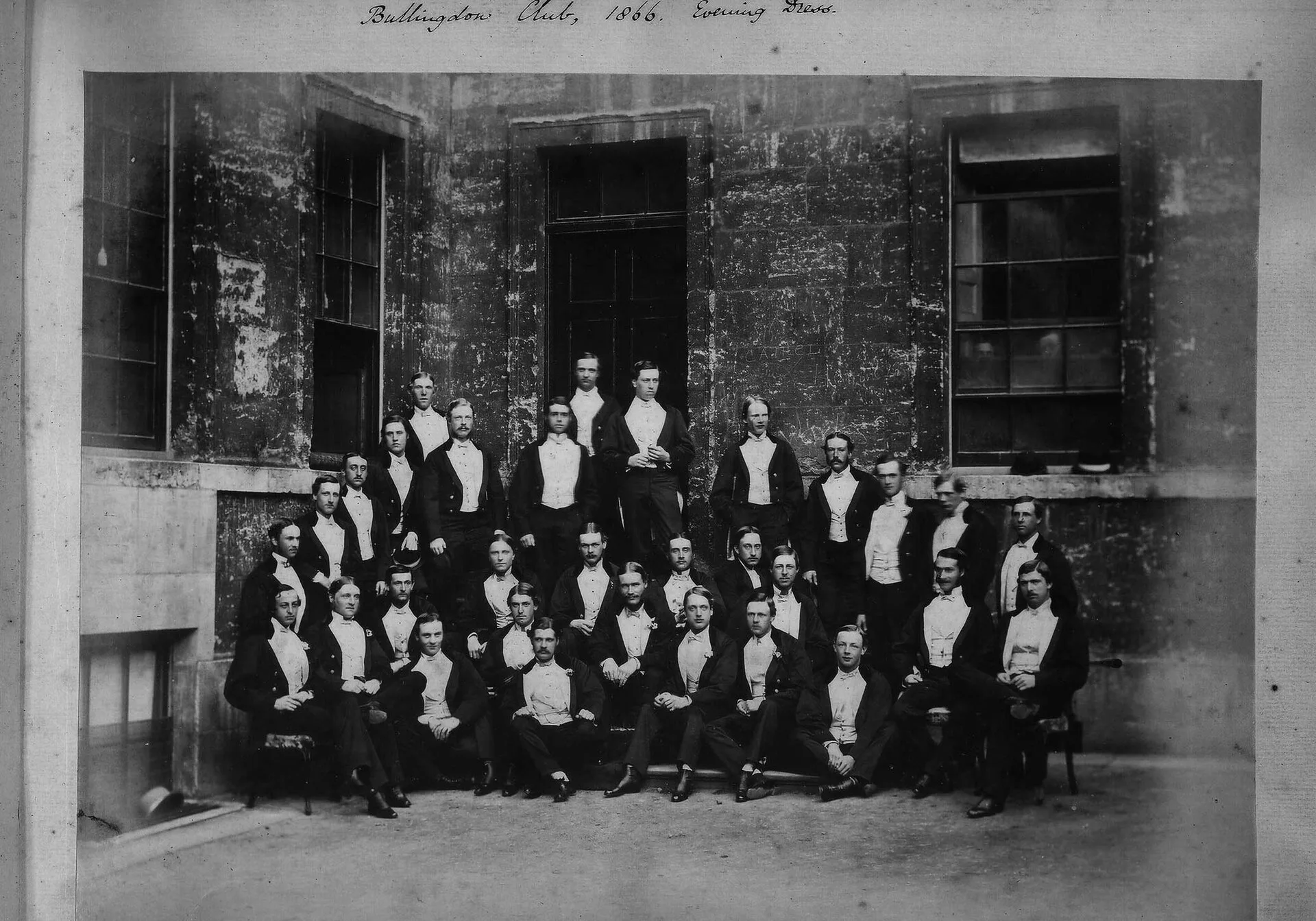
For most of its existence the Bullingdon Club was a private joke among a few dozen rich undergraduates at Oxford. Then three of its members from the 1980s became prime minister, chancellor of the exchequer and prime minister again, and a dining club that smashed windows for fun became, in some tellings, the secret government of Britain.
What happened
The club’s own tradition, recorded by the writer Petre Mais, dates it to 1780 as a hunting and cricket club limited to thirty members. It fielded a side against the Marylebone Cricket Club in 1796 and for much of the 19th century was the only cricket in Oxford, expensive and exclusive. By the 1870s dinners had overtaken sport, and the dinners made its name. On May 12, 1894 members smashed almost all the glass in Christ Church’s Peckwater Quad, 468 windows by the college’s count, and the club was afterward forbidden to meet within fifteen miles of Oxford. On February 20, 1927 a new generation did it again and the club was suspended. Evelyn Waugh had left Oxford three years earlier; Decline and Fall, published in 1928, opens with the “Bollinger Club” wrecking a college while the dons tot up the fines, and his line about county families baying for broken glass has followed the real club ever since.
The uniform is a navy tailcoat with ivory silk lapels and a mustard waistcoat, made for each member. Election conferred nothing except the dinners, the annual photograph and the bill. Edward VII and Edward VIII were members. So, in 1987, were David Cameron and Boris Johnson, and in the early 1990s George Osborne.
The investigation
The club’s modern notoriety starts with a photograph. Taken in 1987 on a staircase in Canterbury Quad at Christ Church, it shows ten members in full dress, Cameron standing in the back row and Johnson seated in front. It surfaced in 2007, in a biography of Cameron and in the Mail on Sunday, when he was leader of the opposition, and was read as proof that the Conservative leadership was out of touch. The Oxford photographers Gillman and Soame then withdrew permission to reproduce it, citing a general policy; the BBC’s Newsnight commissioned a painting of it instead, and on polling day in 2010 the Daily Mirror put the original on its front page regardless. Cameron told Andrew Marr in 2009 that he was “desperately, very embarrassed” by it.
The record of the club itself in these years is one of pub fights and damages. Four members were arrested after a dinner at the White Hart in Fyfield in 2005; a dinner at Hartwell House in 2010 ended with a bill for the damage. When the university was asked in 2008 what it would do, the proctors answered that the Bullingdon was not a registered university society and that incidents off university premises were outside their jurisdiction. Laura Wade’s play Posh, inspired by the club, opened at the Royal Court in 2010 and became the film The Riot Club in 2014.
The explanations
The “cabal” reading rests on a real coincidence. Between 2010 and 2016 three former members, Cameron, Osborne and Johnson, were the most powerful Conservatives in the country, and Johnson returned as prime minister in 2019. But the overlap runs through Eton and Oxford rather than through the club, which has no premises, no agenda and no purpose beyond dinner. Its membership was never secret in any way that matters; it was photographed every year and its tailcoats were recognizable across the city. What the club did supply was an image, and the image did political work for both its members’ enemies and, in the Spectator’s view, for the club’s own decline.
Where it stands
The headlines proved fatal. In 2016 student papers reported four to six members, all postgraduates, and no new recruits. Writing in the Spectator in February 2017, the former member Harry Mount said the club was down to its last two and could not survive eleven years of bad press. That June members were escorted out of Christ Church for trying to take the annual photograph without permission. In October 2018 the Oxford University Conservative Association barred Bullingdon members from holding office; the ban was overturned on a procedural point within a week and then reimposed. The Bullingdon Club exists, if at all, as a handful of names and a tailcoat. As a secret government it never existed.