
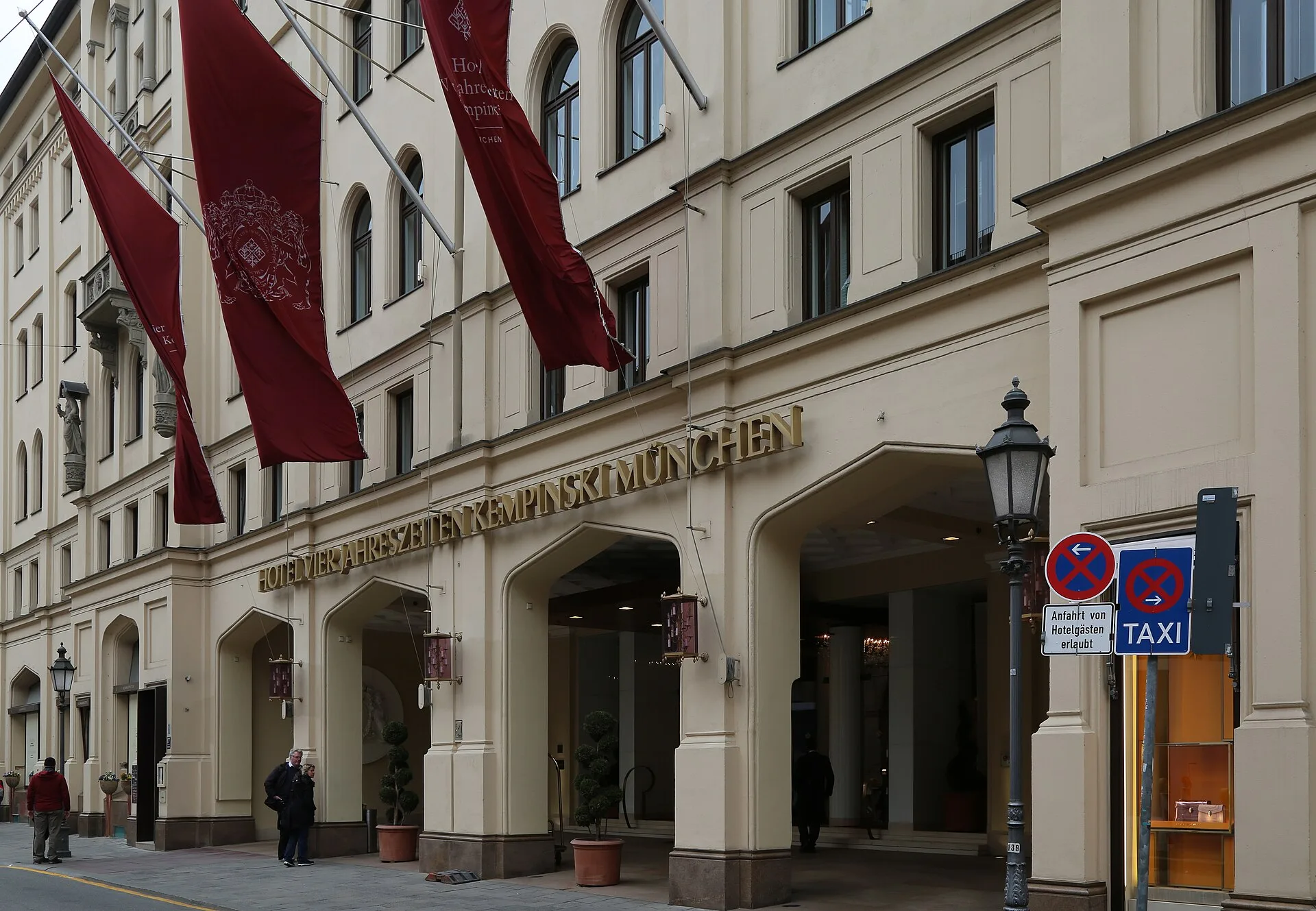
The Thule Society lasted about seven years, met in a Munich hotel and never had more than a few hundred members in the city. It also helped set up the small political party that Adolf Hitler joined in 1919. That one fact has carried a mountain of legend, most of it written after 1960, in which the society becomes the occult inner circle of the Third Reich and acquires a twin, the “Vril Society,” for which no record exists.
What happened
The society was the creation of Rudolf von Sebottendorff, born Adam Alfred Rudolf Glauer, an adventurer who had spent years in Turkey and come home with an enthusiasm for the racial mysticism of the Germanenorden, a secretive völkisch lodge founded in 1912. In August 1918 he opened a Munich branch behind a harmless-sounding study circle that Walter Nauhaus had been running under the name Thule, after the mythical northern homeland. Sebottendorff rented rooms at the Hotel Vier Jahreszeiten on Maximilianstrasse, reached by a side entrance from Marstallstrasse, and the society’s office and the editorial staff of its newspaper worked from there. Its emblem was a swastika behind an upright sword. Candidates signed a declaration that no Jewish or “colored” blood ran in their families. The Historisches Lexikon Bayerns describes the group as a front organization of the Germanenorden; estimates give it roughly 1,500 followers in Bavaria, about 250 of them in Munich.
Its politics were practical as well as mystical. In 1918 it bought a small weekly, the Münchener Beobachter, and used it to announce meetings and to attack Jews and socialists. In December 1918 Sebottendorff planned, and abandoned, the kidnapping of Bavaria’s socialist premier Kurt Eisner. Members also ran a workers’ discussion circle, and on January 5, 1919 the sports journalist Karl Harrer, a Thule member, and the toolmaker Anton Drexler founded the Deutsche Arbeiterpartei, the DAP. Hitler, then an army informant, joined in September 1919, had Harrer pushed out early in 1920 and renamed the party the NSDAP in February. In December 1920 the party bought the Beobachter, which became the Völkischer Beobachter.
The society’s bloodiest moment came during the short-lived Bavarian Soviet Republic. On April 30, 1919 Red Army men shot seven Thule members in the courtyard of the Luitpold Gymnasium, among them Nauhaus, Countess Heila von Westarp and Prince Gustav of Thurn und Taxis. The killings were reported as the murder of hostages and became a rallying cry for the Freikorps who retook Munich days later.
The investigation
Thule’s role has been examined since the 1960s. Reginald Phelps, writing in the Journal of Modern History in 1963, traced the society’s origins in the Germanenorden and its part in the DAP, and Nicholas Goodrick-Clarke’s The Occult Roots of Nazism (1985) placed it in the wider current of “Ariosophy.” The findings are consistent. Several future Nazis, Hans Frank, Rudolf Hess, Alfred Rosenberg, Dietrich Eckart and Gottfried Feder among them, attended or spoke at Thule events. Hitler did not: the diary of the member Johannes Hering records the meetings and he is absent from it. After the Räterepublik fell the society split into quarrelling factions and lost influence. It had effectively dissolved by about 1925, was removed from the register of associations in 1932, and a revival attempt in 1933 went nowhere. When Sebottendorff returned to Munich that year and published Bevor Hitler kam (“Before Hitler Came”), claiming Thule as the cradle of the movement, the Nazi authorities banned the book, held him briefly and deported him in 1934. The Munich court struck the society from its register for good on April 5, 1951, noting that it had no members left.
The explanations
The occult Thule is a later invention. In 1960 two French writers, Louis Pauwels and Jacques Bergier, published Le Matin des magiciens, a bestseller that rewove Thule into a hidden magical order directing Nazism and attached it to “vril,” an energy force borrowed from Edward Bulwer-Lytton’s 1871 novel The Coming Race. The only earlier mention of vril believers in Germany is a 1947 magazine article by the rocket engineer Willy Ley, who recalled a small Berlin circle of eccentrics. From Pauwels and Bergier the idea passed into The Spear of Destiny (1972) and, in the 1990s, into a literature of Nazi flying saucers built by a “Vril Society” of female mediums. Goodrick-Clarke reviewed that literature and found no documentary trace of any such society; he treats the whole strand as fiction. Sebottendorff’s own 1933 boast, written to curry favor with the new regime, is the only contemporary claim that Thule “made” Hitler, and the regime rejected it.
Where it stands
The documented Thule Society was a short-lived nationalist lodge that helped found a party, lent it a newspaper and lost seven members to a firing squad. The Thule of occult legend, with its secret powers and its phantom Vril twin, has no source older than 1960. Far-right groups still borrow the name; historians treat the two Thules as different things.