
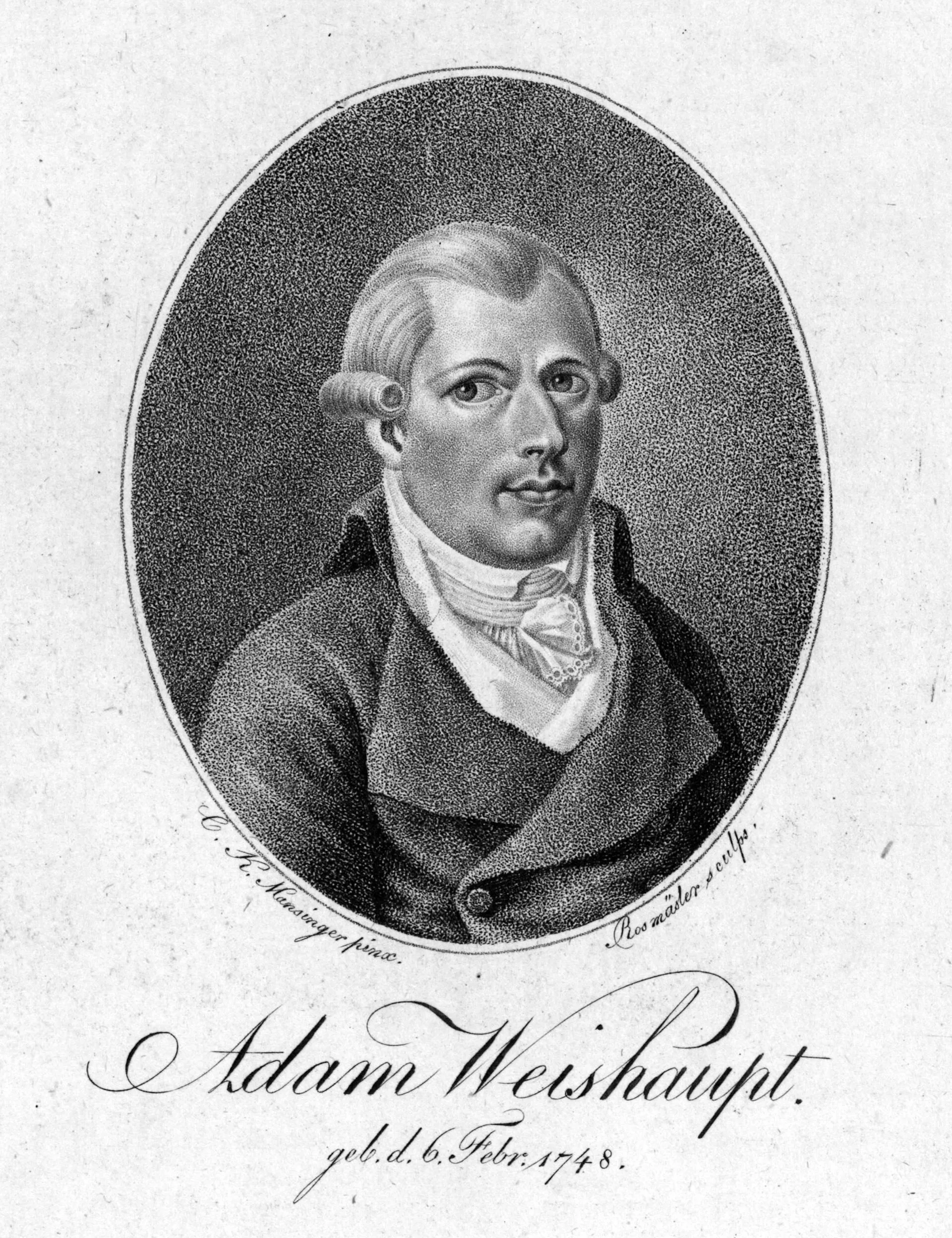
The Order of the Illuminati existed for about nine years, had perhaps two thousand members at its height and was destroyed by a sequence of police decrees in Bavaria. Within a decade of its collapse it had been blamed for the French Revolution; within two centuries it was controlling the music industry. The real society and the imaginary one share a name and almost nothing else.
What happened
On May 1, 1776 Adam Weishaupt, a 28-year-old professor of canon law at the University of Ingolstadt, founded a society with four of his students. He called it the Perfectibilists at first and soon the Illuminati, the enlightened. Weishaupt, educated by Jesuits and now their bitter opponent, wanted a hidden network that would spread rationalist ideas, place its men in offices of state and in time make princes and churches unnecessary. Members took classical code names (Weishaupt was Spartacus), read assigned books, reported on one another and climbed a ladder of grades modeled on Freemasonry.
The order stayed small until 1780, when Adolph Knigge, a Hanoverian baron with wide Masonic contacts, joined and reorganised it. Knigge recruited through the lodges, and the order spread across the German states and into Austria, Switzerland and northern Italy. Estimates of its membership run from about 650 documented names to two thousand or more; they included Duke Karl August of Weimar, Duke Ernst II of Gotha, Goethe and Herder. Knigge and Weishaupt fell out over doctrine and Knigge left in 1784. The Allgemeine Deutsche Biographie’s entry on Weishaupt, published in 1896, already treats the order as an Enlightenment society with an overbearing founder rather than as a cabal.
The investigation
Bavaria’s ruler moved first. On June 22, 1784 the Elector Karl Theodor banned all societies not authorized by the state. A second edict on March 2, 1785 named the Freemasons and the Illuminati specifically; Weishaupt had already lost his chair in February and fled to Regensburg and then to Gotha, where Duke Ernst gave him a pension and a home for the rest of his life. He died there in 1830. In 1786 and 1787 searches of the houses of two members, the court councillor Xavier Zwack in Landshut and Baron Bassus at Sandersdorf, produced the order’s correspondence and instructions, which the government printed as Einige Originalschriften des Illuminatenordens to discredit it. A third edict on August 16, 1787 made recruitment a capital offense. By then the order had stopped functioning.
That is where the documentary trail ends. Researchers at the Forschungszentrum Gotha of the University of Erfurt, where a dedicated Illuminati research unit has worked since 2018 on the surviving papers of the member Johann Joachim Christoph Bode, describe an order that was quarrelsome, bureaucratic and gone by 1787.
The explanations
The myth was born in 1797. John Robison, a professor of natural philosophy at Edinburgh, published Proofs of a Conspiracy Against All the Religions and Governments of Europe, and the French former Jesuit Augustin Barruel his four-volume Memoirs Illustrating the History of Jacobinism. Both used the Bavarian publications to argue that the Illuminati had survived their suppression, captured Freemasonry and engineered the French Revolution. Neither had evidence past 1787; both had the Terror to explain. In 1798 the books reached New England, where the Congregationalist minister Jedidiah Morse preached that Illuminati agents were loose in the republic, a panic examined in Vernon Stauffer’s 1918 study. The idea slept and woke repeatedly: in Nesta Webster’s writing in the 1920s, in John Birch Society pamphlets of the 1960s, in Robert Anton Wilson’s satirical Illuminatus! trilogy of 1975, which many readers took literally, in Dan Brown’s Angels & Demons (2000), and in the internet’s conviction that pop stars flash hand signs for an organization that dissolved before the United States had a constitution.
Every version has the same structure. A real and documented society supplies the name, the pyramid of grades and the Bavarian ban; the ban is read as evidence of going underground rather than of defeat; and whatever the writer fears most is placed at the top.
Where it stands
The Bavarian Illuminati were real, ambitious and briefly fashionable. They were broken by a provincial police action in the 1780s, their papers were published by their enemies, and their founder died an old pensioner in Gotha. No document, member or act of the order is recorded after 1787. The Illuminati who run the world today are the creation of two frightened writers in 1797 and of everyone who has quoted them since.