
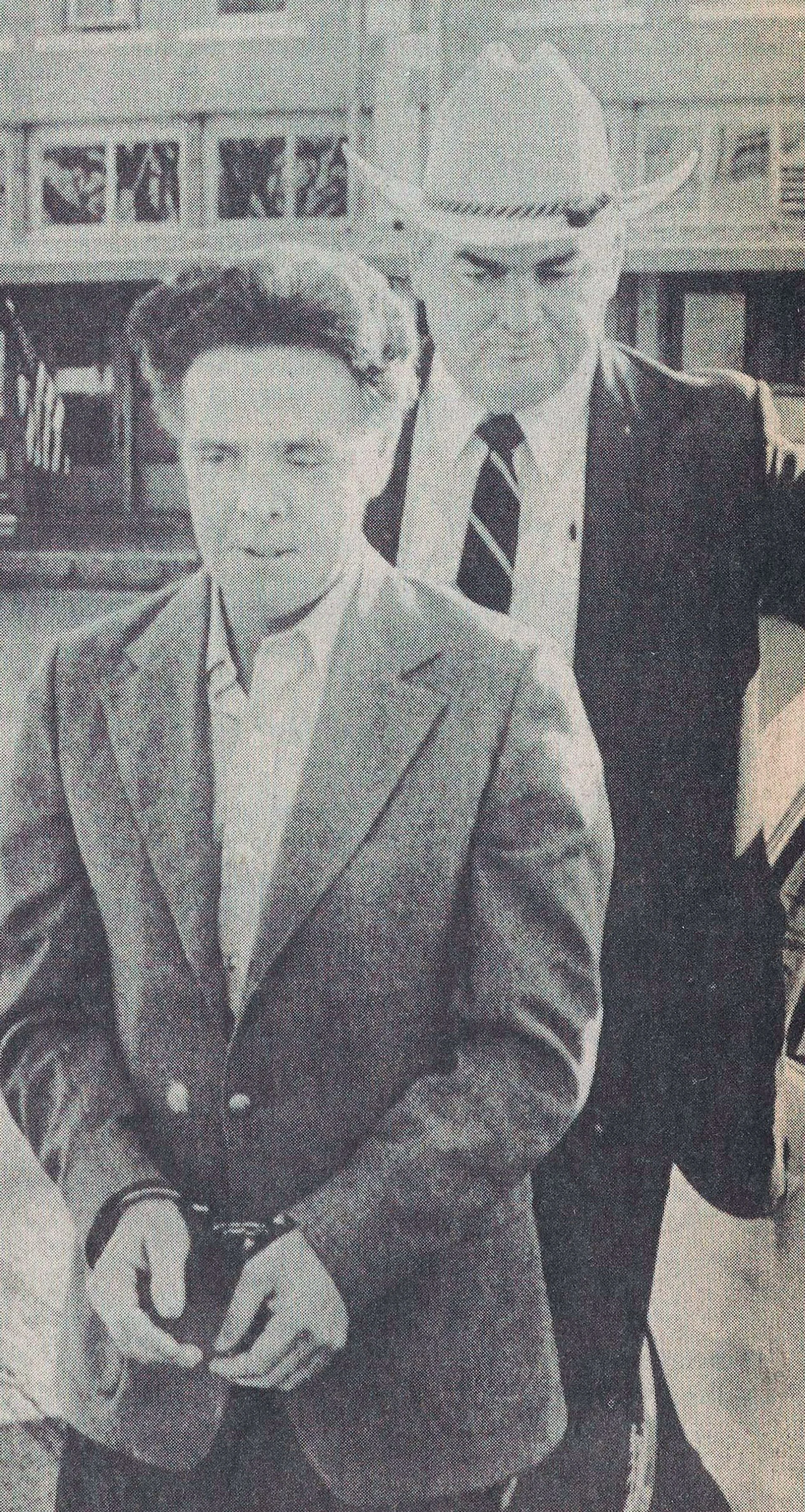
In 1983 a one-eyed drifter in a Texas jail began confessing to murders and did not stop for eighteen months. Henry Lee Lucas eventually claimed more than six hundred killings, and among them he placed a nationwide satanic cult, the Hand of Death, that had trained him, supplied him with victims and reached from the Everglades to Jonestown. A book made the cult famous. An attorney general’s investigation made it disappear.
What happened
Lucas, born in Virginia in 1936, had served about ten years for killing his mother in Michigan in 1960. On June 11, 1983 he was arrested in Montague County, Texas, on a firearms charge and within days confessed to killing Kate Rich, an 80-year-old widow, and Frieda “Becky” Powell, the 15-year-old niece of his companion Ottis Toole, with whom he had been living. In court that month he announced that he had killed about a hundred others. The number grew: 150, 360, 600. The Texas Rangers set up the Henry Lee Lucas Task Force in Georgetown, Williamson County, where Sheriff Jim Boutwell held him, and invited detectives from across the country to interview him. Lucas obliged almost everyone. By 1985 police agencies in more than twenty states had cleared some 213 unsolved homicides on his word.
The cult came out of these sessions and out of interviews with a writer, Max Call, whose book Hand of Death: The Henry Lee Lucas Story was published in Louisiana in 1985. Lucas said that Toole had taken him to a camp in the Florida Everglades where a secret society trained killers, that initiates had to murder on command, that the group kidnapped children for sale and sacrifice, that it had supplied the cyanide used at Jonestown in 1978 and had disposed of the union leader Jimmy Hoffa. Call presented it as fact, with reconstructed scenes and dialogue, and the book circulated among police officers and church audiences at the height of the 1980s alarm over satanic crime.
The investigation
The collapse began in the press. Hugh Aynesworth of the Dallas Times Herald checked Lucas’s confessions against pay records, cashed checks and jail logs and showed in April 1985 that he had often been hundreds of miles from the killings he claimed; a McLennan County grand jury convened by the district attorney Vic Feazell heard Lucas admit he had been lying. Lucas told reporters he had handed the police a hundred, then 240, then 600, then more than a thousand, and had wondered when someone would notice.
Attorney General Jim Mattox then opened an inquiry into how the confessions had been obtained. His report, issued in April 1986, reconstructed Lucas’s movements from his release in Michigan in 1975 to his arrest in 1983 through employers, relatives and officers, and concluded that the confessions were a hoax. Lucas, it found, had been shown case files and crime-scene photographs before “confessing,” had been given privileges, and had been allowed to keep talking long after the evidence of fabrication mounted; some agencies, it said, had cleared cases simply to get them off the books. Mattox found no sign that anyone had deliberately engineered the fraud, and urged every department that had closed a file on Lucas to reopen it. His investigator Mike Feary put the number of murders Lucas had probably committed at three: his mother, Rich and Powell. Nothing in the report, or in any later inquiry, corroborated a cult. No camp, member, victim or trafficking network was ever found, and the Jonestown and Hoffa claims were treated as what they were, the boasts of a man enjoying the attention.
The explanations
Lucas gave his own explanation to the Times Herald: he had wanted to make the police look foolish and corrupt, and the confessions had bought him better treatment, trips around the state and more attention than he had ever had. Officers who believed him had every incentive to keep believing, since each confession closed a file. The Hand of Death fitted a decade in which seminars taught police and therapists that organized satanic networks were real, and Call’s book gave it a shape. The only source for the cult is Lucas, and Lucas was the only source for almost everything else that turned out to be false.
Where it stands
Lucas was convicted of eleven murders. For one of them, the 1979 killing near Georgetown of an unidentified woman known as “Orange Socks,” he was sentenced to death, although work records placed him in Jacksonville, Florida, at the time and Mattox stated that no rational jury could have convicted him. In June 1998 Governor George W. Bush, on the recommendation of the Board of Pardons and Paroles, commuted that sentence to life, the only death sentence he commuted as governor. Lucas died in prison in 2001. The task force was disbanded, the cleared cases went back on the books, and the Hand of Death survives only in the book that named it.