
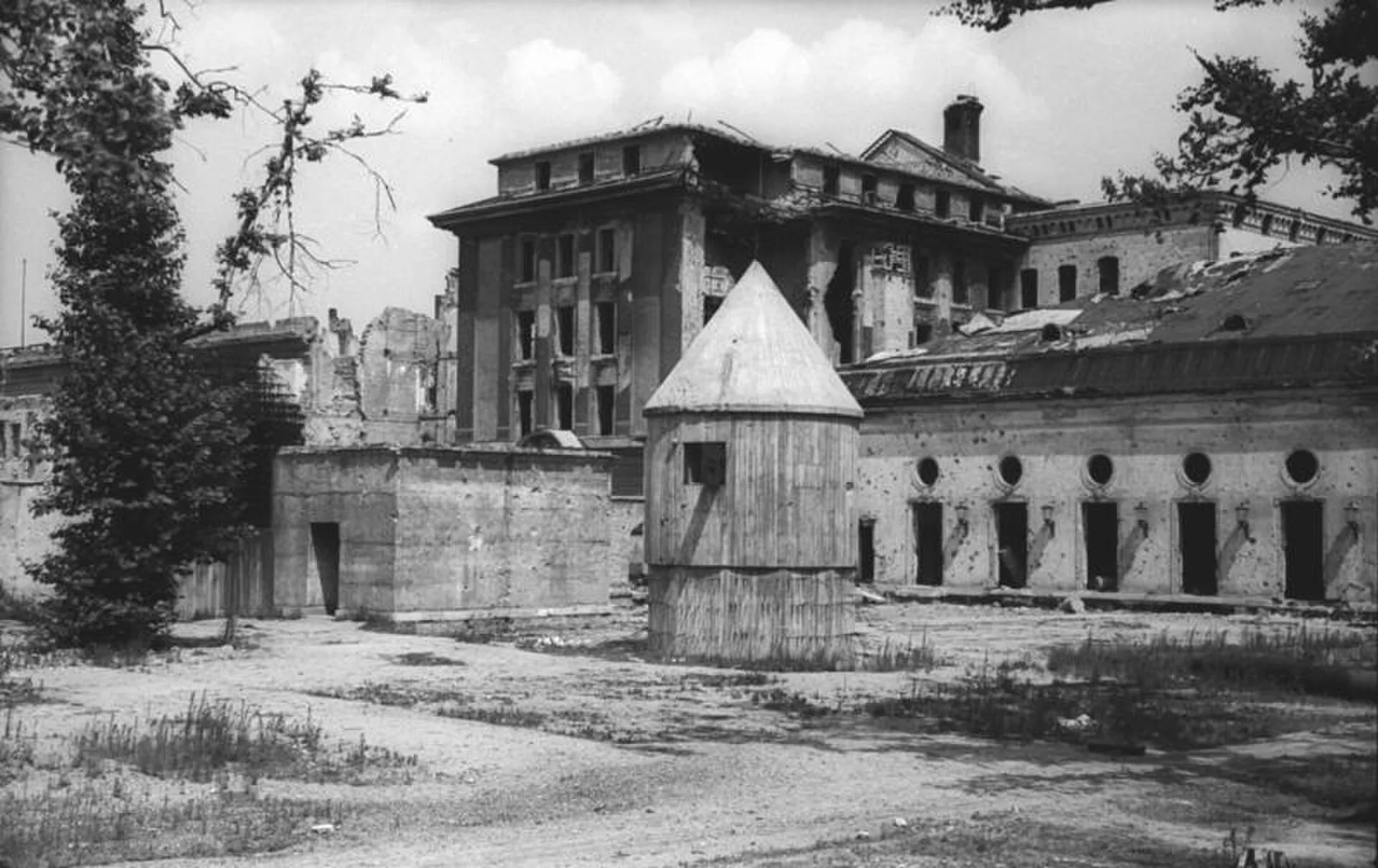
Adolf Hitler died in his underground shelter beneath the Reich Chancellery garden in Berlin on the afternoon of April 30, 1945, with Soviet troops a few hundred yards away. Almost at once a second story began to circulate: that the dictator had slipped out of the ruined city, by plane or by submarine, and lived out his life somewhere far away, most often in Argentina. The rumor outlived the war by decades, fed first by Soviet secrecy and later by books, websites and television series. Nothing that has surfaced since supports it.
The bunker
The account of Hitler’s last days comes from the people who were with him. Interrogated by British, American and Soviet officers after the war, members of his staff described how he married Eva Braun shortly after midnight on April 29, dictated his political testament and, on the afternoon of the 30th, withdrew with her into his study. When the door was opened, Hitler was slumped on a sofa with a gunshot wound to the head; Braun had taken cyanide. His valet, Heinz Linge, and his adjutant, Otto Günsche, carried the bodies up to the garden, poured gasoline over them and set them alight in a shell crater near the emergency exit. The historian Hugh Trevor-Roper, sent by British intelligence to establish what had happened, pieced the sequence together in late 1945 and published it in 1947 as The Last Days of Hitler.
What the Soviets found and said
A Soviet counterintelligence unit, SMERSH, dug up charred remains in the garden in early May 1945. Hitler’s dentist had fled, but his assistant, Käthe Heusermann, and his dental technician, Fritz Echtmann, were shown a jawbone fragment and dental bridges and recognized their own work. Stalin kept this from his allies. In June 1945 Marshal Georgy Zhukov told reporters that no body had been identified and that Hitler might have escaped, and Stalin suggested to American officials at Potsdam that he could be in Spain or Argentina. Western newspapers ran the story, and polls that summer found most Americans thought Hitler was still alive. The Soviet authorities quietly buried the remains at a military compound in Magdeburg and, in 1970, the KGB had them dug up, burned and the ashes scattered in a river. Only the jaw fragments and a piece of skull, found separately in 1946, were kept in Moscow.
The skull and the teeth
When Russian archives put the skull fragment on display in 2000, it seemed to settle the matter. In 2009, however, the University of Connecticut archaeologist Nicholas Bellantoni, working on a television documentary, took a sample from it, and laboratory tests indicated it came from a woman, probably between 20 and 40. Russia’s security service disputed the result. The finding said nothing about the jaw, but survival theorists treated it as a breakthrough.
The question was examined again in 2017, when the French forensic pathologist Philippe Charlier and colleagues were allowed to study the teeth and skull held in Moscow. Their paper, published in the European Journal of Internal Medicine in May 2018, reported that the teeth and bridges matched the dental descriptions recorded by the Soviets in 1945, and that the skull fragment was consistent with X-rays of Hitler’s head taken in 1944. Tartar on the teeth showed no trace of meat, consistent with his vegetarian diet, and bluish deposits on the false teeth were compatible with a reaction to cyanide. The team concluded the remains were authentic and that Hitler died in 1945, very likely by both poison and a bullet.
The Argentina stories
The South American version drew strength from real events. Two German U-boats, U-530 and U-977, surrendered at Mar del Plata in the summer of 1945, and many Nazi fugitives did later reach Argentina through escape networks. The FBI logged hundreds of tips about Hitler sightings in the years after the war, and when the bureau put its file online, some websites presented the collection as proof of an escape. Read in full, the file contains unverified letters and secondhand claims; one informant who described meeting Hitler off a submarine could not be traced. A 2011 book, Grey Wolf, and later television programs revived the idea that he lived in Patagonia, but they offer no document, photograph or remains that can be checked, and historians have dismissed them.
Where it stands
The case rests on independent witnesses from the bunker, the dental identification made in 1945 and the 2018 examination of the same teeth. Against that, the survival claim has Soviet disinformation, a misattributed skull fragment and decades of unconfirmed sightings. Historians treat Hitler’s death in Berlin on April 30, 1945, as established.