
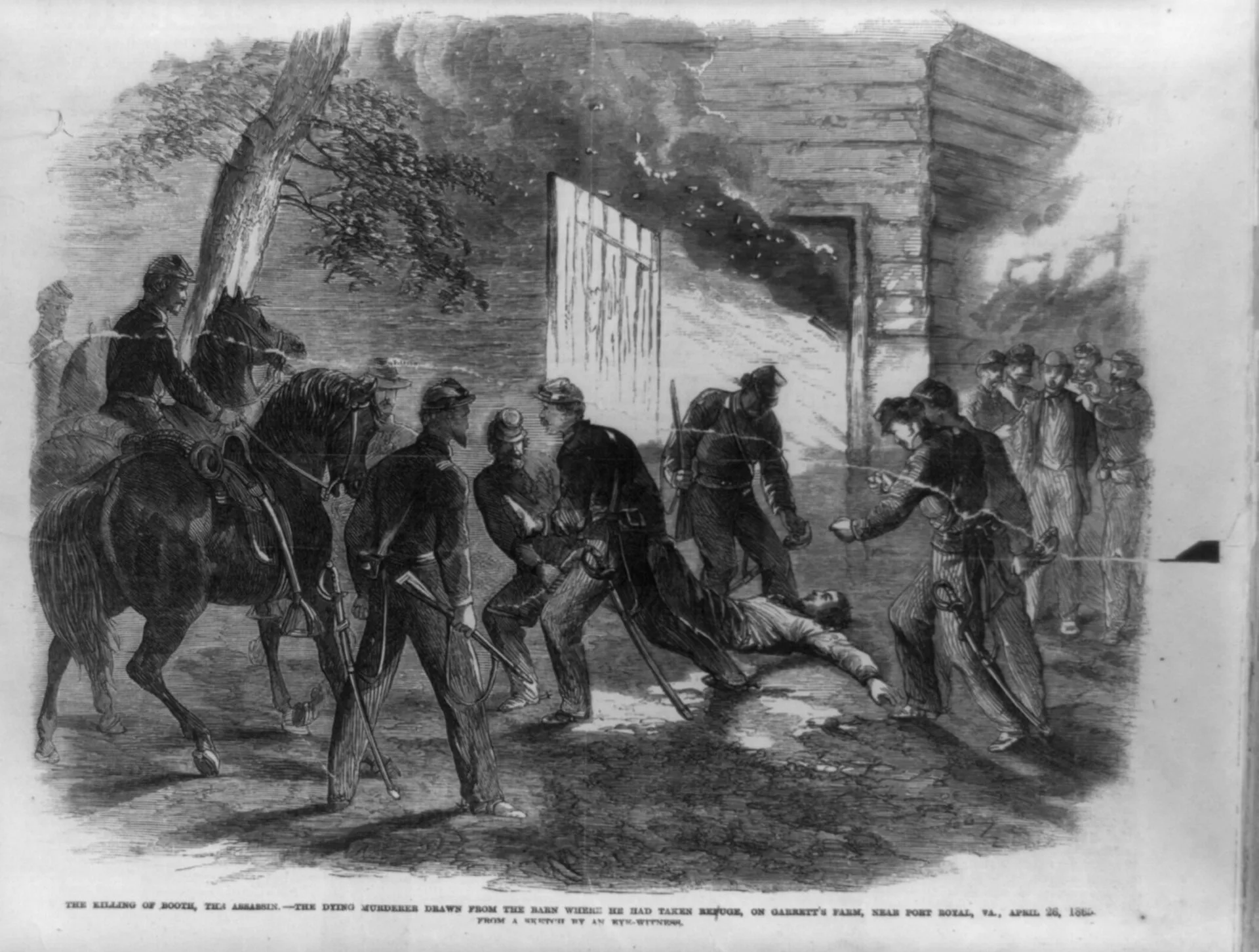
Twelve days after he shot Abraham Lincoln at Ford’s Theatre, John Wilkes Booth was cornered in a tobacco barn on Richard Garrett’s farm in Caroline County, Virginia, and killed. That is the history taught in schools, and it rests on a thick file of sworn statements. For more than a century, though, a rival story has insisted that the man dragged out of the burning barn was someone else, that Booth slipped away to the West, and that he finally died by his own hand in an Oklahoma hotel in 1903, leaving behind a body that toured the country as a carnival exhibit.
What happened at the Garrett farm
Booth broke his left leg jumping from the presidential box on the night of April 14, 1865. With David Herold he rode into southern Maryland, had the leg set by Dr. Samuel Mudd, hid for days in the pine woods and crossed the Potomac into Virginia. On April 24 three former Confederate soldiers led the pair to the Garrett place south of Port Royal. Union detectives picked up one of those soldiers, William Jett, at a hotel in Bowling Green, and he took a detachment of the 16th New York Cavalry under Lieutenant Edward Doherty to the farm. They arrived around three in the morning on April 26.
Herold gave himself up. Booth would not, so the barn was set alight, and Sergeant Boston Corbett fired a shot that struck him in the neck. He was carried to the farmhouse porch and died there a few hours later. The body went by wagon and steamer to the ironclad USS Montauk at the Washington Navy Yard, where the Judge Advocate General, Joseph Holt, took statements before Surgeon General Joseph K. Barnes performed an autopsy. A clerk from the National Hotel, where Booth often stayed, recognized the dead man by his face, by the letters J.W.B. tattooed in India ink on his wrist and by a scar on his neck. Dr. John Frederick May said he had cut a tumor from Booth’s neck and had no doubt it was the same man. Two other acquaintances agreed. Barnes also found a fracture of the left fibula just above the ankle, encased in splints. In 1869 the government released the body to the family, and Booth’s brother identified it again by a filled tooth before he was buried among his relatives at Green Mount Cemetery in Baltimore.
The man in Enid
The survival story belongs mostly to one man, Finis L. Bates, a lawyer from Granbury, Texas. Bates said that in the 1870s an acquaintance named John St. Helen, believing himself near death, had confessed to being Booth and claimed a different man had been shot in the barn. St. Helen recovered and drifted off. In January 1903 a house painter registered as David E. George swallowed poison in a hotel in Enid, Oklahoma Territory. A minister’s wife came forward to say that George had once told her he was Booth. Bates traveled to Enid, declared that George and St. Helen were one person, and in 1907 published The Escape and Suicide of John Wilkes Booth.
The undertaker had embalmed George’s unclaimed body with arsenic, and it dried into a mummy. Bates obtained it, rented it to fairs and sideshows, and after his death in 1923 it passed through the hands of a succession of showmen. In 1931 a group of Chicago physicians examined it and reported injuries they said matched Booth’s, but the broken leg they found was the right one, not the left that Mudd had splinted. The mummy was still on the circuit in the 1950s and has not been seen in public since the 1970s.
Testing it in court
The claim got its most thorough hearing in 1995. Distant relatives of Booth, backed by researchers who doubted the official account, asked a Baltimore court to let them exhume the body in the Booth plot and compare it with photographs. After a four-day trial Judge Joseph H. H. Kaplan refused. The grave was unmarked, a coffin holding three Booth infants had been buried on top of it, and experts testified that without dental records or a known maternal-line relative a positive identification was unlikely. Maryland’s Court of Special Appeals upheld him in 1996. Its opinion noted that the petitioners had stopped relying on Bates’s book, which at least three expert witnesses had called a fraud, and that the Montauk identifications sat in official records.
Where it stands
No document, photograph or physical trace has ever placed Booth alive after April 26, 1865, while several people who knew him identified his body, some of them twice. The Enid mummy’s credentials consist of a deathbed claim, a resemblance in newspaper sketches and the word of the man who profited from exhibiting it. Booth’s three cervical vertebrae, removed at the autopsy, are held by the National Museum of Health and Medicine. The escape remains a durable piece of American folklore, but the record supports the conventional account.