
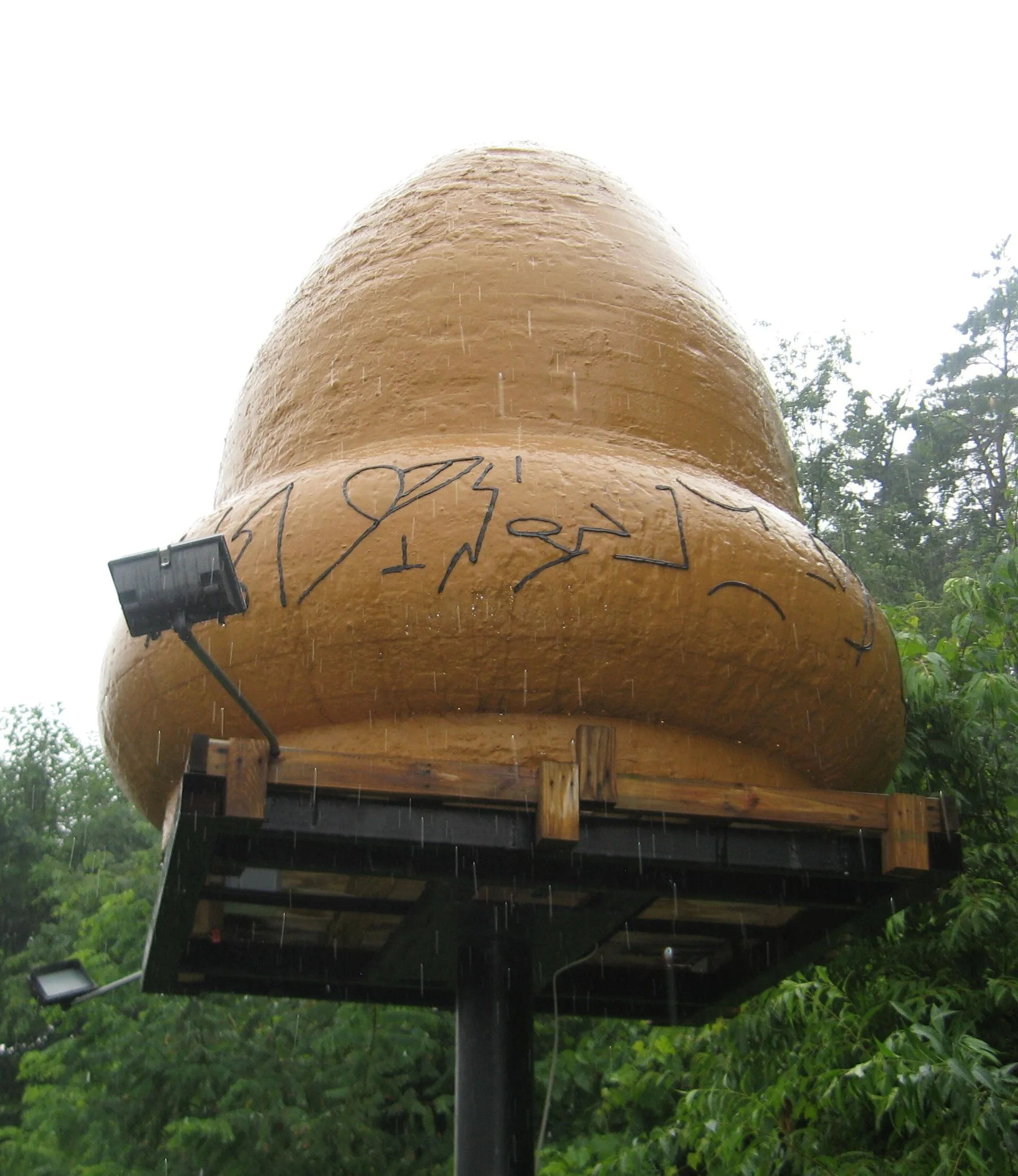
Kecksburg is a small farming community in Westmoreland County, about thirty miles southeast of Pittsburgh. For one night in December 1965 it was the center of a regional news story, and from 1990 onward it became one of the best-known crash cases in American UFO lore, sometimes called Pennsylvania’s Roswell.
What happened
At about 4:43pm on Thursday, December 9, 1965, a very bright fireball streaked across the late-afternoon sky. It was seen in at least six states and in Ontario, reported by the crews of more than twenty aircraft, and its shock waves registered on seismographs. People in Michigan and Ohio claimed to have picked up fragments.
In Kecksburg, residents said they saw something come down in the woods outside the village, along with smoke and a thump. A local radio station, WHJB, sent its news director, John Murphy, who arrived while the search was getting under way. State police closed off roads, and a small team of Air Force personnel came out from a radar station and searched the area with instruments. The next day’s local paper reported that searchers had failed to find any object, and its editors concluded that nothing had landed. The Air Force’s Project Blue Book logged the case as a meteor and closed it.
The investigation
For twenty-five years that was the end of the matter. Then in 1990 the television series Unsolved Mysteries broadcast a segment built on the work of the local investigator Stan Gordon. It featured residents who described a large object shaped like an acorn, roughly the size of a small car, with a band of markings like hieroglyphics around its base, being loaded onto a military flatbed truck under armed guard. A full-sized model built for the program still stands in the village near the volunteer fire company. No account recorded in 1965 mentions an object being recovered, and some residents objected publicly to the broadcast at the time.
The records question came later. In 2003 the journalist Leslie Kean, backed by the Sci Fi Channel, took NASA to court to force the release of its Kecksburg records under freedom-of-information law. While the suit was running, NASA said in 2005 that its experts had examined metal fragments from the area in the 1960s and identified them as parts of a Soviet satellite, but that the paperwork had been lost; the National Archives had told the agency years before that the files were listed as missing from 1987. A settlement in 2007 required a court-supervised search and payment of Kean’s legal fees. The documents released by 2009 contained no account of a recovered craft, though they raised questions about what had been destroyed in routine records purges.
The explanations
Astronomers studied the fireball at the time, using photographs and seismic records, and in 1967 published an analysis in the Journal of the Royal Astronomical Society of Canada. It described a meteor on a steep path that ended near the Detroit and Windsor area, close to Lake Erie and hundreds of miles from Kecksburg. People tend to badly misjudge the distance of a bright fireball, and the geophysicist George Wetherill, who looked at the case, attributed many of the reported impact sites to exactly that.
The leading alternative, that the object was the Soviet Venus probe Kosmos 96, does not fit either. The probe’s orbit decayed hours before the fireball, and NASA has said trajectory analysis rules it out. Some researchers have suggested a returning American reentry vehicle, but no record supports that either.
Where it stands
The event of December 9, 1965 is not in doubt: a large meteor, a frightened village, and a short search. The acorn, the truck and the guarded removal rest on recollections that surfaced a quarter-century later, after the story was on television. NASA’s lost files are a genuine example of poor record-keeping, but they are not evidence of a craft. Kecksburg holds a UFO festival, and the acorn model has become its landmark.