
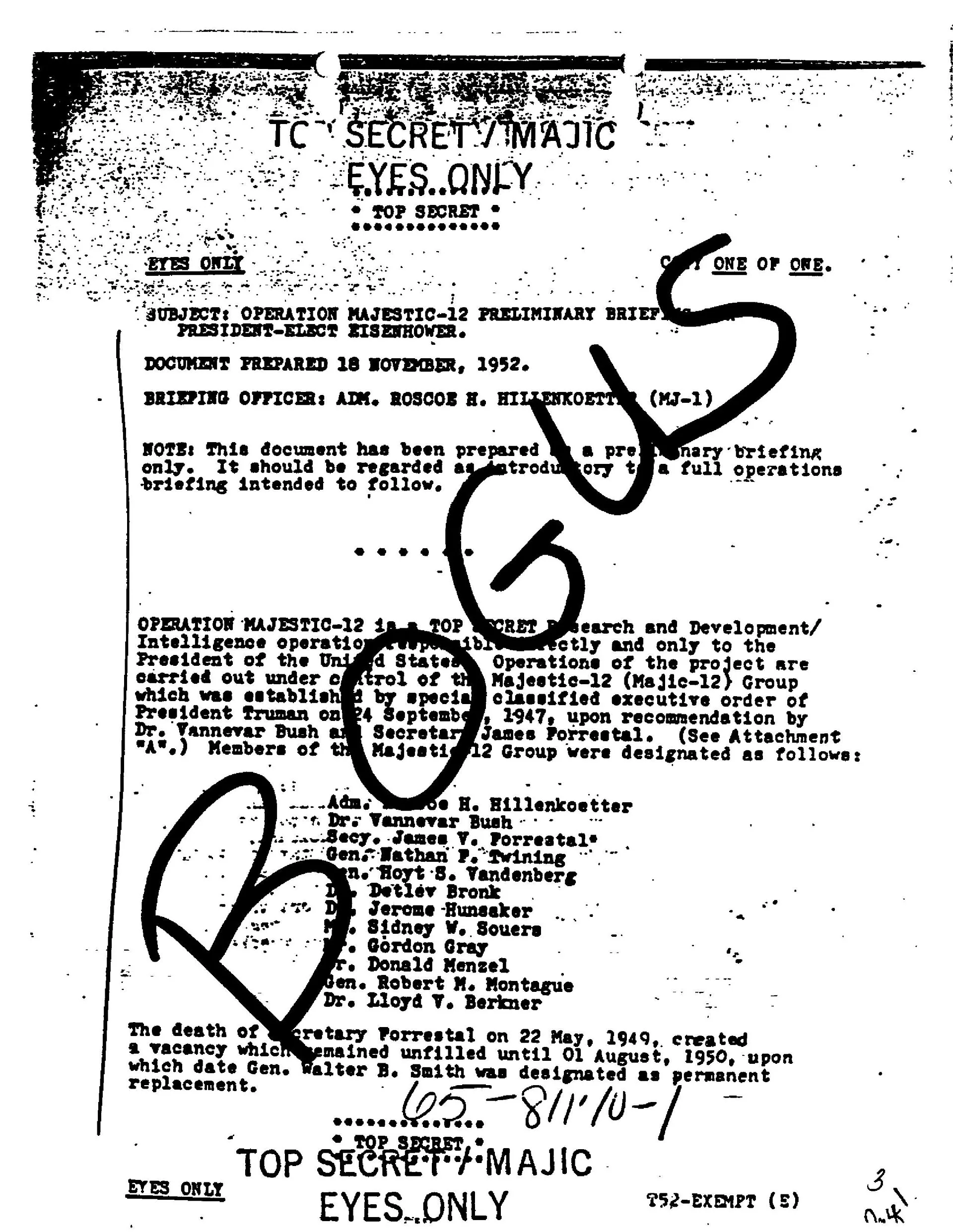
Majestic 12, or MJ-12, is supposed to be a secret committee of twelve scientists, generals and intelligence chiefs that President Harry Truman set up in 1947 to manage the recovery of a crashed flying saucer near Roswell, New Mexico, and the bodies of its crew. The only evidence that the committee existed is a set of documents that surfaced in the 1980s, and those documents are fakes.
What happened
In December 1984 the writer and UFO researcher Jaime Shandera found a package in his mail with an Albuquerque postmark and no return address. Inside was an undeveloped roll of 35mm film. Developed, it showed the pages of two documents. One was presented as a briefing for President-elect Dwight Eisenhower, dated November 18, 1952 and prepared by Admiral Roscoe Hillenkoetter, the first director of the CIA. It described Operation Majestic-12, named its twelve members, among them Vannevar Bush, Defense Secretary James Forrestal and the Harvard astronomer Donald Menzel, and said the group had examined a craft recovered near Roswell in July 1947 together with the bodies of its occupants. The second was a one-page memo, apparently signed by Truman on September 24, 1947, telling Forrestal to proceed with the project.
Shandera shared the film with his research partners William Moore, co-author of the 1980 book The Roswell Incident, and the nuclear physicist turned UFO lecturer Stanton Friedman. They kept it quiet for more than two years. In 1985, following anonymous tips, Moore and Shandera turned up a third item in a box of Air Force records at the National Archives: a short memo dated July 14, 1954 from Eisenhower’s national security aide Robert Cutler to General Nathan Twining, mentioning an “MJ-12” briefing. When the British author Timothy Good published the Eisenhower briefing in his 1987 book Above Top Secret, Moore released the full set, and the story reached newspapers worldwide.
The investigation
The documents drew official scrutiny almost at once. In 1988 copies mailed anonymously around the country reached at least two FBI field offices, and agents in Dallas consulted the Air Force Office of Special Investigations. On November 30, 1988 the Air Force answered that it had never authorized or formed any such group and that the paper was a fabrication. An FBI report that December summed it up in three words that have stuck to the case ever since: completely bogus. The bureau later placed its file, with a copy of the briefing stamped “BOGUS” across the page, in its online records vault.
The National Archives reached the same conclusion about the Cutler memo by checking its own records. The memo carried no top-secret register number, though every other document in that series did, and there was nothing else in the folder about MJ-12. Eisenhower’s appointment books showed no meeting on the day the memo set for the briefing. Cutler himself had been away touring military bases in Europe and North Africa from 3 to July 15, 1954, according to his own trip report to the president. Even the paper differed from the stock used for his genuine office copies.
The forensic problems
The aviation journalist Philip Klass, the best-known skeptic in the field, attacked the Truman memo. He showed that its signature was a duplicate of the one on a genuine Truman letter to Vannevar Bush of October 1, 1947, down to the same stray marks, which pointed to a copied image laid onto a typed page. Real signatures always vary a little; this one did not. Klass and others also noted that the briefing wrote its dates in a hybrid style, with a comma after the month and a zero before single-digit days, that was not used in Truman-era government papers but did appear in Moore’s own correspondence. Supporters, led by Friedman in his 1996 book Top Secret/Majic, answered each point and maintained that the core papers were genuine, though even he dismissed some of the later batches.
Where it stands
In 1989 Moore told a Mutual UFO Network conference that he had spent years passing information about other researchers to Air Force counterintelligence agents in return for UFO stories, which suggests the material may have been planted as disinformation rather than forged by a UFO enthusiast. Who typed the pages has never been established. Further MJ-12 batches appeared in the 1990s, many through the researcher Timothy Cooper, and were rejected by most ufologists as well. As historical documents, the papers are a hoax.