
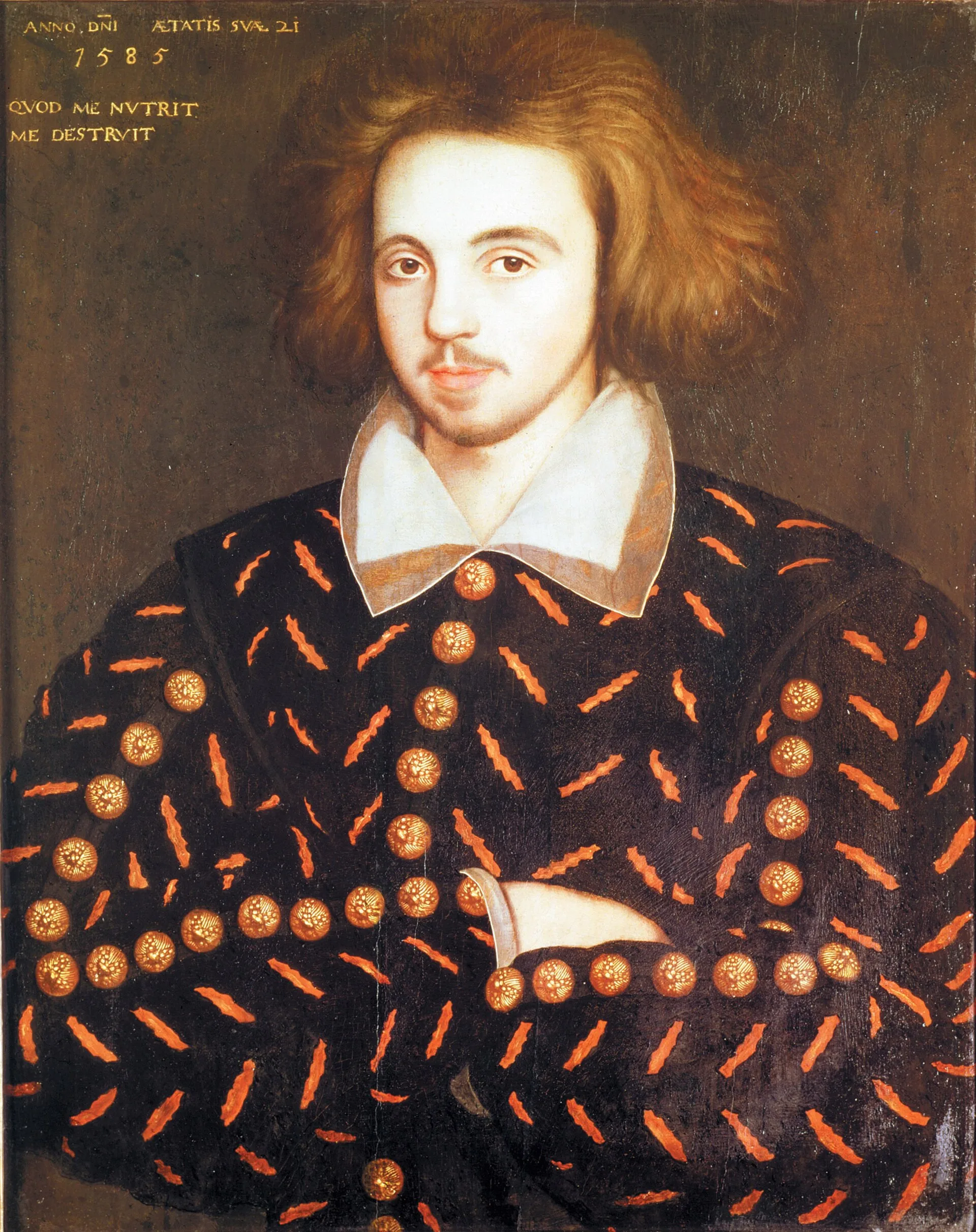
Christopher Marlowe was 29 and the most celebrated playwright in London when he died. A shoemaker’s son from Canterbury, educated at Cambridge, he had written Tamburlaine, Doctor Faustus and The Jew of Malta, and had a second life that the university authorities hinted at in 1587 when the Privy Council intervened to secure his degree on the grounds that he had done the queen good service. Few deaths of the period are better documented than his, and few have been more doubted.
What happened
In May 1593 Marlowe was in danger. The playwright Thomas Kyd, arrested over inflammatory placards, had been found with heretical papers and said they were Marlowe’s. On May 20 Marlowe answered a Privy Council warrant and was told to report daily while the investigation continued; an informer, Richard Baines, was preparing a list of blasphemies attributed to him.
On May 30 he spent the day at a house in Deptford, on the Thames below London, kept by a widow named Eleanor Bull. With him were Ingram Frizer, a business agent of his patron Thomas Walsingham; Nicholas Skeres, a con man who worked alongside Frizer; and Robert Poley, a courier and informer for the queen’s intelligence service. That evening, according to the inquest, a dispute over the bill broke out. Marlowe snatched Frizer’s dagger and cut his head; in the struggle Frizer drove the blade into Marlowe’s face above the right eye, killing him at once.
The coroner of the royal household, William Danby, held the inquest at the house on June 1 with sixteen jurors who viewed the body. They found Frizer had acted in self-defense. Marlowe was buried the same day at St Nicholas Church, Deptford, and Frizer received a royal pardon on June 28. The documents lay unread until 1925, when the American scholar Leslie Hotson found the inquest and the pardon in the Public Record Office and published them.
The theories
Hotson’s discovery gave two kinds of doubters something to work with. One school, set out most fully in Charles Nicholl’s 1992 book The Reckoning, accepts that Marlowe died but argues the quarrel over the bill was a cover story for a killing linked to the factional politics of the court, given that all three men were connected to the spy networks or to Walsingham.
The other school says Marlowe never died at all. The idea was first put forward in the 1890s and was popularized by the American press agent and critic Calvin Hoffman in his 1955 book The Murder of the Man Who Was Shakespeare. In this version Walsingham and his allies staged the killing, perhaps substituting another corpse, and smuggled Marlowe abroad, from where he supplied the plays and poems that appeared under William Shakespeare’s name. Marlovians point to the timing: Venus and Adonis, the first work printed with Shakespeare’s name, was on sale in London within weeks of the Deptford death.
The investigation
Hoffman tested his theory physically. In May 1956, with church permission, the tomb-chest of Thomas Walsingham at St Nicholas Church, Chislehurst, was opened in the hope of finding manuscripts. According to the Kent Archaeological Society’s later account, it contained nothing but sand. A second look into the adjoining family vault in 1984, with Hoffman present, found coffins stacked too deep to examine and nothing to support him.
Against the faked death stand the inquest, the jury’s viewing of the body, the burial entry and the absence of any trace of Marlowe after 1593. Against the authorship claim stands the fact that Shakespeare was already known in London theater before Marlowe died; a 1592 pamphlet attacks him as an upstart writer, and several of his early history plays were already on stage. Stylistic parallels between the two men are real but are usually explained as influence.
Where it stands
The Marlowe Society, which keeps the theory in circulation, paid for Marlowe’s panel in the Poets’ Corner window at Westminster Abbey, unveiled in 2002, and had it read 1564 and then a question mark before 1593. That question mark is about as far as the evidence goes. Marlowe’s death in a room full of spies may never be fully explained, but nothing in the record shows that he walked out of it.