
The flag and the state seal of North Carolina carry two dates. One, April 12, 1776, marks the Halifax Resolves, in which the colony’s Provincial Congress authorized its delegates to vote for independence. The other, May 20, 1775, marks an event that may never have happened: the day the citizens of Mecklenburg County, meeting in Charlotte, supposedly declared themselves free of the British crown, more than a year before Congress did so in Philadelphia.
The 1819 publication
Nobody outside Mecklenburg had heard of a May 20 declaration until April 30, 1819, when the Raleigh Register printed an account supplied by Dr. Joseph McKnitt Alexander. His late father, John McKnitt Alexander, had served as clerk at a meeting of county delegates in Charlotte in May 1775. According to the article, news of the fighting at Lexington arrived during the meeting, and in the early hours of May 20 the delegates resolved to dissolve the political bands connecting them to Britain, absolve themselves of allegiance to the crown, and declare themselves a free and independent people. A rider, Captain James Jack, then carried the resolutions to North Carolina’s delegates in the Continental Congress, who thought them premature. The original papers, the article explained, had burned in a house fire in 1800, and the text came from a copy the elder Alexander had left.
Adams, Jefferson and the witnesses
The story was reprinted across the country. John Adams read it in a Massachusetts paper and was astonished, both because he had never heard of it and because its wording was so close to the Declaration of Independence. He privately suspected Thomas Jefferson had borrowed from it and sent Jefferson a copy. Jefferson replied on July 9, 1819 that he believed the paper spurious. If Mecklenburg had declared independence in 1775, he asked, why had no one in Congress or in the long debates over independence ever cited it? He would not swear it was a fabrication, since a negative could only be proved by presumption, but he would treat it as one until real proof appeared. Adams declared himself convinced.
North Carolinians reacted by gathering statements from surviving old men who remembered a public reading in Charlotte, and after Jefferson’s letter was published in 1829 the state legislature issued its own defense. The witnesses, though, disagreed about who called the meeting, who served as secretary, and the date.
The Resolves turn up
The decisive evidence came from newspapers of 1775. In 1838 the archivist and publisher Peter Force found an abbreviated set of resolutions adopted by the Mecklenburg committee on May 31, 1775, and the full text was later located in a South Carolina paper. These Mecklenburg Resolves were radical: they held that all commissions from the crown were void, set up a provisional county government, and ordered the militia to arm. North Carolina’s royal governor, Josiah Martin, denounced them as treasonable. But they stopped short of a declaration of independence, and they contain none of Jefferson’s phrasing. Unlike the May 20 text, their authenticity is not in doubt.
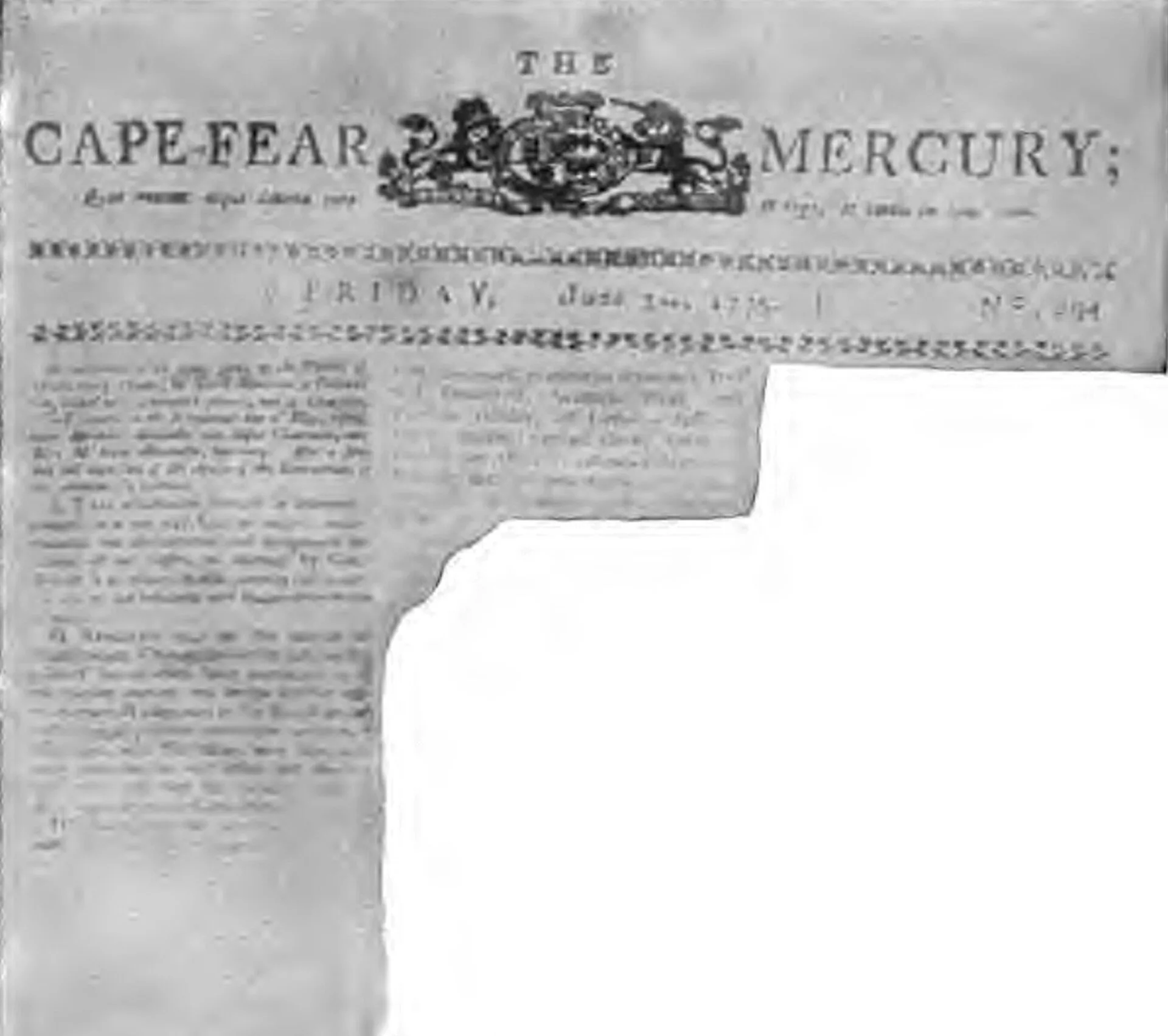
In 1907 William Henry Hoyt published the most thorough case against the declaration. In his reading, John McKnitt Alexander tried after the 1800 fire to reconstruct the lost records from memory, remembered the bold May resolutions as a full declaration of independence, and, with or without help, filled the gaps with language from the famous document of 1776. The eleven-day gap between 20 and May 31 may reflect confusion between old- and new-style calendars. A few defenders, notably the University of North Carolina mathematician Archibald Henderson, argued that both documents were genuine, adopted at separate meetings. The cause was not helped in 1905, when Collier’s magazine published what was offered as a long-lost 1775 newspaper page printing the declaration; it was quickly exposed as a forgery.
Where it stands
Mecklenburg County did adopt one of the most defiant local statements of 1775, and the Resolves deserve their place in Revolutionary history. The May 20 declaration as printed in 1819, however, has no contemporary record behind it, borrows its key phrases from a document written a year later, and is regarded by modern historians as a memory reconstructed and misdated rather than a lost original. North Carolina still celebrates the date.