
In the churchyard of Third Creek Presbyterian Church, near Cleveland in Rowan County, North Carolina, one old headstone is sealed inside a small brick and glass enclosure. It names Peter Stewart Ney, calls him a native of France and a soldier of the French Revolution under Napoleon Bonaparte, and gives his death as November 15, 1846, aged 77. That age points to 1769, the birth year of Michel Ney, Marshal of France. The stone is the center of North Carolina’s best-known historical legend.
What happened
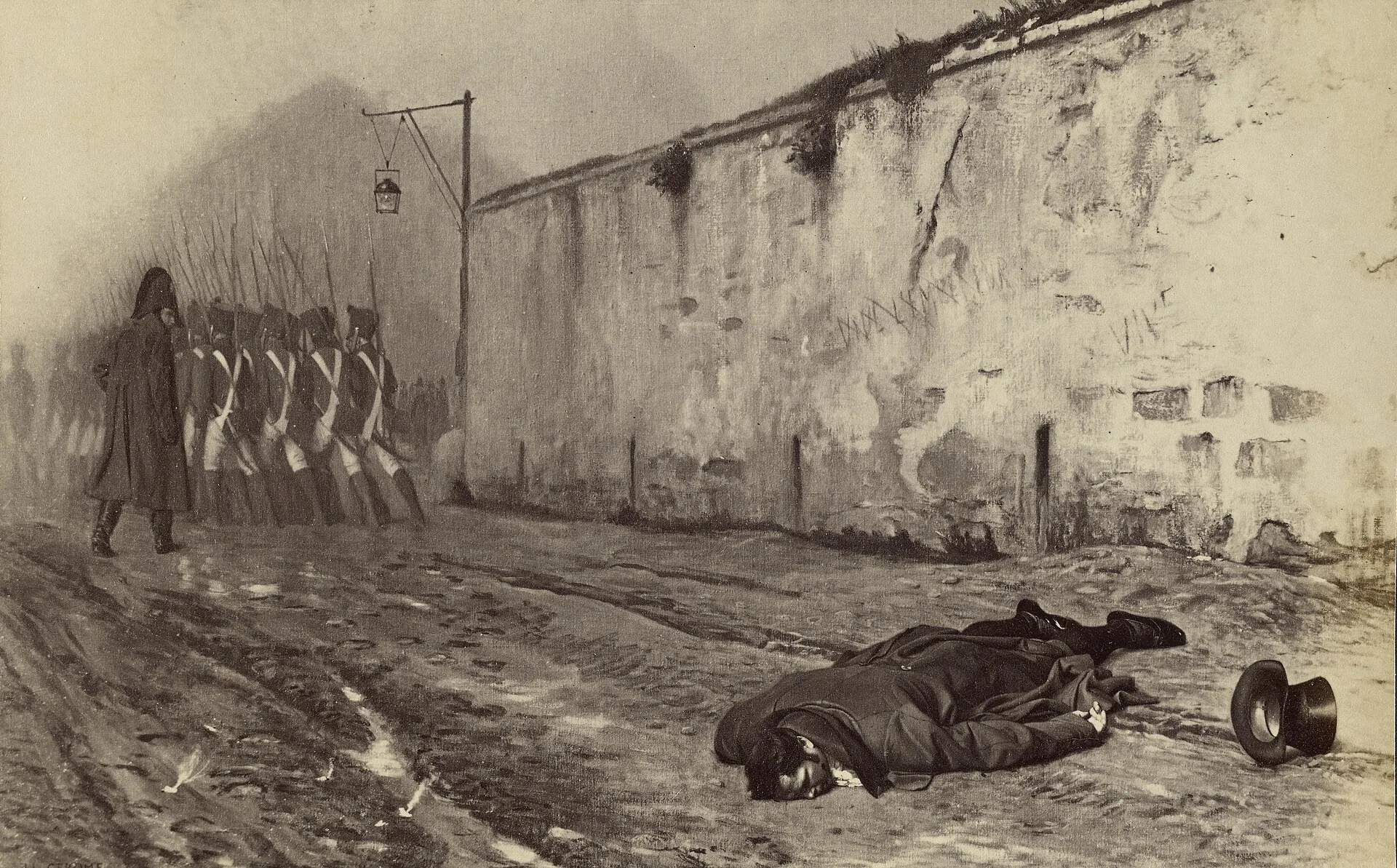
Michel Ney, a cooper’s son who rose to become one of Napoleon’s marshals, earned the nickname bravest of the brave in the retreat from Moscow. When Napoleon escaped from Elba in 1815, Ney was sent to stop him and instead went over to him, fighting at Waterloo. After the restored monarchy tried him for treason, he was shot by a firing squad near the Luxembourg Gardens in Paris on the morning of December 7, 1815, and buried at Père Lachaise Cemetery.
The following year a man named Peter Stewart Ney arrived at Charleston, South Carolina. He declared his intention to become an American citizen in 1820 and spent the rest of his life as an itinerant schoolmaster, teaching in short stints at small schools across Rowan, Iredell and Davie counties. Former students remembered him as a demanding and inventive teacher who challenged pranksters to duels with sticks, wrote his own arithmetic texts and designed the seal of Davidson College. He was also a man of odd episodes. According to stories his pupils told, he tried to cut his own throat on hearing of Napoleon’s death in 1821, and took to commanding imaginary troops when thunder rolled. On his deathbed, as later quoted, he answered a question about who he really was with the words I am Ney of France.
The investigation
Believers argued that the execution had been staged: that the soldiers aimed high on a signal, that Ney burst a hidden bladder of blood and fell, and that his body was shown only briefly and from a distance. In 1895 the Reverend James A. Weston, a North Carolina clergyman and Confederate veteran, published a long book making that case. Handwriting comparisons impressed laymen more than experts. Others followed, including LeGette Blythe’s Marshal Ney: A Dual Life in 1937.
The grave was tested twice. On May 3, 1887 it was opened before a large crowd and a panel of physicians, who reported finding only badly decayed bones, could not say whether the skull had ever been operated on, and found none of the bullets the marshal was said to have carried. Believers had hoped for a metal plate from an old head wound; there was none. A second exhumation in the 1930s was equally inconclusive.
The decisive work came from William Henry Hoyt, a researcher from Connecticut, in the 1940s and 1950s. His conclusions, summarized in the Dictionary of North Carolina Biography, were that the conditions of the execution, witnessed and recorded in Paris, left no realistic way to substitute another man or fake the shooting. He also followed a clue the schoolmaster himself had dropped: that he was born in Stirlingshire, Scotland, to a mother named Isabella Stewart. Hoyt found the baptism of a Peter McNee, son of John McNee and Isbal Stewart, on February 3, 1788 in the parish of Fintry. He could not trace McNee’s later life well enough to close the case, but the match is close. Doubters also note that Marshal Ney had no known command of English, and that after 1830 he could have returned to his family in France and did not.
Where it stands
The state’s own reference works treat the matter as settled. NCpedia’s entry describes the Ney myth as promoted by local writers but dismissed by historians, and the biographical dictionary states plainly that the schoolmaster was not the marshal, while admitting that his early life remains almost entirely unknown. The legend lives on at Davidson College, which holds his annotated books and a sketch labeled Ney by himself, and in Rowan County, where the glass-cased grave still draws visitors. The likeliest answer is a learned Scottish emigrant who found that a famous name made a better story than his own.