
Roswell is a cattle and farming town in southeastern New Mexico. In 1947 it was also home to Roswell Army Air Field and the 509th Bomb Group, at the time the only unit in the world trained to deliver atomic bombs. That combination, a remote ranch country sitting next to the most sensitive air base in the country, shaped everything that followed.
What happened
Some time in June 1947 W.W. “Mac” Brazel, who managed the J.B. Foster ranch near Corona, about 75 miles northwest of Roswell, came across a scatter of debris on the range. By his own account it was made of rubber strips, tough paper, tinfoil, tape and light wooden sticks. That summer the papers were full of “flying disc” sightings, following a pilot’s report over Washington state in late June, and around July 6 Brazel took some of the material into Roswell and showed it to Sheriff George Wilcox. Wilcox called the air field, which sent its intelligence officer, Maj. Jesse Marcel, and a counter-intelligence officer, Capt. Sheridan Cavitt, to collect it.
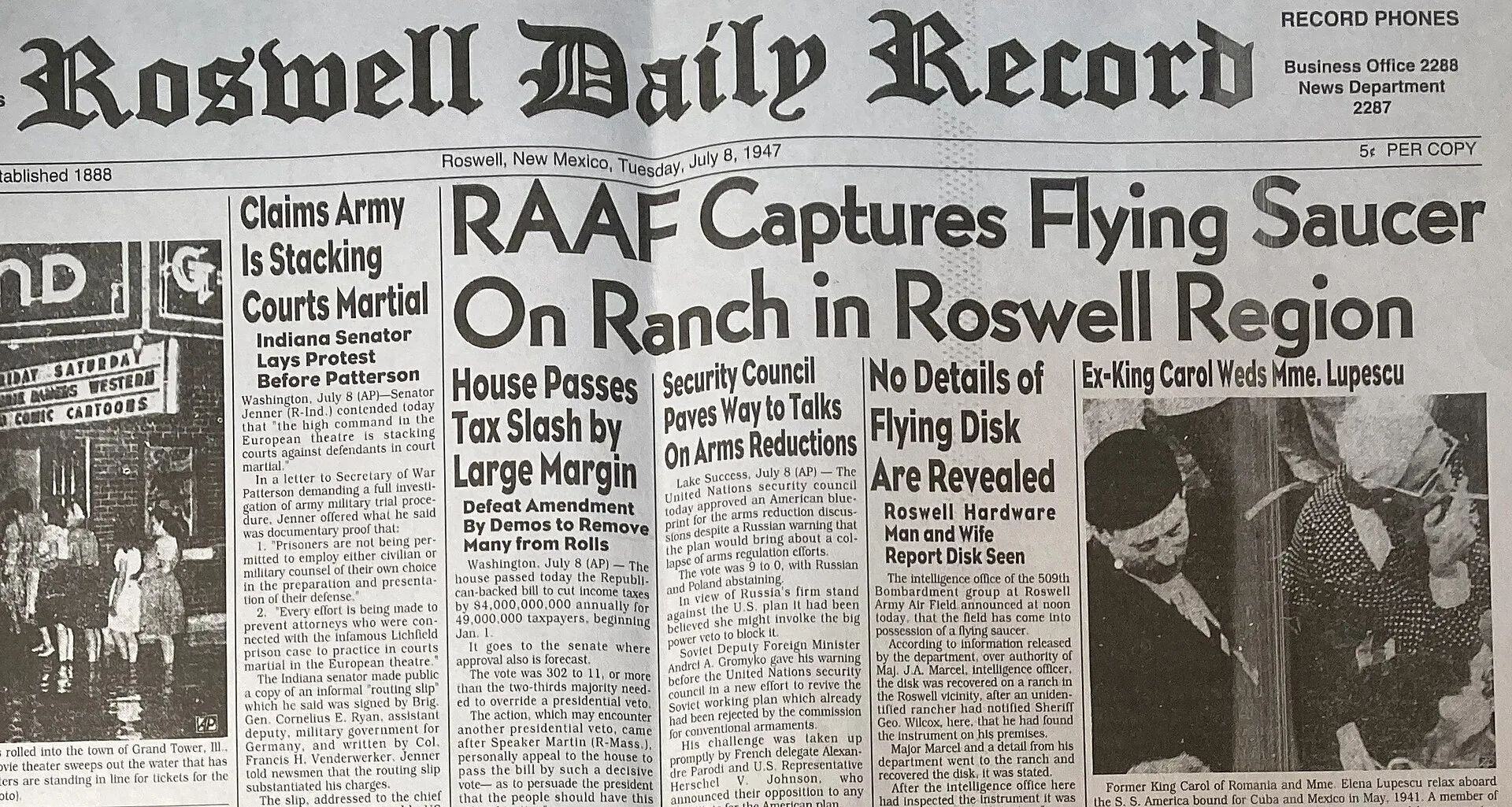
On July 8 Walter Haut, who handled press for the base, put out a statement announcing that the 509th had a flying disc in its possession. The Roswell Daily Record put it on the front page. Within hours Brig. Gen. Roger Ramey of the Eighth Air Force in Fort Worth, Texas, had the material photographed in his office and identified it as the remains of a weather balloon and a radar reflector. The next day’s papers carried the correction and an interview with Brazel describing what he had found. Reporters lost interest, and for three decades Roswell was a footnote.
The revival
In 1978 the nuclear physicist and UFO lecturer Stanton Friedman interviewed Jesse Marcel, by then retired, who said the weather-balloon explanation had been a cover story and that the material was unlike anything he had seen. The National Enquirer took up the story, and in 1980 Charles Berlitz and William Moore published The Roswell Incident. Through the 1980s and early 1990s new witnesses came forward, many after a 1989 episode of Unsolved Mysteries. A local mortician, Glenn Dennis, described odd requests from the base and talk of bodies at the base hospital; other accounts placed a second crash site, alien corpses and military threats against witnesses. Each new book added detail, and the accounts did not always agree with one another.
The investigation
In 1993 New Mexico Congressman Steven Schiff asked the General Accounting Office, the investigative arm of Congress, to find out what government records existed on the crash and whether the military had followed its own reporting rules. The GAO’s report, issued in July 1995, turned up no record of a spacecraft; the official paperwork it could locate treated the event as the crash of a balloon.
Prompted by the inquiry, the Air Force ran its own search. Its 1994 report concluded that the debris almost certainly came from Project Mogul, a classified program run with New York University that flew long trains of balloons carrying radar reflectors and acoustic sensors, intended to detect the shock waves of Soviet nuclear tests in the upper atmosphere. Charles B. Moore, one of the Mogul scientists, later described a flight launched from Alamogordo on June 4, 1947 that was lost near the Foster ranch, and noted that its radar reflectors had been reinforced with tape bearing a flowered pattern, matching Marcel’s description of strange markings. A second Air Force report, The Roswell Report: Case Closed, followed in 1997. It argued that the stories of alien bodies drew on events from the 1950s, notably high-altitude balloon drops of anthropomorphic crash-test dummies and fatal aircraft accidents near the base, which witnesses had merged with 1947 decades after the fact.
The explanations
The documented core of Roswell is modest: a rancher found balloon wreckage, a base announced a flying disc, and a general corrected it. Everything else came from recollections recorded thirty to fifty years later. There was, in a sense, a cover-up: the Army in 1947 could not say the material came from a secret program, so it gave a simpler explanation that was partly true. Believers argue that Mogul Flight 4 may never have flown as described and that the 1997 dummy explanation cannot account for events in 1947, since the dummy tests began years later. The Air Force’s answer is that witnesses had compressed time, not that dummies fell in 1947.
Where it stands
No physical evidence of a spacecraft or bodies has ever surfaced, and the records that do survive describe a balloon. Roswell itself has embraced the story, with a UFO museum founded in 1991 and an annual festival each July. The incident remains the template for the modern crashed-saucer legend.