
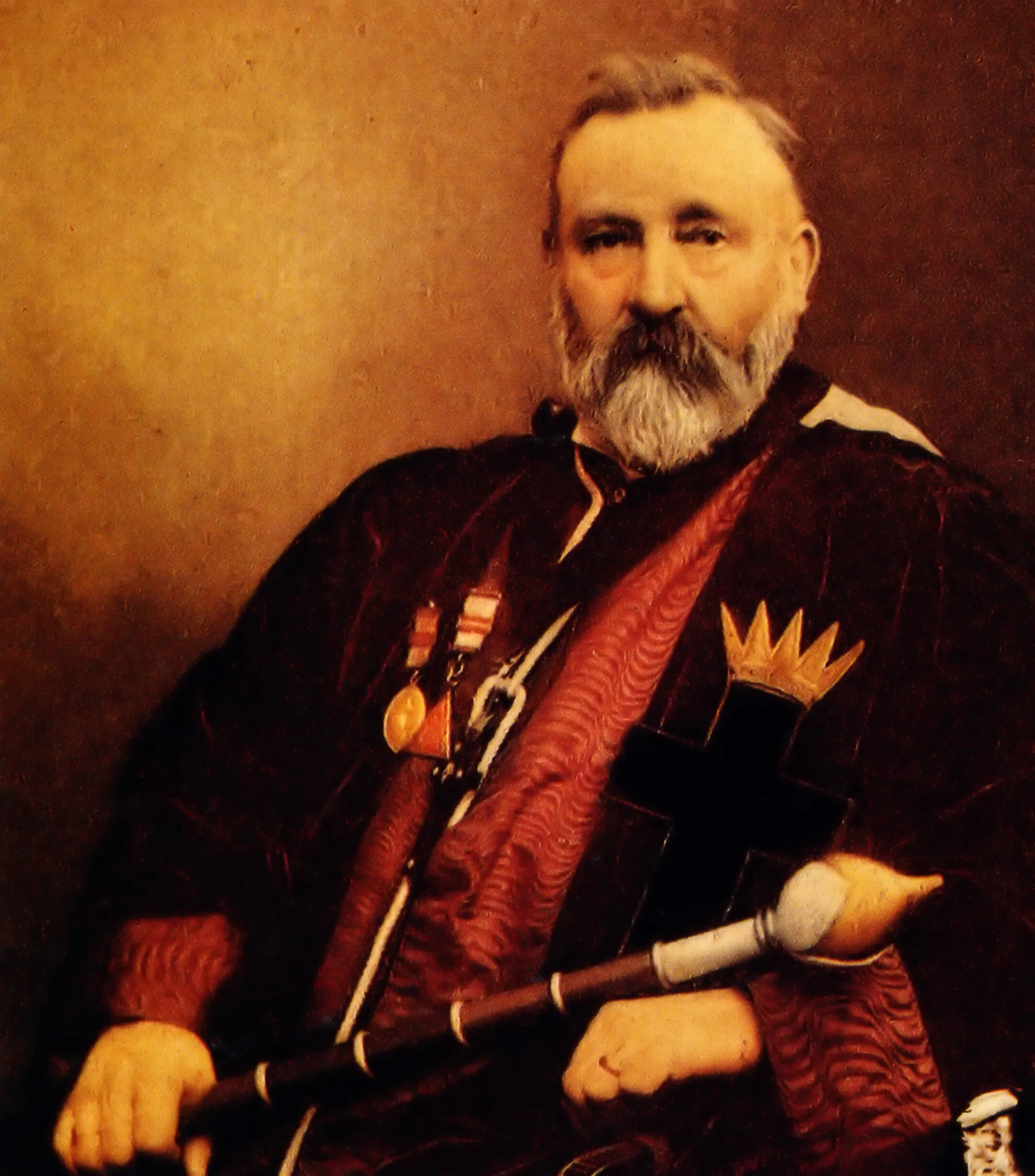
The Hermetic Order of the Golden Dawn was a Victorian secret society that taught ritual magic to doctors, actresses, clergymen and a future Nobel laureate. It lasted fifteen years before splitting, and nearly everything about it now sits in public archives. The one thing it could never prove was the story of its own origin.
What happened
The order began with a bundle of papers. In 1887 William Wynn Westcott, a London coroner, Freemason and officer of the Societas Rosicruciana in Anglia, came into possession of some sixty folios written in a simple cipher taken from a 16th-century book by Trithemius. Decoded, they were skeleton outlines in English for five initiation rituals, with diagrams. Westcott said they had reached him through the Reverend A. F. A. Woodford; the Museum of Freemasonry, which now holds them, says they were probably written by the Masonic scholar Kenneth Mackenzie, who had died in 1886. Westcott also produced letters from a German adept, “Fräulein Sprengel” of Nuremberg, granting him a charter to open an English temple. Those letters are now generally accepted as his own fabrication.
Westcott asked Samuel Liddell Mathers, a self-taught scholar of magic, to expand the outlines into full ceremonies, and with the physician William Robert Woodman they opened the Isis-Urania Temple in London in March 1888. Temples in Weston-super-Mare and Bradford followed by the end of that year, Edinburgh and Paris later. The curriculum was graded: Kabbalah, tarot, astrology, geomancy and alchemy, learned for examination. In 1891 Mathers added an inner Second Order, the Rosae Rubeae et Aureae Crucis, with a seven-sided vault in which adepts practiced practical magic. William Butler Yeats joined in 1890 and stayed, under one name or another, for three decades. Other members included the actress Florence Farr, the tea heiress Annie Horniman, the writers Arthur Machen and Algernon Blackwood and, from 1898, Aleister Crowley. The membership rolls record several hundred initiates over the order’s life.
The investigation
The order’s history was written from its own papers. Ellic Howe’s The Magicians of the Golden Dawn (1972) worked from the private collection of Gerald Yorke and from the records of the order’s successor bodies; the Yorke Collection is now at the Warburg Institute, and the main archive, including the cipher manuscripts and the Sprengel letters, is at the Museum of Freemasonry in London. What emerges is a society run by correspondence and quarrel. Westcott withdrew in 1897 after word of his occult activities reached his employers. Mathers, living in Paris on Horniman’s money until she cut it off, grew autocratic. In February 1900, challenged by the London adepts over his authority, he wrote to Farr that Westcott had forged the Sprengel correspondence and that the order’s legitimacy therefore rested on him alone. London responded by suspending him. In April 1900 Crowley arrived at the Second Order’s rooms at 36 Blythe Road, Hammersmith, as Mathers’s envoy, in Highland dress and a black mask, to take possession; Yeats and the London officers had the locks changed and called a constable. Mathers was expelled and Yeats briefly ran the temple.
The explanations
Worse followed. In 1901 a pair of confidence tricksters calling themselves Theo and Laura Horos, who had obtained Golden Dawn rituals from Mathers, were tried at the Old Bailey for rape and fraud, and the rituals were read out in court and printed in the newspapers. By 1903 the order had broken into three: A. E. Waite’s Independent and Rectified Rite, Robert Felkin’s Stella Matutina, which Yeats followed, and Mathers’s loyalists under the name Alpha et Omega. Crowley printed the rituals in his journal The Equinox in 1909 and 1910, and Israel Regardie published the whole corpus in the late 1930s. The “secret” tradition has been in print for a century.
Historians do not doubt that the order existed or that it believed in its magic. What they reject is its pedigree. The cipher papers are a 19th-century compilation, the German mother lodge was imaginary, and the Golden Dawn’s rituals were assembled in London from Masonic forms, published grimoires and the Egyptological fashion of the day.
Where it stands
The Golden Dawn is the best-documented magical society in history and the model for most that followed. Its archives are cataloged, its rituals published and its members’ letters edited. It was real, serious and influential. The unbroken ancient lineage it claimed was invented by its founder, and the order fell apart the moment that was said aloud.