
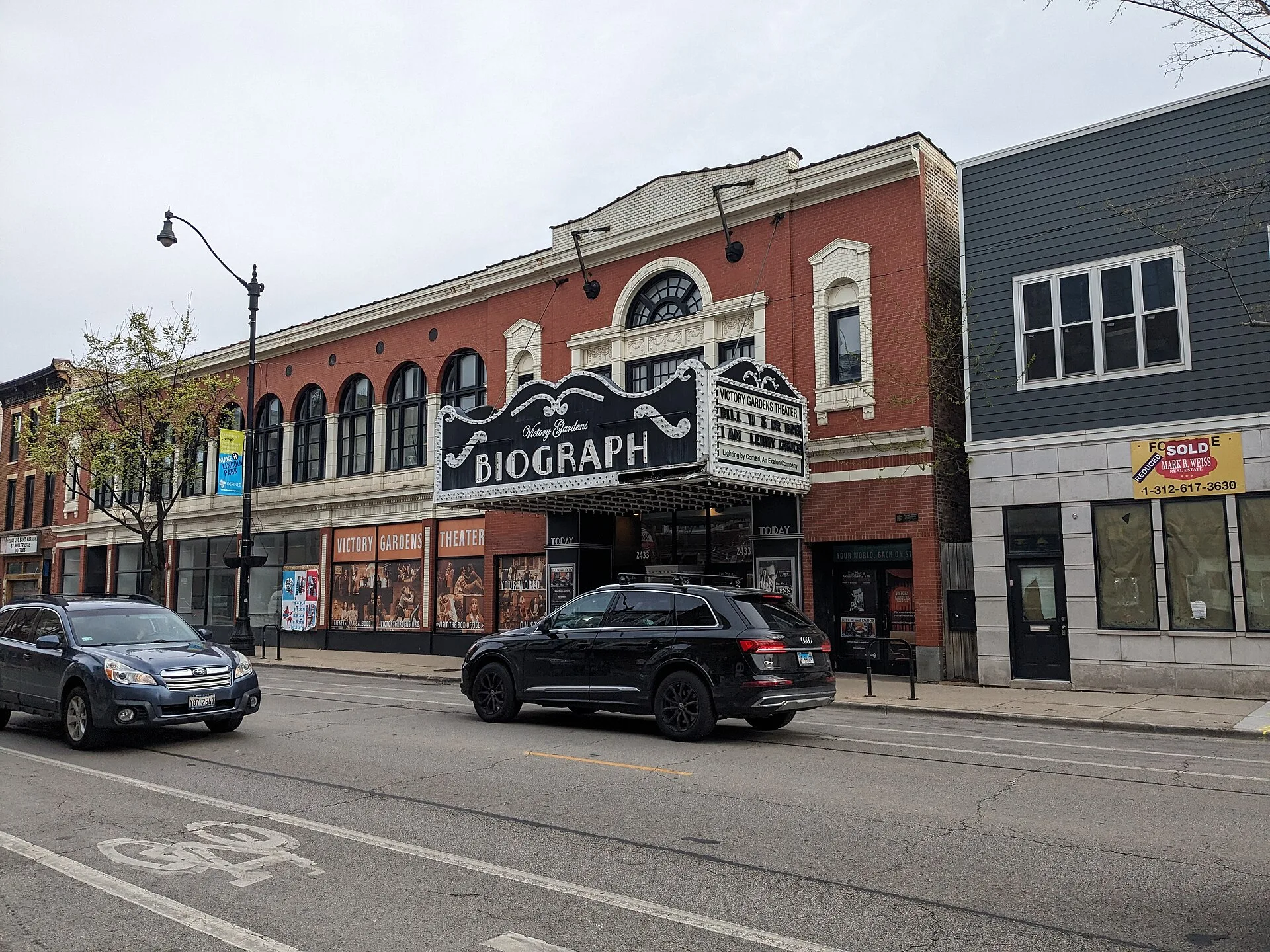
The Biograph Theater at 2433 North Lincoln Avenue was designed in 1914 by Samuel N. Crowen as a neighborhood picture house. It showed films until 2004, was made a Chicago landmark in 2001, and now houses the Victory Gardens stage company behind its restored 1934 marquee. The narrow alley on its south side has been known to Lincoln Park residents for ninety years as Dillinger’s Alley.
What happened
By July 1934 John Dillinger was the most wanted man in the country. He had escaped the Crown Point, Indiana, jail that March with a wooden pistol, and the federal Division of Investigation, soon to be renamed the FBI, had lost agents trying to take him. In Chicago he was living quietly with a waitress, Polly Hamilton, whose friend and landlady Anna Sage ran a brothel and faced deportation to Romania. Sage went to the agents and offered to deliver him in exchange for help staying in the country.
On Sunday July 22, in a heat wave of around a hundred degrees, Dillinger took the two women to the air-cooled Biograph to see Manhattan Melodrama, a Clark Gable gangster picture. They went in at about 8:30 in the evening. Outside, Melvin Purvis, head of the Chicago office, and some sixteen agents and East Chicago, Indiana, policemen spread out along the street; Sage had worn an orange skirt so they could pick her out, which the newspapers turned into the Lady in Red. When the three came out about two hours later and walked south, Dillinger saw the men closing in and broke for the alley. Agents fired five shots; at least two hit him, including one that entered the back of his neck, and he died within minutes. Two women passing by were wounded. By midnight people were dipping handkerchiefs in the blood on the pavement, and the body was put on public display at the county morgue before burial at Crown Hill Cemetery in Indianapolis, where his father had the casket covered with concrete and scrap iron.
The ghost
No one reported anything strange in the alley for decades. The stories that eventually surfaced, and that ghost tours now repeat, describe a bluish figure that runs up the alley, stumbles, collapses and disappears, along with cold spots and a sense of dread near the spot where Dillinger fell. In 2005 the librarian Alice Maggio, writing for Gapers Block, noted that MSN had just ranked the Biograph the most haunted place in America on the strength of this urban folklore, and that a fan group called the Dillinger Died for You Society gathered there each anniversary with tongues firmly in cheek. No named witness, date or photograph attaches to any sighting.
The lookalike theory
The conspiracy is better documented than the ghost, because it has an author. In 1970 the crime writer Jay Robert Nash and the researcher Ron Offen published Dillinger: Dead or Alive?, expanded in 1983 as The Dillinger Dossier, arguing that the man shot outside the Biograph was Jimmy Lawrence, a small-time Chicago criminal who resembled Dillinger, set up by Sage and a corrupt East Chicago policeman to collect the reward while the real outlaw escaped. Nash’s evidence was a set of discrepancies in the paperwork: the autopsy gave the corpse brown eyes where Dillinger’s were recorded as blue-gray, estimated its age at 32 when Dillinger was 31, and listed a height and weight slightly different from his Navy and wanted-poster records. Nash also cited letters from 1959 and 1963 from a man claiming to be Dillinger, whom he never traced.
The investigation
The official record answers most of this. All three sets of fingerprints taken from the body matched Dillinger’s file, despite his having burned his fingertips with acid while on the run, and his sister Audrey identified him before burial. A later Cook County medical examiner suggested that eyes can darken after death in July heat. The FBI, asked again in 2019, called the idea that its agents had not killed Dillinger a myth and pointed to the fingerprint matches.
That year the question went to court. Dillinger’s nephew Michael C. Thompson and his sister obtained an Indiana permit to exhume the Crown Hill grave for DNA testing as part of a History Channel documentary. The cemetery refused in August, calling the theory a decades-old conspiracy and noting that an autopsy and a family identification had been performed in 1934; Thompson sued; the network withdrew in September; and on December 4, 2019 Judge Timothy Oakes of the Marion County Superior Court dismissed the suit, ruling that Indiana law requires a cemetery’s consent and that the cemetery need not give a reason. The grave has not been opened.
Where it stands
The Biograph is a real crime scene with a genuine claim on American memory, which is why both legends grew there. The ghost is a late addition with no first-hand source. The lookalike theory is a book-length argument from clerical inconsistencies that the physical evidence does not support. The alley, meanwhile, is simply an alley, and on July 22 each year it fills with people who know exactly what happened in it.