
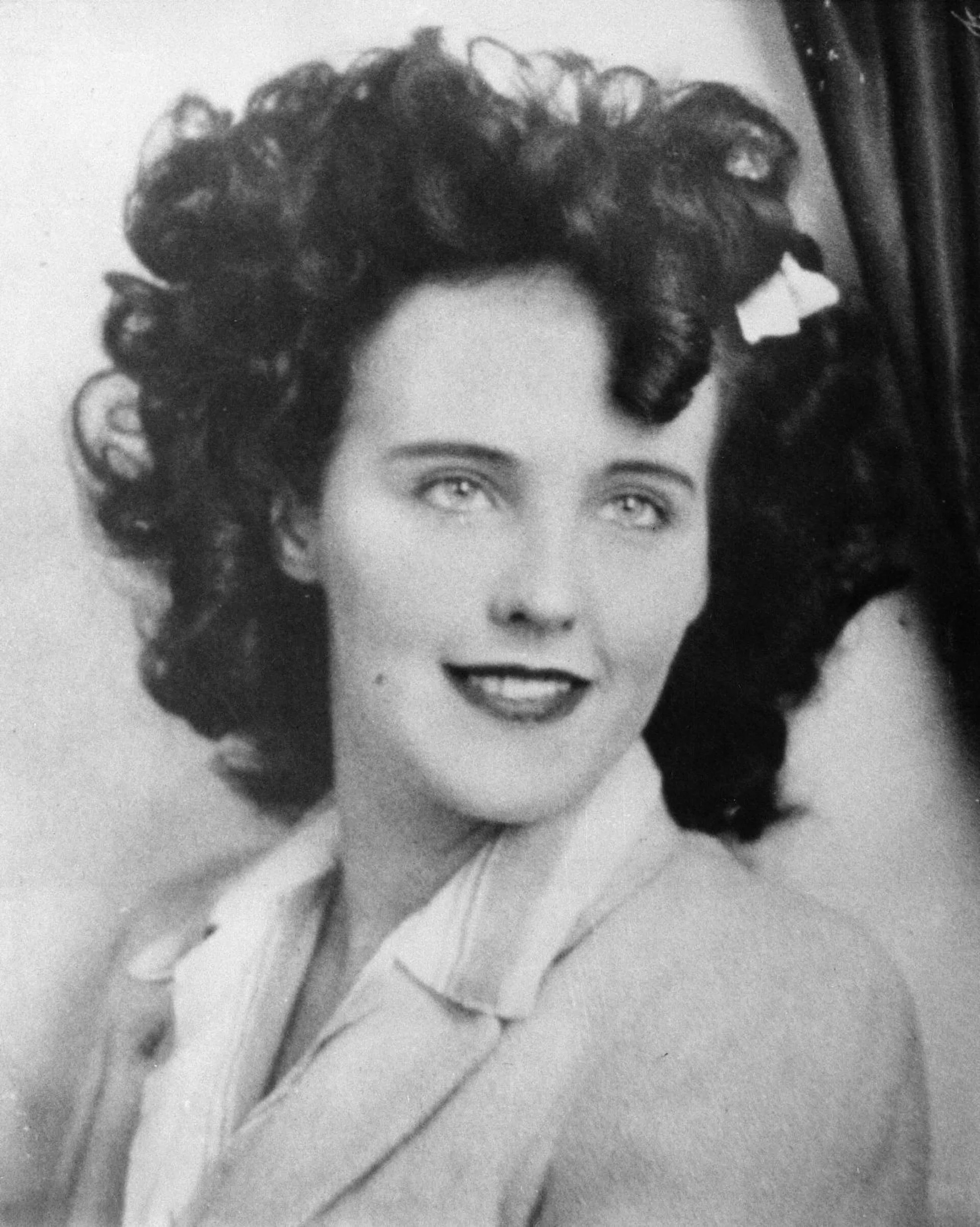
Elizabeth Short was born in Boston in 1924 and grew up in nearby Medford, Massachusetts, one of five daughters of a family left short of money when her father walked out. She drifted west during and after the war, and in the summer of 1946 she was living in Long Beach and Los Angeles, moving between rented rooms and the homes of acquaintances. Staff and regulars at a Long Beach drugstore, noting her black clothes and dark hair, took to calling her the Black Dahlia, probably a play on the 1946 film The Blue Dahlia. After her death the newspapers seized on the name, and it has since eclipsed her own name.
What happened
Short spent December 1946 in San Diego and returned to Los Angeles on January 9, 1947 with Robert Manley, a salesman who had given her a ride north. He left her in the lobby of the Biltmore Hotel downtown that evening. No one has ever reliably accounted for her movements after that. On the morning of January 15 a local woman walking with her small daughter along South Norton Avenue, in the Leimert Park neighborhood, saw what she took to be a discarded mannequin in a weedy lot. It was Short’s body, severed at the waist, drained of blood, washed and deliberately arranged, with the corners of her mouth slashed. Detective Harry Hansen relayed the medical examiner’s view that the bisection had been done with surgical skill.
She was identified within a day, after the Los Angeles Examiner helped send her fingerprints to the FBI, which had them on file. On January 24 an envelope arrived at the Examiner addressed in letters cut from newspapers. It held her birth certificate, photographs, business cards and an address book embossed with the name of Mark Hansen, a nightclub owner in whose house she had stayed. Investigators came to regard that first mailing as genuine and the many taunting notes that followed as pranks.
The investigation
The case drew hundreds of officers from the police department, the sheriff’s department and the highway patrol. Detectives interviewed thousands of people, tested every lead from the Biltmore onward and took a long run of confessions, all of which they discounted. Coverage was relentless and often inaccurate, with competing papers sometimes inventing details. Hansen remained in charge of the file until he retired in 1968.
Two later episodes shaped the legend. In 1949 a police psychiatrist, Dr. J. Paul De River, ran his own inquiry outside the homicide bureau and fixed on Leslie Dillon, a bellhop who had once worked for a mortician. The district attorney’s office established that Dillon had been in San Francisco at the time of the murder, and the fiasco fed into a county grand jury inquiry. In early 1950 the district attorney’s investigators bugged the house of Dr. George Hodel, a Hollywood physician who had just been acquitted in a sensational incest trial. A transcript has him telling an unidentified visitor that, supposing he had killed the Black Dahlia, it could not be proved now. Lieutenant Frank Jemison’s final report concluded that the evidence tended to eliminate him.
The theories
Theories multiplied after the original detectives retired. In 2003 Steve Hodel, a retired Los Angeles homicide detective, published Black Dahlia Avenger, arguing that his father killed Short and other women and fled to Asia. He cites photographs found among his father’s belongings, handwriting comparisons and, in later work, soil samples from the family’s Hollywood house. Critics, among them the journalist and Dahlia researcher Larry Harnisch, reply that Hodel had little surgical training, that no link between him and Short was ever established, and that the 1950 investigators cleared him. The British author Piu Eatwell’s 2017 book returned to Dillon, suggesting he acted for Mark Hansen, whose advances Short was said to have refused; Harnisch counters that no connection between the two men has been shown. A woman named Janice Knowlton accused her late father in the 1990s, and a childhood friend of Short’s wrote a book blaming Orson Welles.
Basic facts remain contested too. Popular accounts describe Short as an aspiring actress; Harnisch, who has studied the police and district attorney files for decades, says she was essentially homeless by the end, did not smoke and rarely drank, and has no proven link to any of the hotels and bars that legend attaches to her final week.
Where it stands
The murder of Elizabeth Short is still listed as unsolved, nearly eighty years on. Everyone ever publicly named as her killer is dead, the physical evidence has been handled and stored for decades, and the theories that sell books have not persuaded the authorities. James Ellroy’s 1987 novel and the 2006 film made the case a fixture of Los Angeles noir, which has done more for the legend than for the woman at its center.