
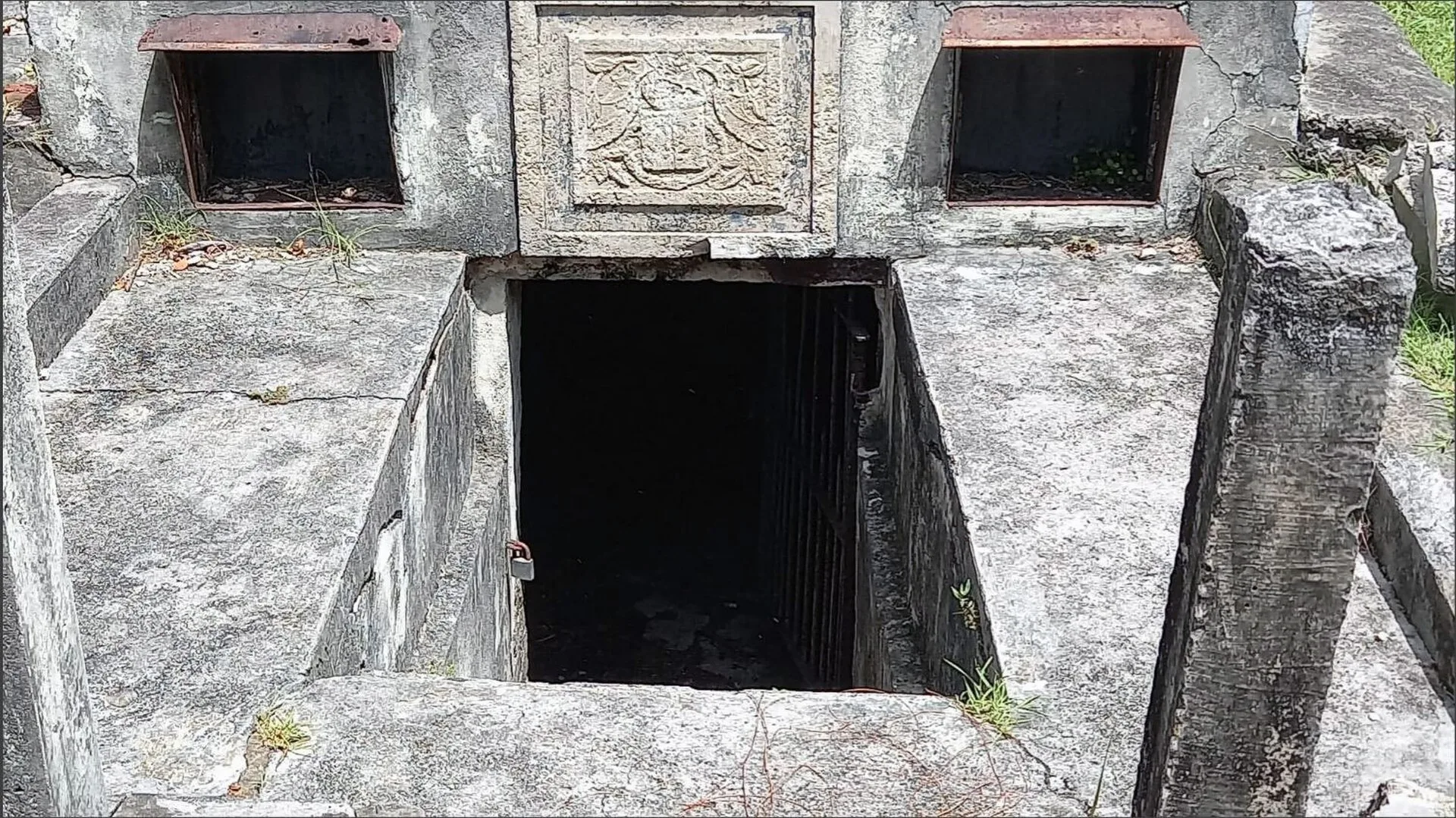
Christ Church Parish Church stands on a rise above the fishing town of Oistins on the south coast of Barbados. In its graveyard, partly below ground, is a small vault of brick and stone closed by a heavy slab. It was built for another family and passed to the Chases in the early nineteenth century. Its fame rests on one story: that the coffins placed inside would not stay where they were left.
What happened
The earliest version in print appeared in 1833 in Transatlantic Sketches, a travel book by the British army officer James Edward Alexander. He lists the burials: a Mrs. Goddard in 1807, a Miss A. M. Chase in 1808 and a Miss D. Chase in 1812. When the vault was opened at the end of 1812 for the Honourable T. Chase, usually identified as Thomas Chase, the earlier coffins were reportedly found in disarray, as if they had been flung from their places. The same was said of later openings, for an infant, for a Mr. Brewster in 1816 and for a Mr. Clarke in 1819. Each time, Alexander writes, the coffins were set back in order, three on the floor and the rest on top, and the door, a stone that took six or seven men to shift, was cemented shut. The floor was sand, and it showed no footprints and no trace of water. At a final opening in 1819, attended by the governor, Lord Combermere, the coffins lay scattered, some upended. Alexander wondered whether an earthquake or a flood might be responsible and set the story beside a similar tale from Suffolk.
Later tellings grew more detailed. In the best-known version the governor had fresh sand spread on the floor and the cement marked with private seals, and an opening in April 1820 found the seals unbroken and the coffins strewn about, one large lead coffin lying across the entrance. The family then removed the remains for burial in the churchyard and the vault was left empty. That version is credited to an eyewitness account by Nathan Lucas, a local judge, which is known only because an anonymous writer attributed it to him. The original has never been found.
The investigation
Beyond the governor’s visit described in the legend itself, no inquiry is on record. In 1907 the folklorist Andrew Lang examined the story and found no confirmation in the parish burial register or in Barbados newspapers of the period. The writer Jerome Clark traced most versions to anecdotes told by Thomas Orderson, rector of Christ Church in the early 1800s, who gave conflicting accounts. Joe Nickell, writing in 1982, noted that the dates, the number of coffins and the order of openings change from source to source, and argued that the story is laden with Masonic symbolism. In 2019 the investigator Benjamin Radford inspected the vault. He found its original interior bricks free of the gouges and scrapes that heavy lead coffins crashing into the walls ought to have left, and he counted at least a dozen similar vaults close by that never produced such a tale.
The explanations
Natural causes have been proposed since Alexander’s time: flooding that floated the coffins, earth tremors, and in recent years lightning, a theory Radford rejected after measuring the vault’s position relative to the church. Others have looked for human hands, from intruders to people with grudges against the Chase family. None of these can be tested, because there is no reliable evidence that the disturbances took place. Radford found an older tale of the same type attached to another vault in the parish, belonging to the Williams family, and concluded that the Chase story is best explained as a legend that migrated and gathered detail in the retelling, rather than as a real event or a deliberate hoax. He did not accept Nickell’s suggestion of a Masonic invention, regarding the symbolism as a later addition.
Where it stands
The vault remains in the Christ Church graveyard, open and empty, and is pointed out to visitors. Writers from Arthur Conan Doyle onward have retold the story. As history it is unsupported: the first account is anonymous, no witness’s own words survive, and the records that ought to mention it are silent. It is a legend.