
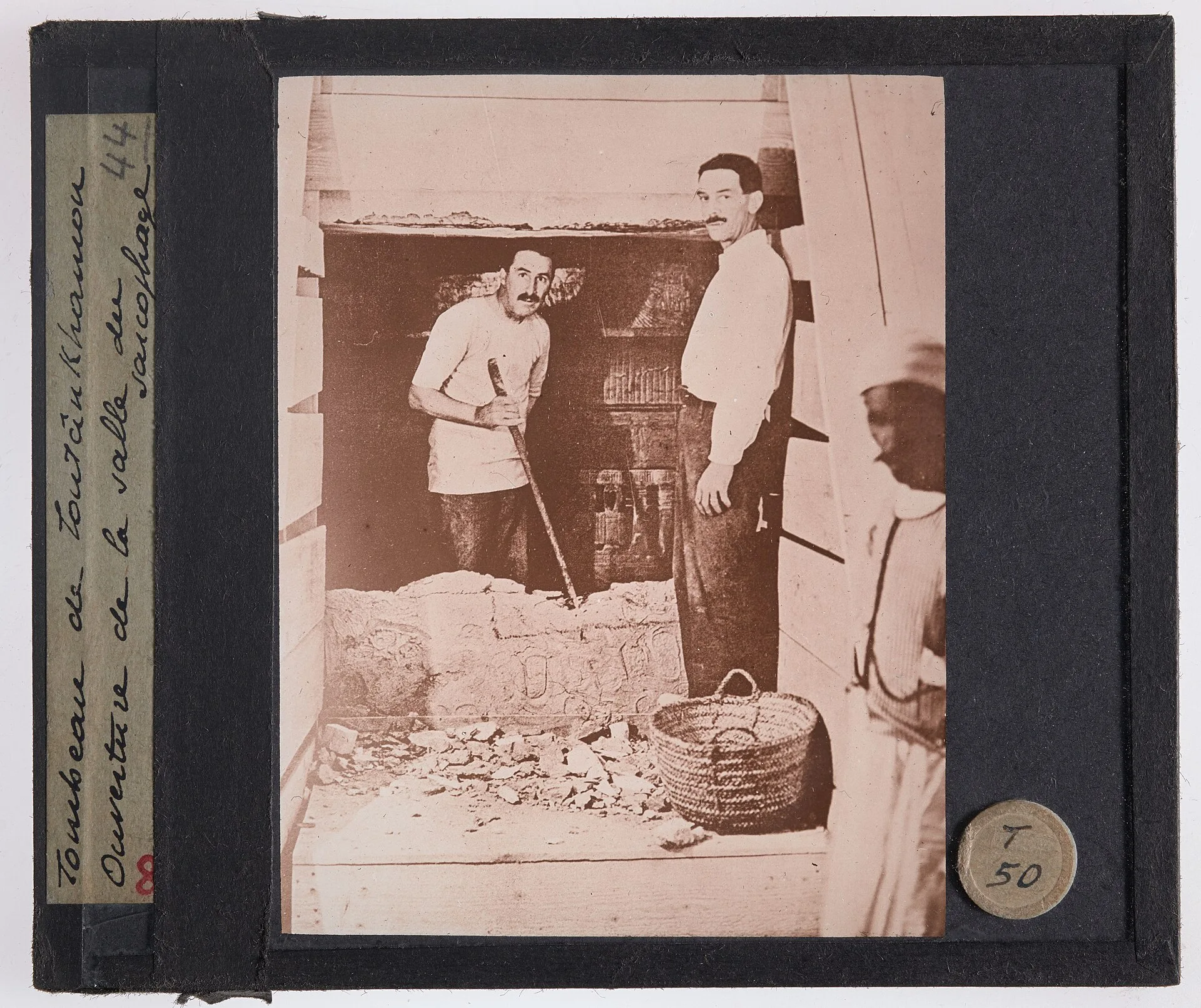
In November 1922 the British archaeologist Howard Carter, working in the Valley of the Kings opposite Luxor with money from George Herbert, the fifth Earl of Carnarvon, found the steps down to the tomb of Tutankhamun. It was the only royal tomb of ancient Egypt found largely intact in modern times, and it made both men famous. Less than five months after the first chamber was entered, Carnarvon was dead, and the idea that the boy king had punished the people who disturbed him has been attached to the tomb ever since.
What happened
Carter’s own excavation journal, now held by the Griffith Institute at Oxford, records the sequence plainly. After the formal opening of the sealed burial chamber in February 1923, Carnarvon left to rest at Aswan and then went to Cairo. On March 20 Carter traveled to Cairo because his patron was ill, and found him suffering from erysipelas, a streptococcal skin infection, with blood poisoning. Carnarvon had nicked an infected insect bite on his cheek while shaving. Pneumonia followed, and he died in the early hours of April 5, 1923. He was 56 and had been in poor health for years.
The press was ready. The excavation had been front-page news around the world since the discovery. About two weeks before his death the novelist Marie Corelli had published a letter warning of dire punishment for anyone entering a sealed tomb, and afterward Sir Arthur Conan Doyle suggested that guardian spirits set by Tutankhamun’s priests might be responsible. Stories multiplied: that the lights of Cairo failed at the moment of death, that Carnarvon’s dog howled and died at the same moment, that Carter’s canary was swallowed by a cobra, and that a tablet in the tomb promised death to intruders. Each subsequent death of anyone remotely connected with the excavation was added to the tally.
The investigation
None of the decorative details hold up. The blackout and the dog appear only in newspaper accounts, and no curse inscription has ever been found in Tutankhamun’s tomb or among Carter’s records. Carter himself dismissed the curse, writing that sane people should treat such inventions with contempt. Herbert Winlock of the Metropolitan Museum of Art, who worked alongside him, counted in 1934 that only six of the people present at the opening had died.
The most direct test came in 2002, when the epidemiologist Mark Nelson of Monash University published a historical cohort study in the British Medical Journal. Using Carter’s records, he identified 44 Westerners who were in Egypt during the excavation. Of these, 25 were present on at least one of four occasions when sealed parts of the burial were breached, from the opening of the burial chamber through the examination of the mummy, and so were exposed to any curse. Those exposed lived to an average age of 70 and survived about 21 years after exposure. The unexposed group lived to 75 on average. Neither difference came close to statistical significance, and Nelson concluded that the data gave no support for a curse. Carter, who directed the work inside the tomb for years, lived until 1939.
The explanations
The curse needs no explanation beyond Carnarvon’s medical history and the way newspapers in the 1920s handled a mystery. A man in his fifties with a weak chest, an infected wound and no antibiotics was at genuine risk of dying from blood poisoning and pneumonia; Carter’s journal notes the diagnosis without mentioning anything else. Later attempts to explain the curse scientifically, such as molds or bacteria sealed in the tomb, run into the same problem: Carnarvon fell ill months after first entering the burial, the other visitors were unaffected, and tourists have walked through the tomb for a century. The skeptic Brian Dunning noted that a toxin strong enough to kill would act quickly and widely, not selectively and years later.
The story’s literary roots are older than the tomb. Nelson pointed to fiction about mummies’ curses circulating in the nineteenth century, including an 1869 story by Louisa May Alcott, and the motif of a dead pharaoh’s revenge was already familiar to readers before Carnarvon’s death gave it a real name to attach to.
Where it stands
The curse of the pharaohs is a product of the 1923 news cycle, not of ancient Egypt. Carnarvon’s death is well documented and medically ordinary, the dramatic details trace back to unreliable press reports, and a formal survival study found no excess deaths among those who entered the tomb.