
What happened
Eastern Air Lines Flight 401 left New York’s Kennedy Airport for Miami at 9:20 on the evening of December 29, 1972 with 163 passengers and 13 crew aboard N310EA, a Lockheed L-1011 TriStar delivered to the airline that August. The captain, Robert Loft, 55, had nearly 30,000 hours; the first officer was Albert Stockstill, 39, and the flight engineer Donald Repo, 51. On the approach to Miami the green light confirming the nose gear was down failed to come on. The crew abandoned the approach, climbed to 2,000 feet, were told to hold over the Everglades, and set about the light: they pulled the lamp assembly, jammed it, and sent Repo down into the electronics bay beneath the cockpit to look at the gear through a sighting port.
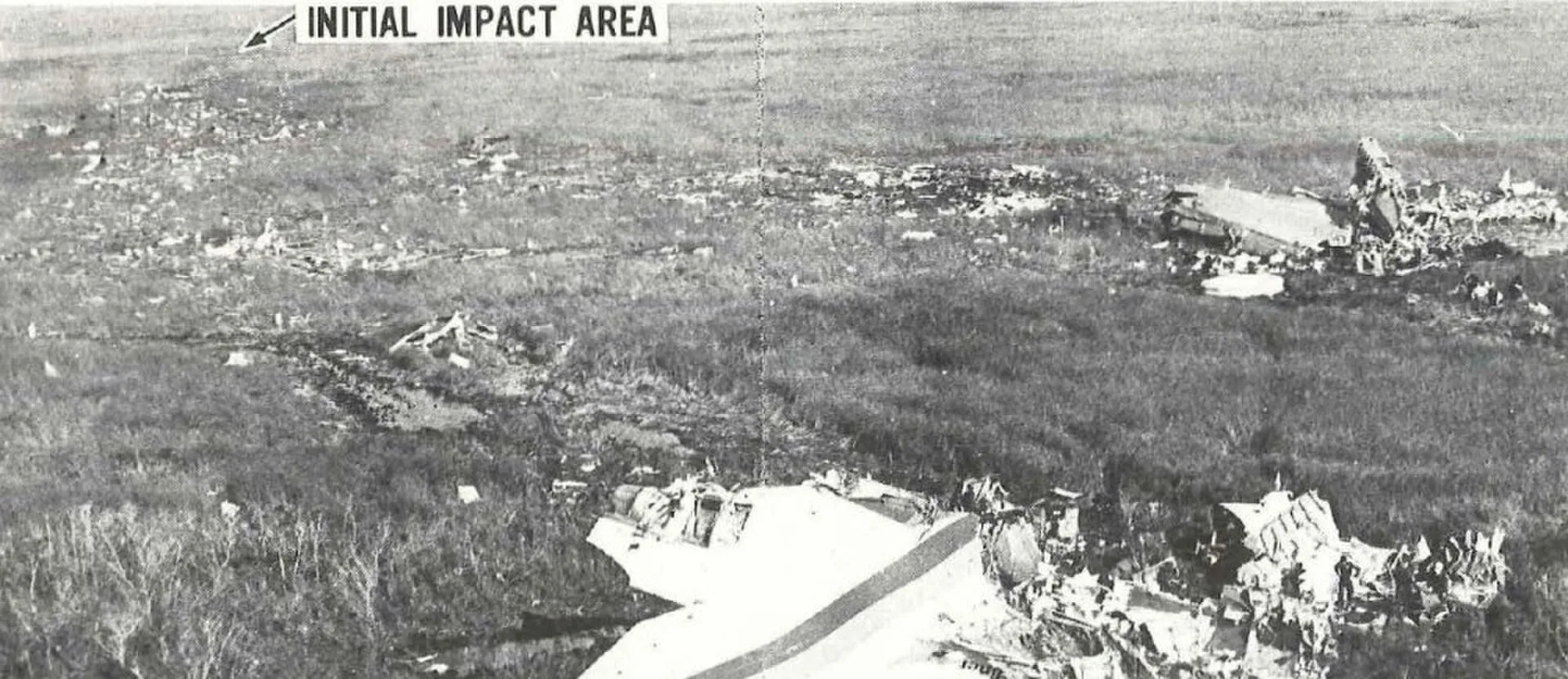
Loft had engaged the autopilot. At some point a push on the control column, probably Loft leaning on it as he turned to talk to Repo, dropped the autopilot out of altitude hold into a mode that simply kept whatever pitch the yoke was given, and the aircraft began a descent so gentle nobody felt it. A half-second altitude chime sounded at the flight engineer’s station, which was empty. Over black swamp there was nothing to see. Stockstill noticed the altimeter as they turned, said so, and seconds later, at 11:42 p.m., the TriStar hit the Everglades at about 227 miles an hour, 18.7 miles west-northwest of the airport. The wreckage broke up across the sawgrass. A frog hunter in an airboat, Robert Marquis, reached the site first and ferried survivors through the night. Ninety-four passengers and five crew died at the scene and two more later; 75 people lived. Loft died in the wreckage of the cockpit; Repo was pulled alive from the electronics bay and died in hospital the next day.
The NTSB report of June 1973 found that the bulb had simply burned out and that the crew had failed to watch their instruments for the last four minutes of the flight. The accident became a founding case for crew resource management training, and led to changes in autopilot warnings and cabin safety.
The investigation
The ghost stories were circulating among Eastern staff within a year or two. In outline: parts salvaged from N310EA, in particular a galley oven, had been fitted to other TriStars, above all N318EA, and on those aircraft Loft and Repo appeared. A captain found Loft sitting in first class before a flight, spoke to him, and watched him vanish. Repo’s face looked out of the oven door at a flight attendant on a trip to Mexico City and told the flight engineer to beware of fire; an engine later failed on the flight home. Repo told other engineers the pre-flight checks were already done. In 1976 John G. Fuller, a writer known for UFO books including the Betty and Barney Hill story, published The Ghost of Flight 401, which gathered these accounts, added his own Ouija-board sessions, and alleged that Eastern had torn pages from logbooks and quietly ordered the salvaged parts removed. The book sold widely and NBC broadcast a film of it in February 1978 with Ernest Borgnine as Repo.
Eastern’s response was blunt. Frank Borman, the former astronaut who ran the airline, called the stories garbage, and management warned staff that spreading them could cost their jobs. The company considered suing Fuller and decided a lawsuit would only sell books. Loft’s widow and children did sue, under a Florida statute against commercial use of a name, and lost in the Fourth District Court of Appeal in 1981, which treated the book as a non-fiction account of an investigation rather than an advertisement. Robert J. Serling, the aviation writer who published a history of Eastern in 1980, found employees who felt Fuller had misquoted or invented them, an airline search over several weeks that turned up no one who claimed to have seen a ghost, and no evidence that any part of the destroyed TriStar had been installed in another aircraft.
The explanations
Every witness in Fuller’s book is anonymous, on the stated ground that they feared reprisal, so none of the sightings can be checked. The one event that can be is the Mexico City emergency, which did happen and did involve an engine problem; Serling found that the Flight Safety Foundation’s newsletter had run a light-hearted item about it in which a pilot joked that the real scare was thinking Repo’s ghost was on board. A joke in a trade newsletter, passed through crew rooms where everyone had known the dead men, is a plausible seed for the whole legend. The salvaged parts, the logbooks and the cover-up are Fuller’s, and the first could not have happened: the airframe was wrecked and its remains were not returned to service.
Where it stands
Survivors and families still gather each December. The crash is one of the most thoroughly documented in American aviation, and the training it produced has saved more lives than it cost. The ghosts of Loft and Repo are a story about grief in a close-knit workforce, told well by a writer who wanted it to be true, and nothing more has ever been found.