
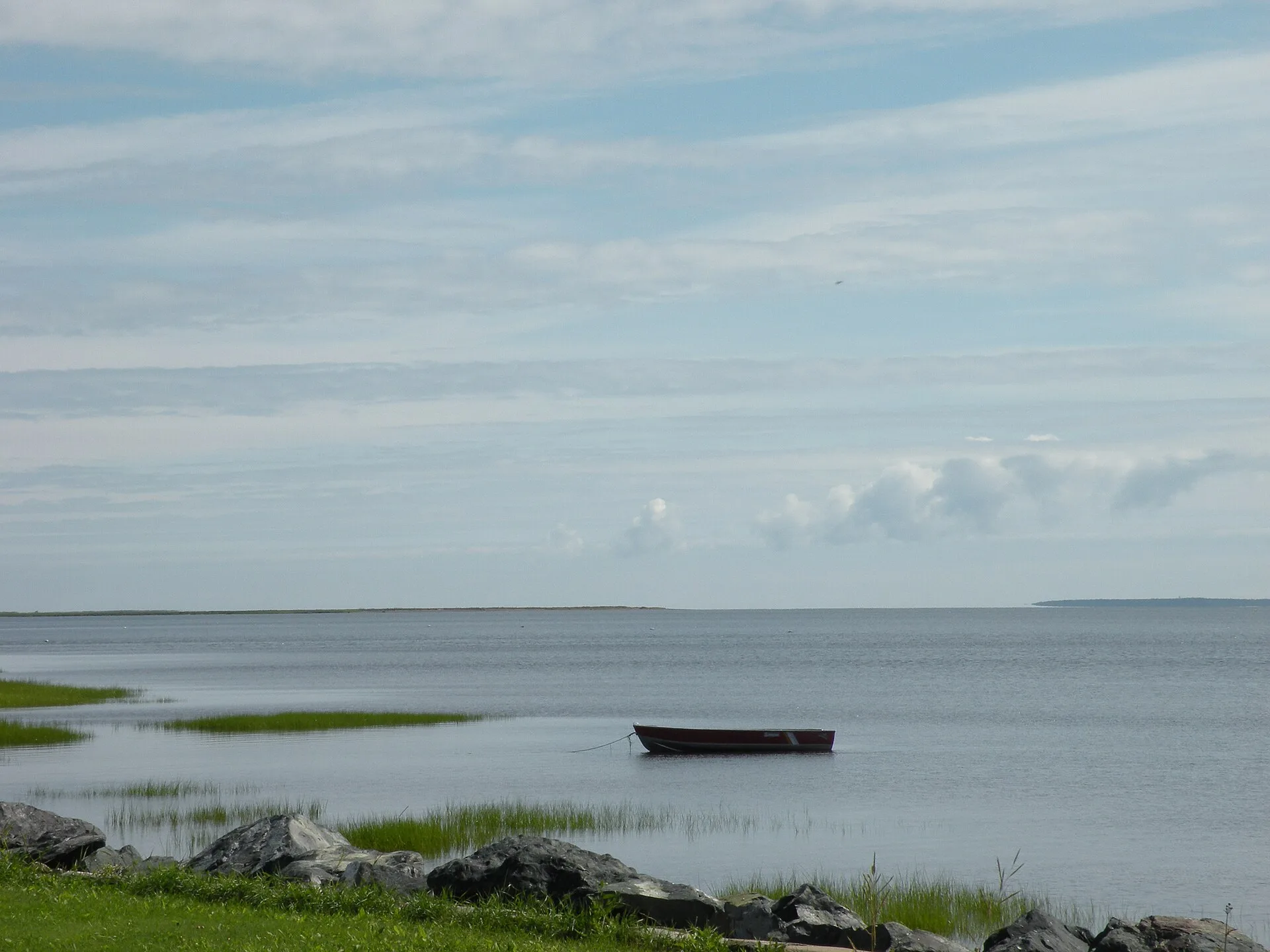
Chaleur Bay, or the Baie des Chaleurs, is the long inlet of the Gulf of St. Lawrence that separates the north shore of New Brunswick from the Gaspé coast of Quebec. Its southern shore runs past Dalhousie, Bathurst and the Acadian fishing town of Caraquet to Miscou Island at its mouth. For as long as anyone there can remember, people on both sides have told of a light on the water that looks, to some of them, like a ship on fire.
What people report
The classic description is of a three-masted sailing vessel blazing from deck to topmast, sometimes with dark figures climbing the burning rigging. Many witnesses describe something less shaped: a ball or mound of fire sitting on the water, glowing, flaring and fading, sometimes splitting into several columns of light and drawing back together. It has been reported in summer and over the winter ice, and it is said to move quickly and to keep its distance from anyone who approaches. In a 1951 article for Maclean’s, Ian Sclanders told how fishermen at Lamèque once crowded on sail in a dozen schooners to chase it across the bay to the Quebec shore and never gained on it.
Acadians call it le feu du mauvais temps, a name that records its oldest reputation as a warning of storms. The keeper of the Miscou light told Sclanders that it always did. Marie Allard of Pokemouche, who died at 104 and had been an early amateur photographer, tried for years to photograph it without success, and insisted it was a light rising from the water before a gale, not a ship at all.
The folklore
There are many ghost crews to choose from. Writers of the early 1900s tied the fire to a ship burned during an attack in the age of the Portuguese explorers. Newspaper accounts from 1969 mention a vessel wrecked near the mouth of the Restigouche with only two boys surviving, a warship set alight during the War of 1812, a lost immigrant ship bound for Quebec and a pleasure boat from the United States. On Lamèque and Miscou islands the light has been called the John Craig light, after a ship said to have sunk nearby some two centuries ago.
The investigation
The only serious inquiry came from William Francis Ganong, a New Brunswick-born botanist and historian who taught at Smith College in Massachusetts. In a note read to the Natural History Society of New Brunswick in 1905 and published the following year, he admitted that he had once dismissed the fire ship as pure invention. Two trips to the region changed his mind. Sea captains, fishermen and a lighthouse keeper described it to him: Robert Wilson of Miscou said he had passed within about a hundred yards of a glowing half-moon shape on the water, and James Harper saw a column of light rise and sink over the ice. Most residents said they had seen it at some time, though a few experienced sailors said they never had. J. Orne Green, a Harvard Medical School professor who spent several weeks on Miscou every year, told Ganong he had once seen a fire on the bay that he took for a forest fire until people in Caraquet told him it had moved; a gale followed the next day.
Ganong concluded that a real, physical light appears over the bay at all seasons, usually ahead of a storm, normally roughly dome-shaped but able to stretch into moving columns that could pass for flaming rigging. He suggested it was electrical, a kind of St. Elmo’s fire, while noting that a Harvard climatologist knew of no case anywhere that large. He ended by calling for proper study by a trained observer living on the coast. It never happened.
The explanations
St. Elmo’s fire has a problem: it normally clings to masts, steeples and other points and often crackles, while the Chaleur light appears over open water and is silent. Burning natural gas from the coal seams beneath the bay, whose lumps wash up on Miscou’s beaches, would still need something to ignite it. Phosphorescent sea life does not explain sightings over ice. In 1980 a Bathurst teacher, Kevin Mann Jr., photographed a triple red-orange glow off Youghall Beach and suggested a mirage over cold water as one possibility. None of these ideas has been tested on the bay itself.
Where it stands
Sightings have continued into recent decades. A family at Stonehaven watched the light for half an hour on the stormy night of September 9, 1969, and a couple at Janeville reported a glowing ship through binoculars in August 1998. Ganong’s century-old verdict is still the most careful one available: something real seems to shine on the bay from time to time, and local people have long linked it to bad weather. Without measurements, nobody can say what it is.