
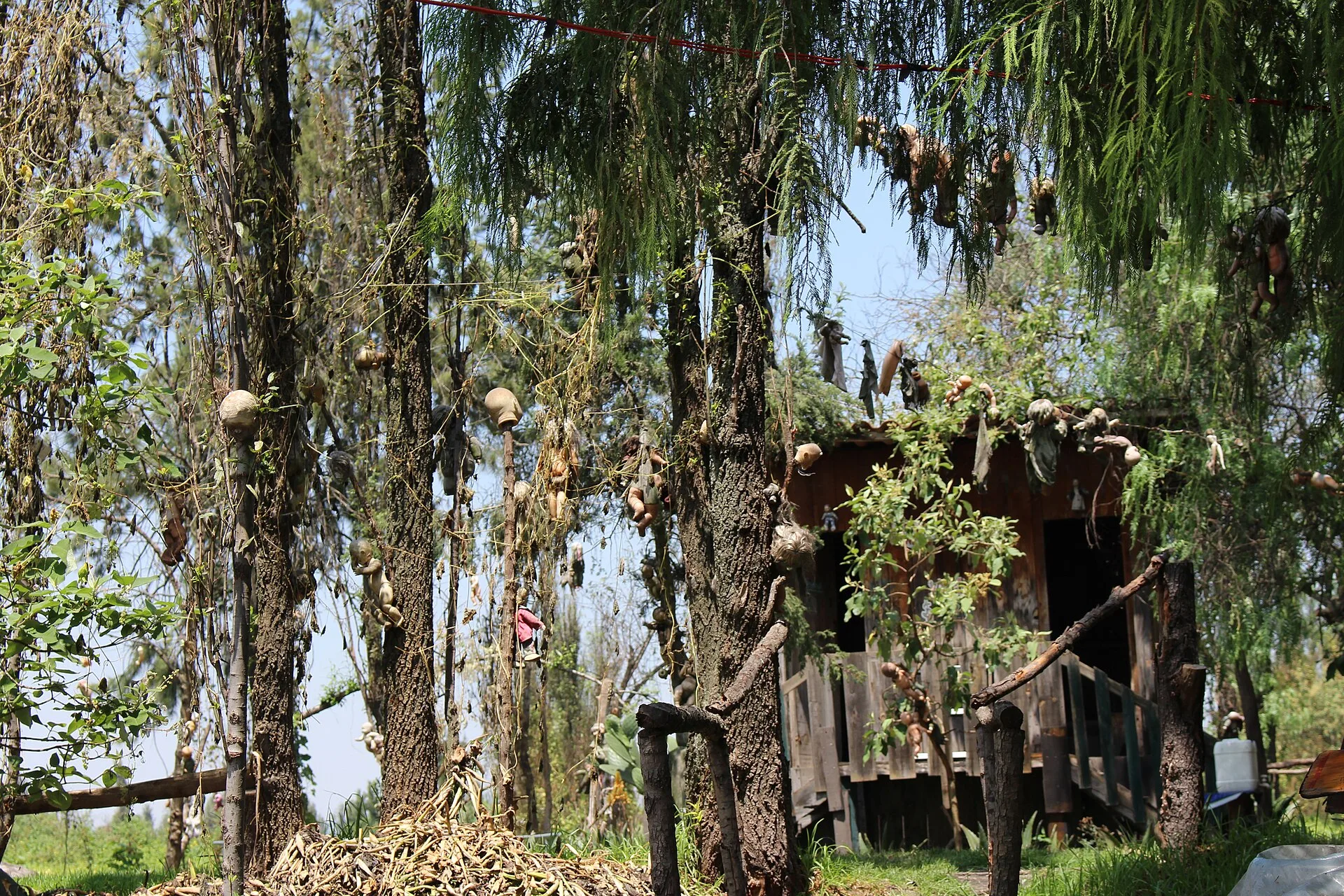
Xochimilco is the last surviving piece of the lake system on which Mexico City was built. Its canals wind between chinampas, rectangular plots of farmland raised out of the water on timber and roots, a technique that predates the Spanish conquest and earned the district a place on UNESCO’s World Heritage list in 1987. On one chinampa about 20 kilometers from the city center, the trees, fences and sheds are hung with dolls: hundreds visible from the water, thousands on the island itself, most of them sun-bleached, limbless or headless, and all of them left there on purpose.
What happened
The island belonged to Julián Santana Barrera, a farmer born in 1921 who, by the account of relatives and neighbors, settled alone on the plot in the 1950s. He was devout, solitary and, by most accounts, inclined to the mystical. The story he told was that a young girl had drowned in the canal beside his land after falling from a passing boat and getting caught in the water lilies, and that he had been unable to save her. Soon afterward he found a doll floating in the same spot. He hung it in a tree as a mark of respect, and because he believed the girl’s spirit was unquiet.
One doll became a lifetime’s work. He fished dolls out of the canals, pulled them from rubbish dumps and traded vegetables for them, and when his crops failed he hung more, reasoning that the spirit wanted appeasing. He gave the first doll a place of honor in his hut and named a favorite, Agustina. By the 1990s journalists and curious boatmen were finding their way to the island, and he received them without fuss and told the story the same way each time.
In 2001, at about 80, he died on the island. Accounts differ: some say he was found face down in the canal, close to where he said the girl had drowned; others say he had a heart attack. The symmetry was irresistible, and the legend grew from there.
The investigation
No one has ever investigated the island in any formal sense; there is nothing to investigate except a story. What can be checked is thin. No newspaper report, parish record or police file for a drowned girl at that spot has been produced, and even the website run for visitors acknowledges that the girl’s existence is questioned and that some conclude Julián invented her in his solitude. Guinness World Records, which certified the island in October 2022 as holding the world’s largest collection of haunted dolls, was careful to say that the record counted dolls, not ghosts, and that the haunting could not be proven. The island’s current administrator puts the number at more than 4,500.
The explanations
The simplest account is that a lonely, religious man made sense of a frightening memory, or an imagined one, with the materials to hand, and kept doing so for half a century until the habit became a landscape. Dolls left out in sun and rain crack, discolor, lose their eyes and become home to insects and spiders; the effect is unsettling by design of weather rather than of anyone’s intent. Reports that the dolls turn their heads, open their eyes or whisper are the kind that people have always made about faces in the dark, and the boatmen who refuse to moor there are keeping a tradition as much as a fear.
There is also an economy around the story. The island is reached only by trajinera, the painted flat-bottomed boats of Xochimilco, from the Cuemanco and Nativitas landings, and the family that took it over after Julián’s death charges a small entry fee. At least four imitation doll islands have appeared along the same canals, and guides are careful to point out which one is the original. Visitors are encouraged to bring a doll, so the collection keeps growing. The filmmaker Tim Burton visited and is said to have left a doll; a Lady Gaga video directed by Burton was shot there.
Where it stands
The Island of the Dolls is a genuine place and, in its way, a genuine folk shrine: candles and religious objects are still left for the girl, and some visitors ask the dolls for favors. As a haunting it rests entirely on one man’s testimony about an event nobody else recorded, which is the definition of a legend. It remains one of the most visited spots in the Xochimilco canals and, for many people, the most frightening.