
Readers of Washington Irving’s “The Legend of Sleepy Hollow” remember the Headless Horseman. Fewer notice that the story’s most frightening landmark is a real one. The enormous tulip tree that Ichabod Crane has to pass on his ride home, the one the common people treat with respect and superstition, is named in the text as Major André’s tree, and the brook beyond it is the spot where André was captured. Irving was drawing on a true story from 1780 that was still raw in Tarrytown when he wrote in 1820, and on ghost talk that had grown up around it in the forty years between.
What happened
John André was born in London on May 2, 1750 to a Huguenot merchant family, educated in Geneva, and bought a commission in the British Army in January 1771. Taken prisoner early in the war and exchanged in 1776, he rose quickly: by 1779 he was adjutant general to Sir Henry Clinton in New York with the rank of major. In that post he handled the secret correspondence with the American general Benedict Arnold, who was offering to hand over the fortress at West Point.
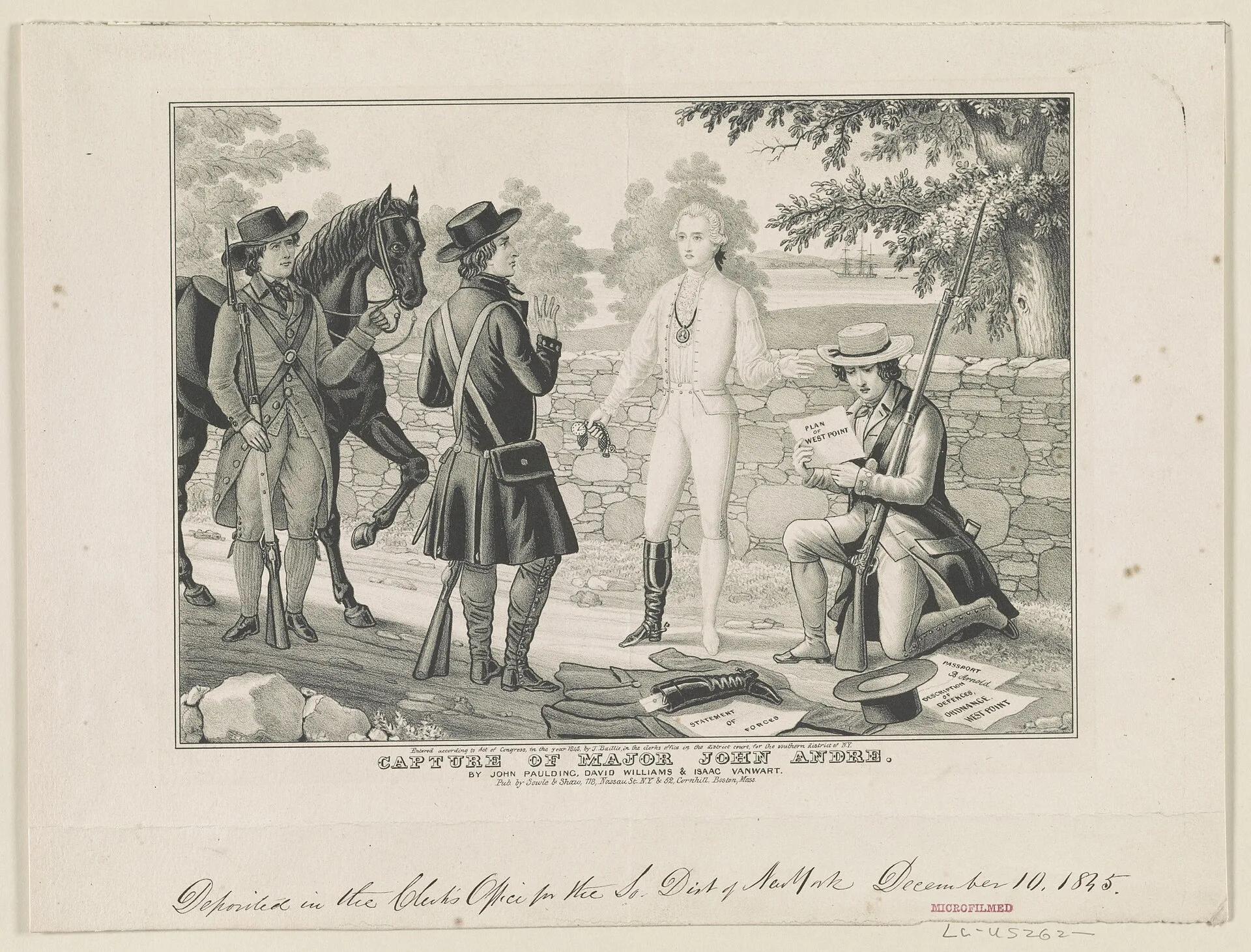
In September 1780 André went up the Hudson to settle the terms in person. The meeting ran long, his ship was driven off, and he had to return overland in civilian clothes and under the name John Anderson, which Clinton had told him never to do. At about nine on the morning of September 23 three militiamen, John Paulding, David Williams and Isaac Van Wart, stopped him on the road near Tarrytown. Mistaking one of them for a loyalist in a Hessian coat, André said he was a British officer. The papers in his boot described West Point’s defenses. A note sent to Arnold by the officer who took charge of the prisoner reached the traitor in time for him to escape to a British ship.
George Washington convened a board of officers at Tappan, on the west bank of the Hudson. It found that André had acted as a spy and should die. Clinton sent a delegation under a flag of truce to argue for his life and the British were offered a trade for Arnold, which they refused. Alexander Hamilton pressed for a soldier’s death by firing squad; Washington would not allow it, because a spy’s death had to be a hanging. André was hanged at Tappan on October 2, 1780, aged 29, and buried under the gallows. A British captain’s journal records that the army learned of his death four days later and that he had asked only that his commission be sold for his sisters.
The investigation
André’s conduct won him sympathy on both sides. George III paid for a monument in Westminster Abbey in 1782, and in 1821 the British consul in New York had the remains dug up at Tappan and shipped to London, where they were reburied beside the monument on November 28. A peach tree planted on the grave, said to have grown from fruit given to him on the way to the gallows, had pushed its roots through the coffin. A granite monument erected in 1879 by the financier Cyrus Field now marks the hanging site on André Hill in Tappan; it was so unpopular locally that there were three attempts to blow it up.
The explanations
The ghost belongs to Tarrytown. In his 1897 “Chronicles of Tarrytown and Sleepy Hollow,” the local historian Edgar Mayhew Bacon set down the tradition as the old people told it. On still autumn nights travelers on the post road heard a horse galloping toward them at full speed with no horse or rider to be seen; some heard the word “halt” spoken in a soldier’s voice; and the hoofbeats always stopped as though reined in, and were never heard south of the great tulip tree. Bacon, writing tongue in cheek, claimed the ghost had been heard within his own decade and that he was among the witnesses. He also recorded the tale that when news of Arnold’s death in England reached the village in 1801, a storm broke and a bolt of lightning split the tree from top to bottom.
Irving had used all of this a lifetime earlier. The guests at the Van Tassel party tell dismal tales of funeral trains and wailing heard about the tree; Ichabod sees a white scar on the trunk where lightning struck it; and the brook under the chestnuts is called a haunted stream precisely because the militiamen hid there to surprise André. Irving’s version is the one that spread, so that the ghost of a hanged spy ended up as supporting cast in a story about a headless Hessian.
Where it stands
The capture, the trial and the hanging are among the best documented events of the war; the ghost is documented only as something people said. A later tulip poplar stood for more than two centuries in Patriots’ Park, where the capture is commemorated, until it died; in October 2019 Tarrytown’s historical society and village planted a replacement and dedicated it to Paulding, Williams and Van Wart. The galloping hoofbeats have not been reported in living memory, but the tree, the brook and the road are all still there, and so is the book that made them famous.