
What happened
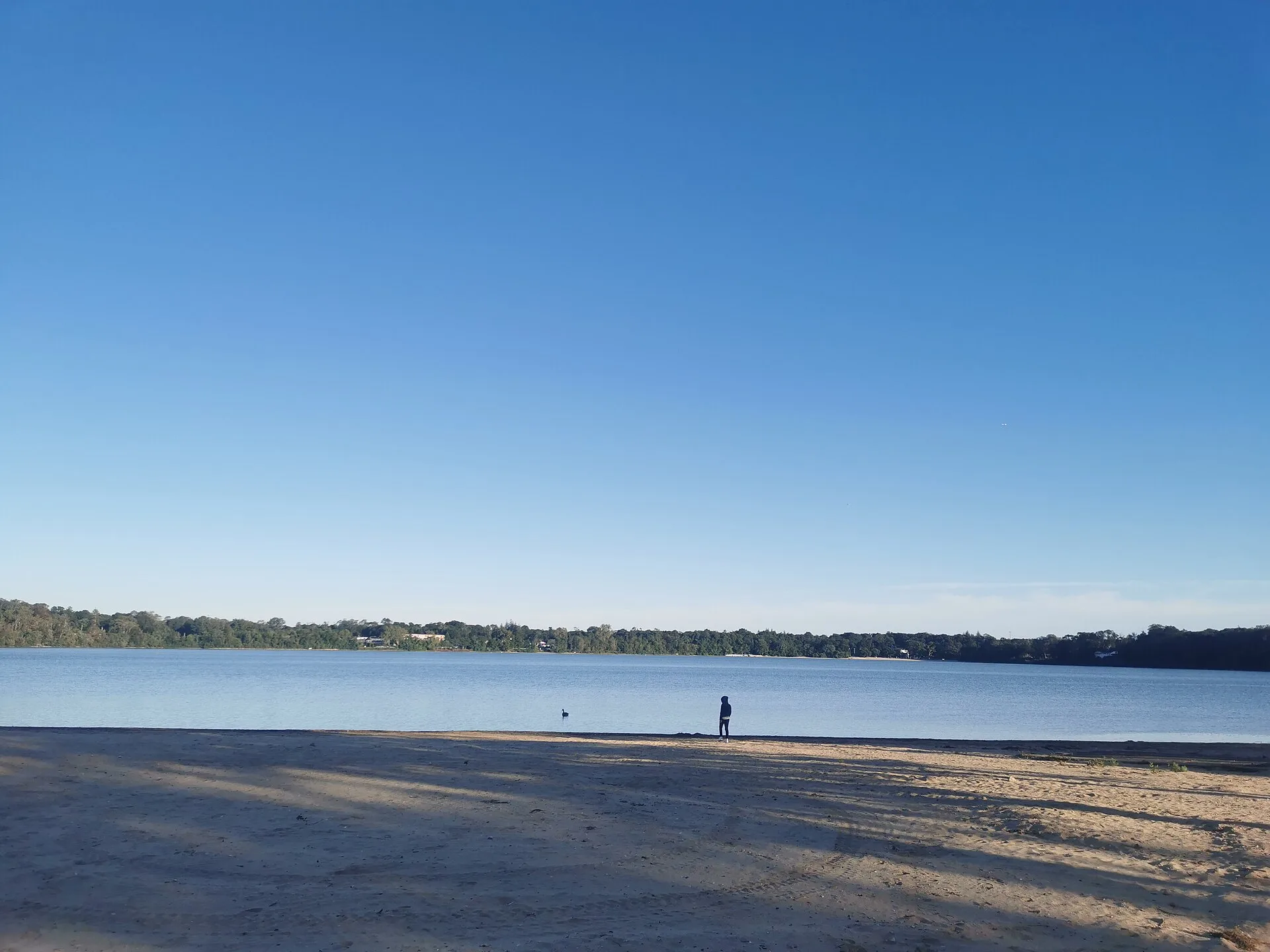
Lake Ronkonkoma lies at the center of Long Island where the towns of Islip, Brookhaven and Smithtown meet, a round sheet of water about two miles around and 243 acres in area. It is a kettle hole: when the last ice sheet retreated from the island it left a block of ice buried in its own debris, and the hollow that formed when the block melted filled with groundwater. No stream feeds the lake and none leaves it, so its level rises and falls with the water table beneath the island. Most of it is less than 15 feet deep, but a hole off the southwest shore drops to about 65 feet; a survey by three local men in 1875 found 72 feet there, which the state conservation authorities considered remarkable for a lake whose surface sits only about 60 feet above the sea. The name is Algonquian and is usually translated as boundary fishing place, because the shoreline was divided between three Native communities who sold it in separate deeds, which is why three towns still share it.
The lake was a summer resort from the 1890s, with hotels, boarding houses and bathing pavilions along the shore and a railroad station nearby, and it was a place where a great many people swam. The deep hole begins close to the beach, and bathers walked out on a shelf and stepped off it. Ropes were eventually strung to mark the drop. The lake has been drowning people for as long as records exist. The chair of the local historic commission has documented 126 deaths from the late 1700s through 2022. Dr David Igneri, head lifeguard for 32 summers, counted 160 drownings from the 1800s to 1970 in his book on the lake and said he had witnessed 30 himself, every one a male. The historian Dale Spencer puts the figure at 166 men since 1893. Suffolk County police records, which begin in 1995, show five.
The investigation
The story that explains the deaths is the Lady of the Lake. In its most common form a Setauket woman, called Princess Ronkonkoma or Tuskawanta, loved a settler named Hugh Birdsall in the mid-1600s; her father forbade the match; she sent messages on bark across the water for seven years, and when none were answered she paddled to the middle of the lake and either stabbed herself or drowned. Other tellings have her betrothed murdered by a settler, her body surfacing in Connecticut, or a maiden sacrificed to a god. In all of them she takes one young man each year, pulling him down to be with her. The lake was long said to be bottomless and linked by underground channels to the Great South Bay or Long Island Sound; weighted lines that never found bottom, a wagon that vanished in the lake and turned up in the bay, and a murdered bootlegger from Long Island Sound whose body surfaced on the lakeshore in the 1930s were all cited as proof. Suffolk County’s historical society notes that the lake was regarded as sacred by the island’s Native people and treats the princess as an urban legend. A version appears in Verne Dyson’s 1967 collection of Long Island Indian stories, and the tale has been revived in a 32-foot carved statue, a mural, a psychological thriller and a 2016 Legends and Lore marker on Lake Shore Road, put up by the William G. Pomeroy Foundation at the request of the Lake Ronkonkoma Heritage Association.
The explanations
Spencer has said flatly that there is no verifiable evidence the princess existed, and another local historian, Evelyn Bozler, calls it just a story. The men who drowned need no curse. For most of the twentieth century the lake was a crowded, cheap, unguarded resort visited mainly by young men who swam hard, drank and could not always swim, over a sudden drop into cold, dark, oxygen-poor water where a body can stay down for days. That is the profile of drowning victims everywhere, and the odd male skew in the local count reflects who was in the water. Divers have mapped the bottom; the depth is unusual for Long Island but ordinary for a kettle hole; and nothing travels underground from Ronkonkoma to the sea except groundwater.
Where it stands
The lake is now ringed by town beaches and a park, the resorts are gone and swimming is supervised, which is why the police count is so low. The Lady of the Lake belongs with the island’s other borrowed-Indian romances of the nineteenth century, an invented tragedy that gave a frightening place a reason. The drownings were real, and so is the hole.