
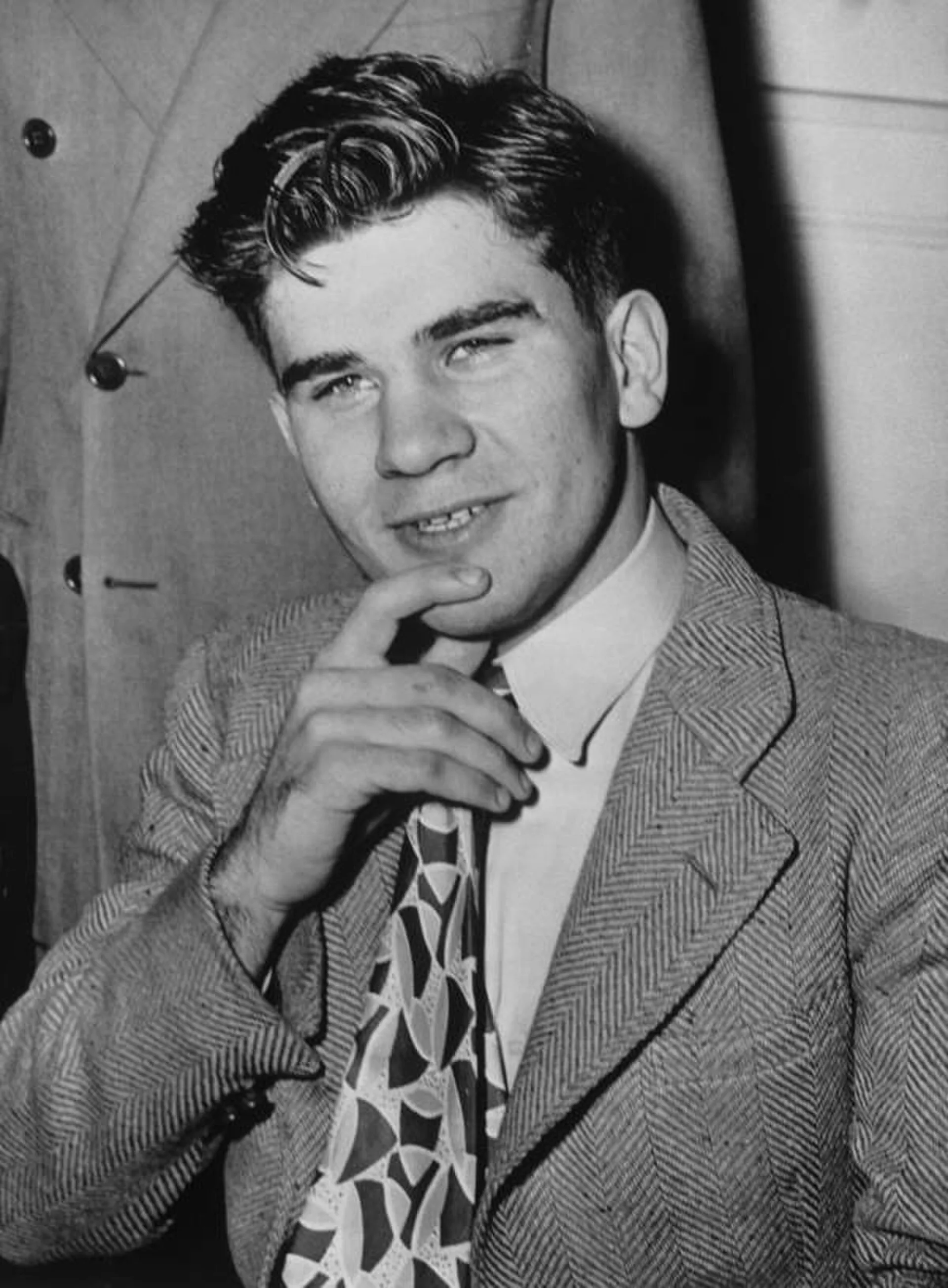
Chicago at the end of the Second World War was a city of crowded apartment blocks and a police force under pressure, and the three killings that came to be called the Lipstick Murders frightened it as few crimes have. The man convicted of them was a teenager. Whether he did them is still argued.
What happened
On June 5, 1945 Josephine Ross, 43, was found dead in her North Side apartment, stabbed repeatedly, her head wrapped in a dress and dark hairs in her hand. On December 10 Frances Brown, in her early thirties, was found in her apartment with her pajamas wrapped around her head, a knife through her neck and a bullet wound in her skull. A bloody fingerprint was on the door jamb. On the wall, in lipstick, the killer had written: “For heaven’s sake catch me before I kill more. I cannot control myself.” Then, on the night of January 7, 1946, six-year-old Suzanne Degnan was taken from her bedroom in Edgewater. A note demanded $20,000. Her head, torso and legs were recovered from sewers over the following days; her arms a month later.
On June 26, 1946 an off-duty officer caught William Heirens, 17, burgling an apartment in Rogers Park and stopped him with a flowerpot to the head. Heirens, a University of Chicago student, had a record of break-ins. His dormitory room held stolen goods and two surgical kits. He was questioned for days while recovering in hospital. Newspapers reported that he was given sodium pentothal; he was also given a spinal tap without anaesthetic, and a polygraph that officials called inconclusive. Under the drug he was said to have blamed a friend called George Murman, which the press turned into Murder Man; Heirens later said police supplied the name. The transcript of the interrogation was lost before trial.
Police announced that a print from the ransom note matched his left little finger on nine points, short of the FBI’s twelve-point standard; a palm print was said to match on ten, later twelve. The bloody print from the Brown door jamb, first reported as not his, was later declared a 22-point match. The Chicago Tribune printed a detailed account of the murders as his confession before he had confessed to anything. His lawyers urged a plea: a minor could be spared the electric chair. At a first attempt on July 30 he refused, saying he knew only what the police had told him. On September 4, 1946 he pleaded guilty to the three murders and 26 burglaries, and the next day received three life terms. He said afterward that he had confessed to save his life.
The investigation
The case began to come apart almost at once. The handwriting expert Herbert Walker, who had tied Heirens’s printing to the lipstick message and the ransom note, recanted in January 1947, finding more differences than similarities; an FBI analyst who re-examined the samples in 1996 found that Heirens had written neither. The fingerprints have been attacked for their late discovery, their chain of custody, and the fact that the door-jamb print looked rolled, like one taken for a police card. On the day Heirens was arrested, Richard Russell Thomas, a nurse jailed in Arizona who had been in Chicago at the time, confessed to the Degnan murder; he recanted after Heirens was charged and died in prison in 1974. The author Dolores Kennedy, whose 1987 book argued his innocence, believes Thomas was the killer.
None of this moved the courts or the Illinois Prisoner Review Board. He was paroled on the Degnan sentence in 1965 but held on the others; a federal order for his release in 1983 was reversed on appeal. In April 1988 the board refused him for the 28th time, with the Cook County State’s Attorney, Richard M. Daley, calling his innocence claims ridiculous and citing the prints, the handwriting, the loot and a full confession. A clemency petition failed in 2002. In August 2007, at 78 and in a wheelchair after 61 years inside, he was refused 14 to 0; the board’s chairman, Jorge Montes, said its job was not to retry cases.
The explanations
Two readings fit the record. In one, Heirens was a compulsive burglar whose break-ins turned violent, caught with stolen property and surgical instruments, whose prints were at two scenes and who confessed in open court. In the other, a frightened boy was worked over for days by police who needed a killer, matched to prints that did not meet the standard, convicted by newspapers before trial, and trapped by the plea that saved him from execution. The Illinois Supreme Court later condemned the handling of his interrogation as a flagrant violation of his rights while leaving the conviction standing.
Heirens earned a bachelor’s degree in 1972, the first Illinois prisoner to do so. He was found unresponsive in his cell at Dixon Correctional Center and died in a Chicago hospital on March 5, 2012, aged 83, after 65 years in custody, the longest in the state’s history.
Where it stands
The conviction was never overturned, and no court has reopened the case. The three murders are solved on paper and unresolved in fact: a guilty plea obtained under duress, physical evidence that has been argued both ways for seventy years, and a confessed alternative suspect nobody pursued. What Chicago has is a verdict, not an answer.