
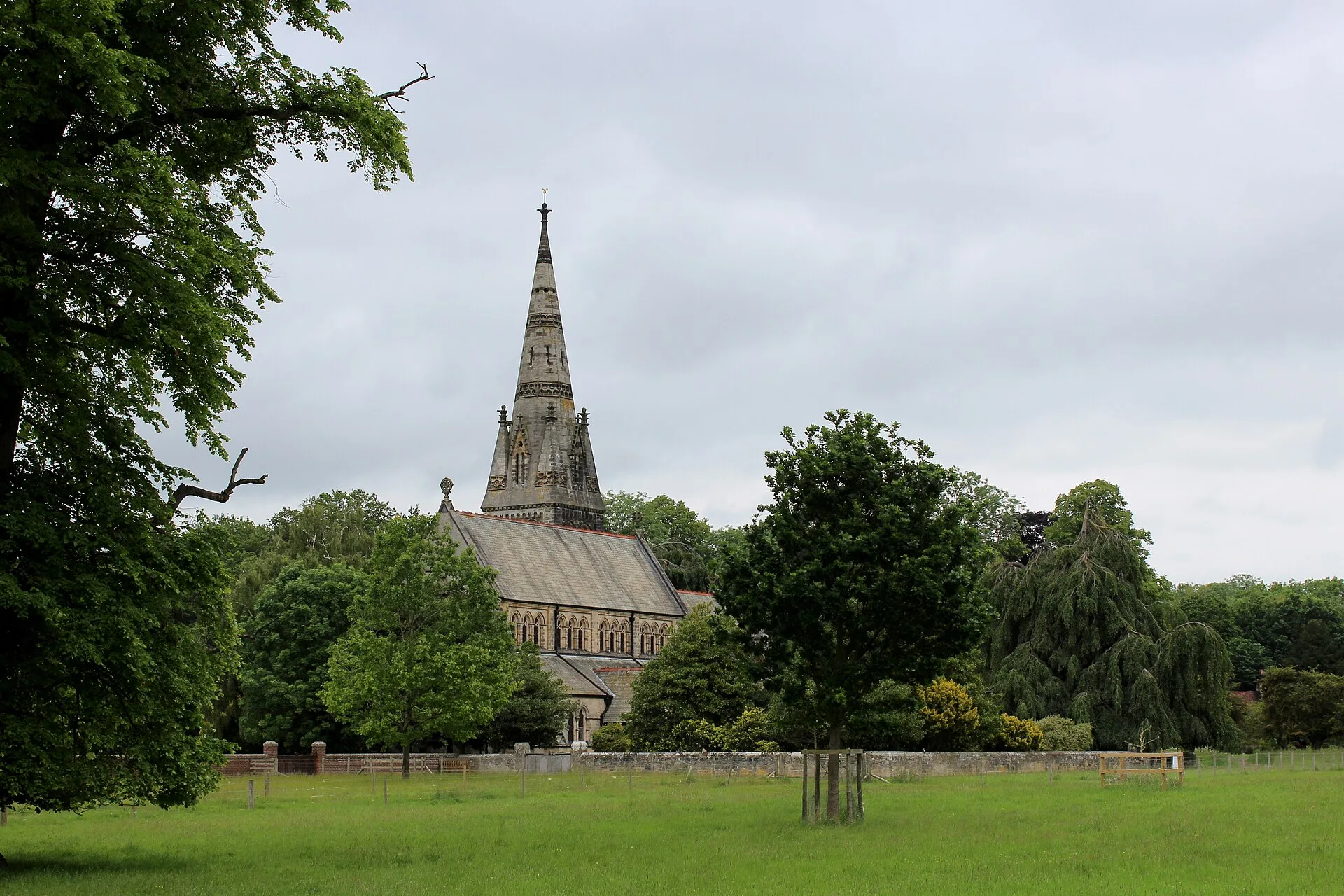
The Church of Christ the Consoler stands in the park of Newby Hall at Skelton-on-Ure, a few miles southeast of Ripon in North Yorkshire. It was built between 1871 and 1876 to designs by William Burges for Lady Mary Vyner, whose son Frederick had been kidnapped by brigands in Greece in April 1870 and killed when a rescue went wrong; the ransom money that was never paid went into two memorial churches, this one and another at Studley Royal. It is listed Grade I, was closed for regular worship in 1991 and is now cared for by the Churches Conservation Trust. It is also the setting for one of Britain’s best-known ghost photographs.
What happened
The vicar, the Reverend Kenneth F. Lord, was a keen amateur photographer with his own darkroom. On an afternoon usually given as 1963 he set up his camera, a Rolleicord twin-lens reflex, to photograph the interior looking toward the altar, with the church, by his account, empty. When he developed and printed the film he found a tall figure standing on the altar steps to the left: a cowled, robed shape, its face hidden behind a pale cloth with dark eyeholes, its hands apparently folded and its feet lost in the shadow at the base of the steps. Lord said the figure had not been there when he took the picture.
The photograph reached print on August 13, 1967, in the Sunday People, which asked whether the vicar had snapped a ghost. In that interview Lord put the date seven years back, which would make it about 1960, and said he had no interest in spiritualism or ghost-hunting and was frankly skeptical of his own picture. A laboratory had told him the negative showed no emulsion or processing fault. The 1963 date that now attaches to the image has no primary source behind it.
The investigation
There has never been a formal examination. Claims that BBC experts studied the negative in the 1970s or 1980s and ruled out double exposure appear in many retellings but in no published report. The figure’s height, often quoted as eight or nine feet, is an estimate from its position relative to the altar; since the feet are not visible, a person standing on the step or on a box would fill the same space. Janet Bord’s 1974 book Ghosts reproduced the picture and helped fix it in the canon, and it has appeared in newspaper round-ups of famous ghost photographs ever since.
A 2026 discussion on the Metabunk forum went back to the 1967 article and noted two things. First, the newspaper’s own suggested method, a long exposure at a small aperture in a dim church with a cloaked figure posed for part of it, would produce exactly this semi-transparent, slightly blurred result. Second, the article’s assurance that a device on the camera prevented double exposure does not hold, since the Rolleicord model concerned could be made to expose a frame twice. Either way the mechanics are simple: an empty church on a tripod, then a draped hood and robe on a stand, photographed onto the same negative or during the same open shutter.
The explanations
The popular reading makes the figure a sixteenth-century monk whose face was veiled because of leprosy or disfigurement. The church was built in the 1870s on an estate with no monastic history, and the white face-covering, with its cut eyeholes, looks less like any medieval habit than a pillowcase, as the Mysterious Britain gazetteer put it. The skeptical reading is that Lord, or someone with access to his camera and darkroom, made the image deliberately, as a joke or a technical exercise. Lord’s own public position, that he did not know what it was and did not believe in ghosts, sits awkwardly with both camps and has kept the picture alive.
Where it stands
The negative has never been published for independent study. The image survives as a staple of ghost books and websites, and the church, with the altar steps on which the figure stood, is open to visitors through the Churches Conservation Trust. As a haunting it has one witness who declined to vouch for it; as a photograph it is a good example of how an interrupted exposure makes a ghost.