
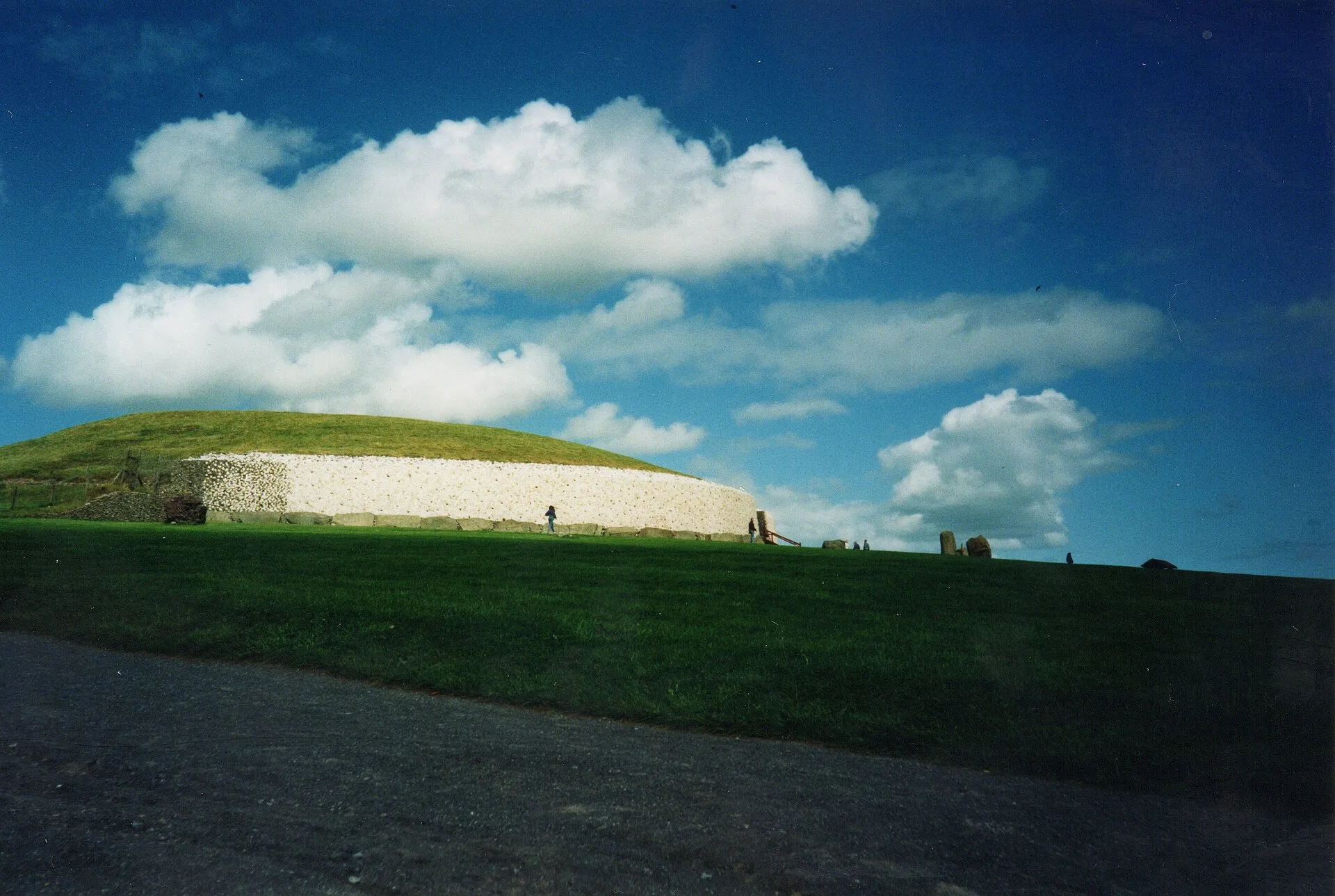
In a loop of the River Boyne in County Meath, about forty kilometers north of Dublin, a broad grassy mound sits on a ridge facing south across the river. Its base is wrapped in a ring of large kerbstones and its front is faced with a glittering wall of white quartz. This is Newgrange, the best known of the three giant passage tombs of Brú na Bóinne, alongside Knowth and Dowth. The Office of Public Works dates all three to around 3200 BC, which makes Newgrange older than the great pyramids of Giza and the stone circle at Stonehenge as it stands today.
What happened
Inside the mound a narrow stone passage climbs gently toward a cross-shaped chamber roofed with overlapping slabs that have kept the interior dry for some five thousand years. The entrance is marked by a kerbstone carved with spirals, and directly above the doorway is a second, smaller opening that archaeologists call the roof box. For a few mornings either side of the winter solstice, roughly 19 to December 23, the rising sun lines up with that slot. If the sky is clear, a beam slides up the passage and lights the chamber floor for something over a quarter of an hour before narrowing and fading.
The modern discovery of that event belongs to Michael J. O’Kelly, who led the state excavation of the monument from 1962. On the solstice of 1967 he was inside the chamber to watch the light arrive, a moment that turned Newgrange into one of the most famous sites in the study of ancient astronomy. Each December since, crowds have gathered outside in the dark, and a lucky few wait inside.
The investigation
O’Kelly’s project was a reconstruction as much as a dig. According to Ireland’s World Heritage office, the stones lining the passage had been pushed out of true over the centuries, so the passage roof was taken apart entirely, the uprights were set straight with modern reinforcement, and a protective cowl was built over the chamber. The curb and the retaining wall at the front were also rebuilt from the stones found fallen around the base. The roof box was dismantled and put back as part of that work.
That process is the source of the modern doubt. In 2016 the archaeologist Michael Gibbons co-wrote a paper in the journal Emania arguing that the roof box had no claim to be original and that the solstice spectacle was effectively a fifty-year-old creation of the restoration. He also argued that people in the Iron Age had reshaped the monument, so it was not the untouched Neolithic tomb O’Kelly described. The author of a 2015 book on the origins of the tomb told the Irish press that this was simply wrong, pointing to other studies that put the structure at about 5,000 years old.
The explanations
The strongest answer to the fabrication charge has come from the excavation archive itself. The photographer and researcher Ken Williams, going through the National Monuments Service’s photographs and drawings, found images showing a block of quartz sitting inside the roof box before it was dismantled, exactly as the excavation report had said. O’Kelly had noted scratch marks on the slab beneath the block, suggesting it had been slid in and out many times, as if the opening were deliberately closed and reopened. The decorated lintel over the roof box was described by Sir William Wilde in 1850 and appears in photographs from the 1880s onward, long before any modern rebuild. A gap above the door was therefore real; what remains open to argument is how precisely its 1960s reassembly reproduces the angle the builders intended.
Where it stands
Newgrange keeps producing surprises. During the drought of July 2018, Anthony Murphy and Ken Williams flew drones over a parched field nearby and saw the outline of a previously unknown henge picked out in the crop, perhaps 4,500 years old, which the National Monuments Service agreed was significant. In 2020 a team publishing in Nature reported that a man whose remains lay in the most elaborate recess of the chamber was the child of a union between first-degree relatives, and argued this pointed to a ruling dynasty behind the great tombs; other scholars have questioned that reading. Most archaeologists accept that the solstice alignment was intended. How the people who built Newgrange understood it, and how closely today’s light show matches theirs, has not been settled.