
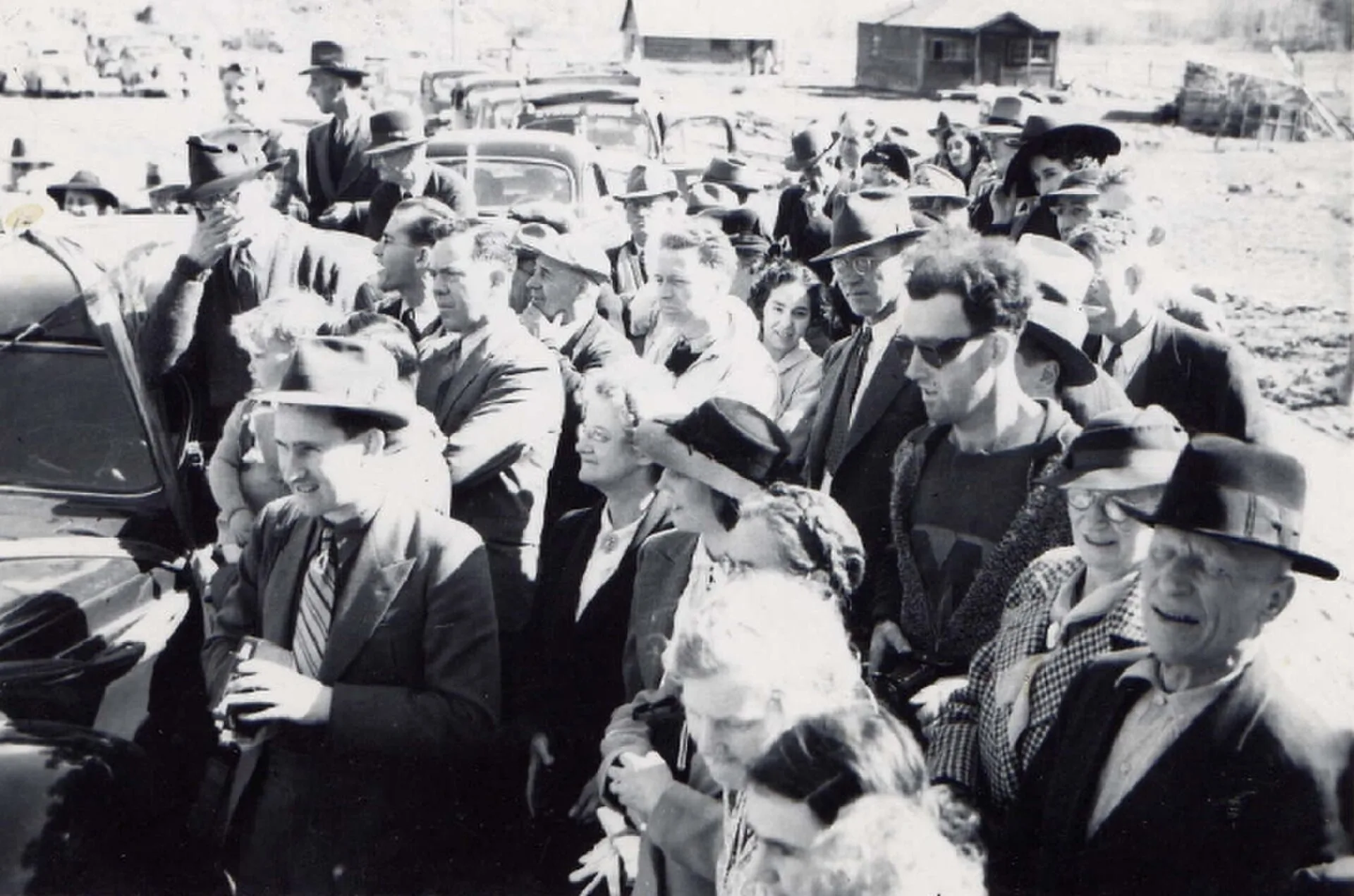
Bralorne and Gold Bridge sit in the Bridge River Valley of British Columbia’s Coast Mountains, about five hours northeast of Vancouver by road. In the 1930s and 1940s the valley held the richest gold mines in the province, and the Bralorne Pioneer Museum keeps the photographs of those towns. One of them, a view of a crowd gathered on a timber bridge, has become the most famous image in its collection for a reason the museum never intended.
What happened
The print shows the reopening of the South Fork Bridge near Gold Bridge after the original span was washed out by flooding in November 1940; a note on the back dates it, with a question mark, to 1941. Several dozen people line the deck in overcoats, fedoras and work clothes. Near the right-hand side stands a man who looks nothing like his neighbors: dark glasses that wrap around his face, a loose knitted top with a large letter on the chest, hair cropped short, and what appears to be a small camera held at his waist.
The museum included the photograph in a 2004 exhibit called Bralorne-Pioneer: Their Past Lives Here, and the exhibit was digitised and put online through the Virtual Museum of Canada, where it was still available in early 2010. On March 22, 2010 someone posted the image to the forums Fark and AboveTopSecret; on April 15 the Brazilian blog Forgetomori wrote it up; Boing Boing followed on April 16 and Gizmodo the day after. Within a week the “time-traveling hipster” was a meme.
The investigation
The first question was whether the image had been altered. It had not. The print existed in the museum long before the internet took an interest, and in December 2010 two journalists from the Russian network NTV traveled to the valley, examined the original with museum staff and reported that it was authentic. A second photograph of the same ceremony, taken from another angle and held in the John Wihksne Collection, surfaced in April 2010 and shows the same gathering.
The second question was the man’s kit, and Snopes’s Dan Evon set it out in 2015. Sunglasses with protective side shields, made for glare and dust, were on sale in the 1940s and were an unusual but available choice in 1941. The “printed T-shirt” is a knitted sweater with a sewn-on emblem, and the emblem’s letter M matches the crest of the Montreal Maroons, a National Hockey League club that played from 1924 to 1938. The camera is consistent with the folding and compact Kodaks sold before the war; Kodak had several pocket-sized models on the market in 1941. Nothing on him is out of its time.
The explanations
What made the man look modern was contrast rather than content. Nearly everyone else in the frame dressed formally for a civic occasion, in hats and long coats, while he turned up in a sports sweater and sunglasses, the 1941 equivalent of a hoodie at a ribbon-cutting. The grain of the print flattens the texture of his sweater into something like a printed shirt, and the sunglasses hide the eyes that would otherwise place him. Viewers in 2010 read the combination through their own fashions, which is how a hockey fan became a visitor from the future.
Where it stands
Nobody has identified the man. The museum in Bralorne still holds the print, the Community Stories exhibit remains online, and the image sits in Wikimedia Commons as a public-domain Canadian photograph. The case is a useful lesson in how an ordinary picture becomes an anomaly: not through anything in the photograph, but through what the people looking at it expect to see.