
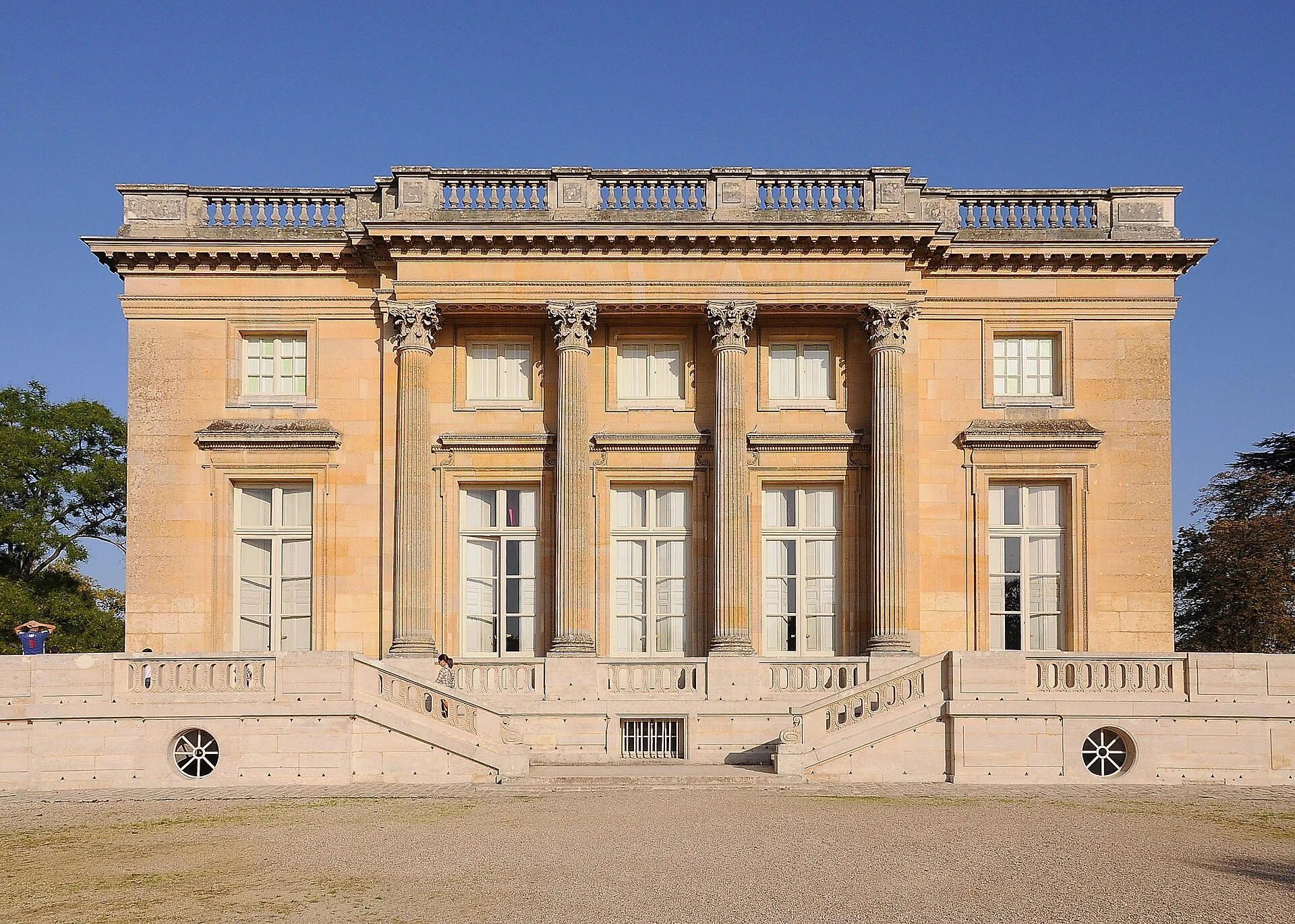
In August 1901 two Englishwomen on holiday in Paris spent an afternoon at Versailles, got lost on the way to the Petit Trianon, and came home with what became the most famous claim of a trip into the past. Charlotte Anne Moberly was the first principal of St Hugh’s College, Oxford, and the daughter of a bishop. Eleanor Jourdain, the daughter of a Derbyshire vicar, was being considered as her deputy; she later succeeded her as principal. The trip was partly a chance for the two to get to know each other.
What happened
On August 10, unimpressed by the palace, they walked out across the park toward the Petit Trianon, the small château that Louis XVI had given to Marie Antoinette. Somewhere past the Grand Trianon they took a lane instead of the main drive. Moberly noticed a woman shaking a white cloth from a window; Jourdain saw farm buildings and an old plow. Two men in long gray-green coats and three-cornered hats, whom they took for gardeners, sent them straight on. Jourdain saw a woman handing a jug to a girl at a cottage door.
In a wood they came to a round garden kiosk where a cloaked man with a pockmarked face sat. Both later described a sudden heaviness: the trees looked flat, like a tapestry, and nothing moved. A young man in a cloak and wide-brimmed hat ran up, told them in French not to go that way, and pointed them along a path. Near the house Moberly saw a fair-haired lady in an old-fashioned summer dress sitting by the terrace as if sketching; Jourdain saw nobody. A young man came out of a side building and showed them round to the entrance, where they had to wait while a wedding party went in, and the afternoon returned to normal.
They said little about it for a week, and compared notes properly only three months later, when they found that each had seen things the other had not. Jourdain went back alone in January 1902 and reported workmen who vanished, a sense of an invisible crowd and faint band music. On later visits neither could find the kiosk or a small bridge they remembered. Over the next decade they read up on Versailles and came to believe they had walked into the summer of 1789, or into the Queen’s memory of it, and that the sketching lady was Marie Antoinette herself.
The investigation
Their book, An Adventure, appeared in 1911 under the pen names Elizabeth Morison and Frances Lamont and sold well through several editions. The Society for Psychical Research was not persuaded. Its 1911 review, written by Eleanor Sidgwick, argued that ordinary people and buildings, misremembered and then fitted to later reading, accounted for the story. In 1950 the Society’s W. H. Salter pointed out that no notes had been made on the day, that the first written accounts dated from months later and had been destroyed after being copied for publication, and that each edition seemed to add detail. The women’s papers, including maps, engravings, diaries and their correspondence with the Society, have been held at the Bodleian Library in Oxford since Moberly gave them to the university in 1928.
The explanations
Three explanations dominate. The first is memory: two people lost in a huge, unfamiliar park, each noticing different things, then spending years matching hazy recollections to old engravings and costume histories. The Skeptoid writer Brian Dunning notes that the grounds run to several kilometers and are full of footbridges and pavilions, so failing to find the same ones again proves little.
The second is a mistaken encounter with costumed people. In his 1965 biography of the poet and aesthete Robert de Montesquiou, the French writer Philippe Jullian noted that Montesquiou had a house at Versailles and staged fancy-dress tableaux vivants with his friends. The art historian Joan Evans, Jourdain’s literary executor, took this up in 1976 as the likeliest answer. No record shows that Montesquiou held such an event on August 10, 1901, so the idea remains a plausible guess.
The third is personal. In 1957 Lucille Iremonger, a former St Hugh’s student, argued that the two women’s close relationship made them prone to a shared delusion, a reading later commentators have treated as speculation. Psychical researchers have offered paranormal alternatives as well, including G. W. Lambert’s argument that the scenes better fitted the gardens of the 1770s.
Where it stands
Nobody has questioned the women’s sincerity, and nothing they described can now be checked against the day itself. The case shows how a single confusing afternoon, reworked over ten years of research and successive editions, can harden into a detailed vision. No independent evidence supports a slip in time.