
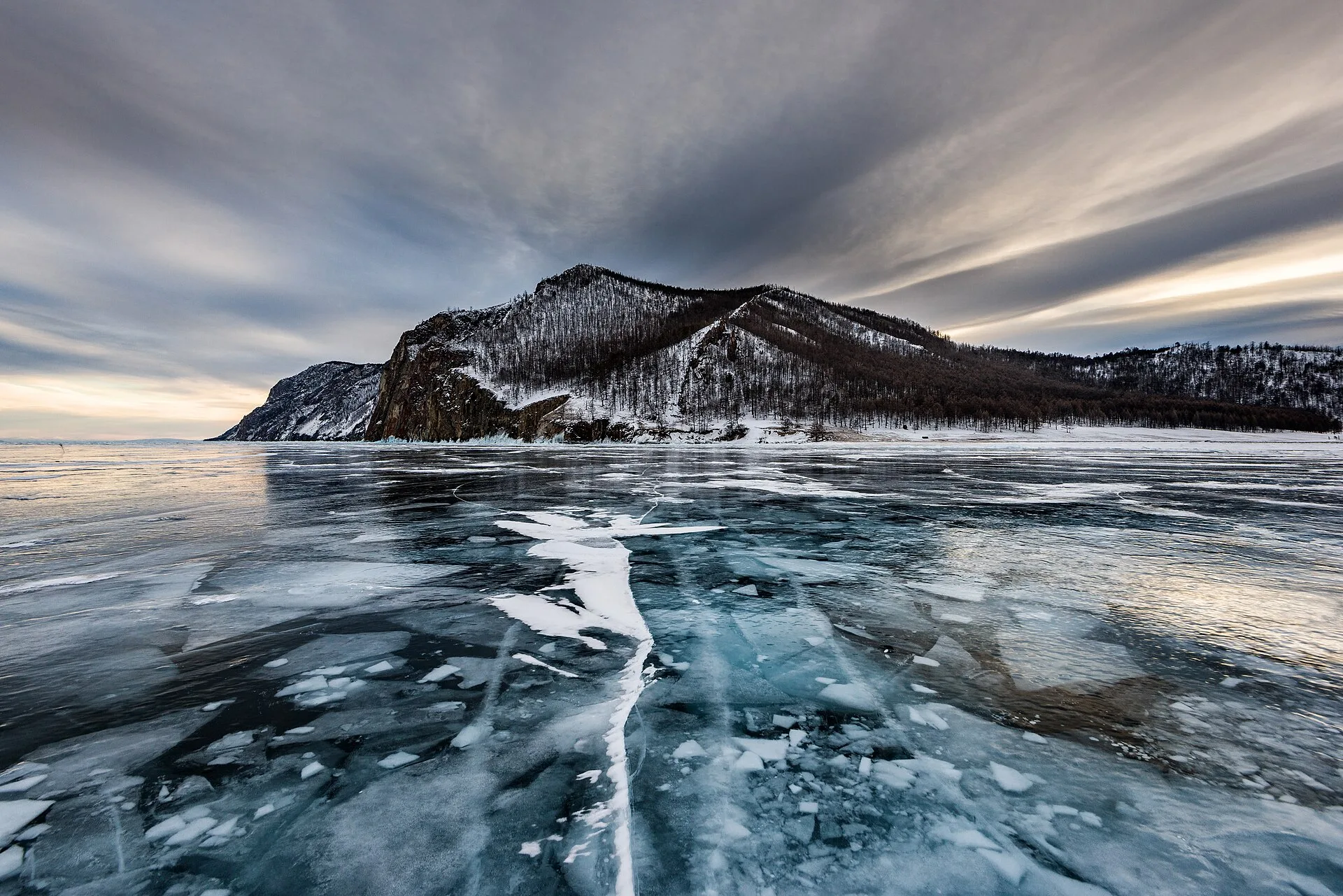
Lake Baikal in southern Siberia is the deepest and oldest lake on Earth and holds more than a fifth of the fresh water found on the planet’s surface. It is also the setting for one of the most repeated stories in the literature of underwater UFOs: that Soviet military divers training beneath its surface met a group of giant, silver-suited swimmers, tried to capture one and paid for it with their lives. The story is usually dated to 1982 and said to come from secret military files. Traced back, it rests on neither.
What happened
In its standard modern form, seven Soviet navy divers were on an exercise under the Baikal ice when, at a depth of about 50 meters, they came upon humanlike figures nearly three meters tall. The strangers wore close-fitting silvery suits and spherical helmets but carried no air tanks, despite the near-freezing water. When the divers’ commander ordered them to throw a net over one of the beings, some force hurled the whole team to the surface. Rising that fast from that depth is dangerous, and all seven came down with decompression sickness. The only pressure chamber at hand had been built for two people; four were squeezed in, three of the men died, and the rest were left disabled. The survivors are said never to have spoken about it.
The details have hardly changed in decades of retelling. What varies is the claimed source, which is usually described as a set of Soviet navy records on unidentified objects that were declassified in 2009.
The investigation
The 2009 connection comes from news coverage that July. The Russian state broadcaster RT, citing a Russian news website, reported that the navy had released Soviet-era files on encounters with unexplained objects, compiled by a group under a deputy commander, Admiral Nikolay Smirnov. The article quoted the UFO researcher Vladimir Azhazha and, in the same piece, summarized the Baikal divers story as one of the cases. It also reported that navy officials denied any such collection existed; a navy source told the ITAR-TASS agency that sightings of the kind could be explained by fish shoals, floating debris or natural effects. Fox News and other Western outlets repeated the story, and the idea of a “declassified” Baikal incident stuck.
The account is older than that, and its trail is thin. In 2021 the Skeptoid podcast’s Brian Dunning followed it back through the Russian-language UFO books of Azhazha and an English summary by the writer Paul Stonehill. In Stonehill’s version, already online by 2001, nothing happens at Baikal in 1982 at all. That summer two diving instructors, Mark Shteynberg and Lieutenant Colonel Gennady Zverev, were training reconnaissance frogmen at Lake Issyk-Kul in what is now Kyrgyzstan when a senior officer, Major General Demyanenko (the name is spelled several ways), head of the military’s diver service, arrived and told them of an encounter during exercises somewhere in Siberia. The giant swimmers, the net and the deaths are all in his account, but no date, no named diver and no document.
The explanations
Dunning concluded that the tale is at best a fourth-hand anecdote: a general’s story, repeated by two instructors, collected by a UFO enthusiast and translated by another, with no original record anyone has produced. In the accounts Dunning traced, the general told the story as a warning to the trainees against reckless pursuits and the danger of decompression, which may explain its most vivid details. Why a safety talk would feature alien swimmers is anyone’s guess, because nobody has found his words written down.
The setting does some of the work. Baikal is often pictured as an unreachable wilderness, but its shores include Irkutsk, a city of about 600,000 people, and its southern basin hosts one of the world’s largest neutrino detectors, a cubic kilometer of sensors anchored in the deep water. No corroborating report has come from the scientists, fishermen and visitors who use the lake every year.
Where it stands
No Soviet or Russian document describing the Baikal divers has ever been published, the navy denied holding the files that were supposed to contain it, and the earliest traceable version places the storyteller some 2,500 kilometers away at a different lake. The silver swimmers of Lake Baikal are best understood as a legend of the Cold War diving world that found a second life online.