
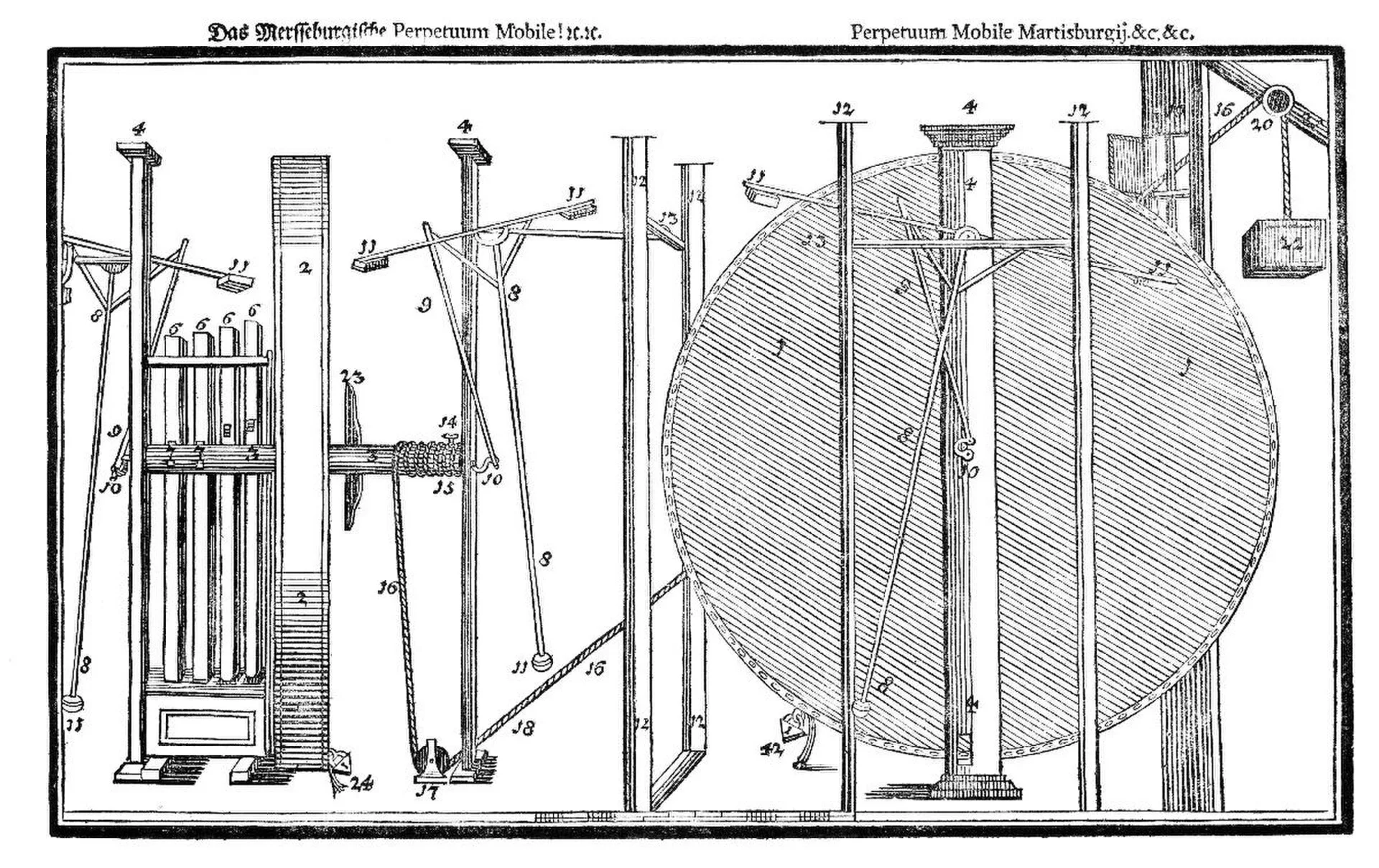
By the early eighteenth century most serious mathematicians had concluded that perpetual motion, a machine running forever on gravity alone, was impossible. Johann Ernst Elias Bessler, a Saxon of humble birth who called himself Orffyreus, spent the 1710s persuading some of them otherwise. His wheels turned in front of princes and professors for years, survived a sealed-room test, and drew interest from Peter the Great. Their mechanism was never shown to anyone but one patron, and the wheel that made him famous ended in pieces.
The wheels
Born around 1680 near Zittau, Bessler had been a soldier, a healer and a watchmaker. His pseudonym came from a simple cipher: he wrote the alphabet in a circle and took the letters opposite those of his surname. In 1712 he showed a self-turning wheel at Gera. Larger versions followed at Draschwitz, near Leipzig, where Gottfried Wilhelm Leibniz came to see it in 1714, and then at Merseburg. Each was a hollow drum on a horizontal axle, its insides covered with cloth. Set going with a slight push, it accelerated by itself and could lift a weight on a rope.
Skeptics appeared at once. The mining engineer Johann Gottfried Borlach published an engraving showing how he believed the Merseburg wheel was turned by a person in the next room, through a crank hidden in one of its posts. The Dresden model-maker Andreas Gärtner and the Leipzig mathematician Christian Wagner also called it a fraud. Bessler answered with pamphlets.
Kassel and the sealed room
In 1716 he found a powerful patron in Karl, Landgrave of Hesse-Kassel, a collector of clocks and machines, who made him a commercial councillor and gave him rooms in Weissenstein Castle. There Bessler built his largest wheel, twelve feet across, wrapped in oilcloth, with pendulum regulators on either side. Only the Landgrave was allowed to look inside.
In November 1717 the wheel was set turning in a castle room and the doors and windows were sealed in the presence of the Landgrave and his officials. On November 26 the room was opened and the wheel was still moving. It was sealed again, and when the seals were checked and broken on January 4, 1718, it was turning at its usual speed. The Landgrave put his name and seal to a certificate in May 1718. Bessler’s price for the secret, as reported in London, was £20,000, the same sum Parliament had offered for finding longitude at sea.
The imperial architect Joseph Emanuel Fischer von Erlach tested the wheel around 1721 and wrote to John Desaguliers at the Royal Society that he could hear roughly eight weights dropping gently on one side with each turn, that it ran at about twenty-six revolutions a minute, and that, when he stopped it and nudged it, it built itself back up to full speed. Willem ‘s Gravesande, professor of mathematics at Leiden, came at the Landgrave’s invitation the same year and wrote to Isaac Newton that he could find no sign of outside power. He examined the bared axle ends and the brass bearings and saw no link to the next room. The day after, Bessler destroyed the wheel and wrote on the wall that the professor’s impertinent curiosity was to blame.
The maid’s confession
In 1727 a new wheel was said to be nearly ready, but none was tested. Late that year Bessler’s maid, Anne Rosine Mauersbergerin, fled his house. She testified that the wheels had always been turned by hand from an adjoining room, by her, by Bessler’s wife, by his brother Gottfried or by Bessler himself, and she produced the oath he had made her swear, under threat of damnation, to keep quiet. Jean-Pierre de Crousaz, a tutor at the Kassel court, summed up the case for ‘s Gravesande in 1729: Bessler was a fool, the girl had fled in fear, and he had made no move to clear his name. ‘s Gravesande brushed her aside: a servant’s opinion of machinery counted for little, he wrote, and perhaps while turning the kitchen spit she had imagined she was driving perpetual motion.
The explanations
The physics leaves no room for a gravity wheel. A device driven only by its own weights must keep lowering its center of mass to do work or overcome friction, and after each full turn the weights are back where they started; Desaguliers made this argument to the Royal Society at the time. What remains uncertain is the method. The maid’s account fits Borlach’s earlier drawing of a drive hidden inside a hollow post, and the physicist Alejandro Jenkins, reviewing the case in 2013, notes that seeing the axle turn in open bearings does not rule out such a coupling. The sealed-room run is harder to reconstruct, but the seals guarded doors and windows, not walls, and no one watched the wheel between inspections.
Where it stands
Bessler was later arrested, freed, and died in 1745 after falling from a windmill he was building. German writers in the nineteenth century treated him as a proven confidence man; some twentieth-century authors, including Rupert Gould, kept the mystery open. Historians of science now see him as a skilled showman who exploited a live debate about the conservation of force. How the trick was done is lost; that it was a trick is not.