
In the thirteenth century BC the eastern Mediterranean looked like a stable club of great powers. Egypt, the Hittite Empire in Anatolia, Mycenaean Greece, Cyprus, the trading kingdom of Ugarit on the Syrian coast, Assyria and Kassite Babylonia exchanged letters, princesses, copper, tin, grain and luxury goods. Within a few generations after 1200 BC most of that world had broken apart. Palaces burned or were abandoned, writing disappeared from Greece for centuries, the Hittite state vanished, and trade routes fell silent. The episode is known as the Late Bronze Age collapse, and the question of what caused it has been argued for more than a century.
What happened
The clearest snapshot comes from Ugarit, whose archives run almost to the moment the city fell, sometime between about 1190 and 1185 BC. Its last letters, as summarized by the archaeologist Eric Cline of George Washington University, speak of enemy ships approaching, fields laid waste, drought and hunger. The city was destroyed and never rebuilt.
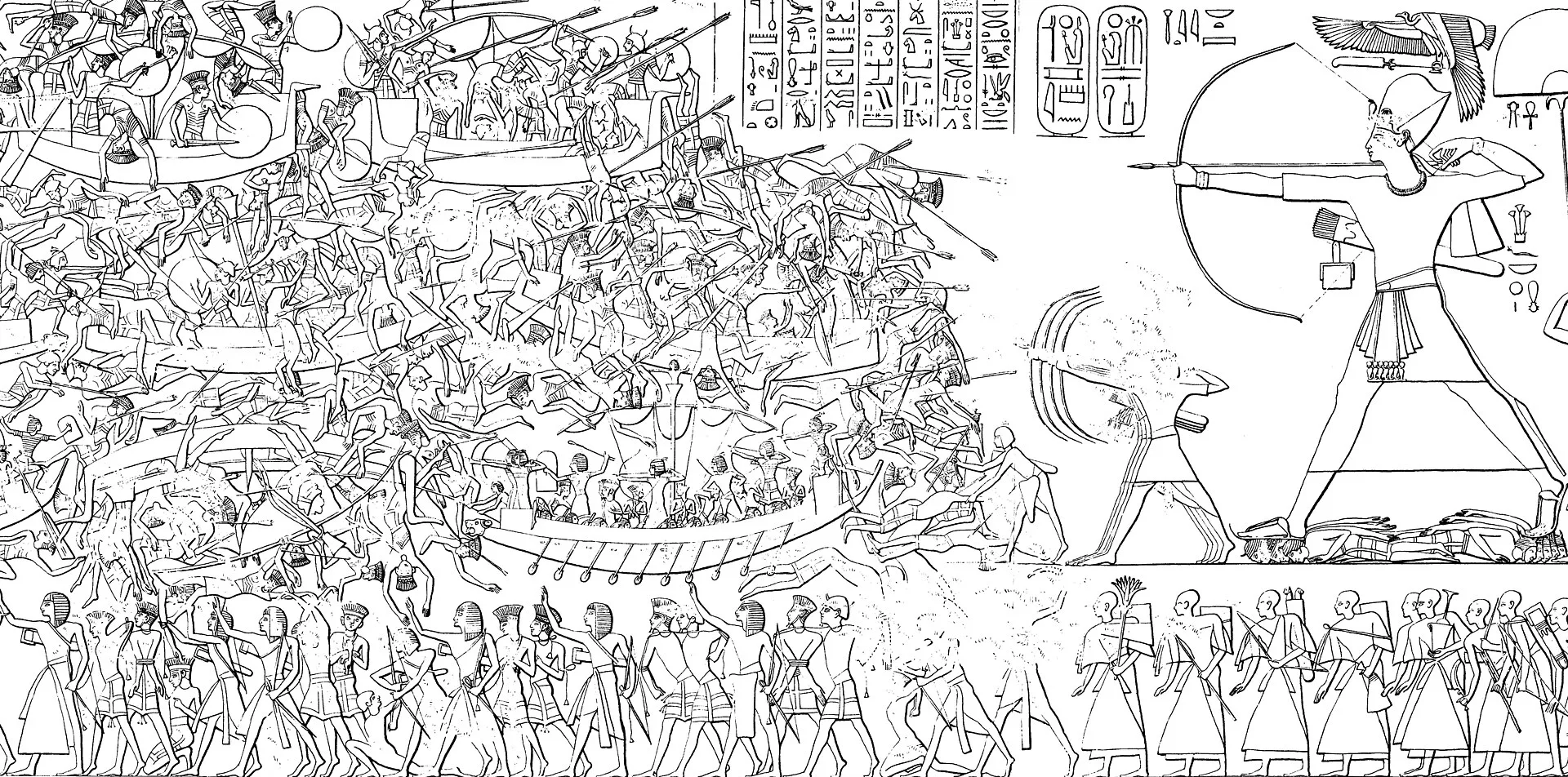
In Egypt, Ramesses III recorded on the walls of his mortuary temple at Medinet Habu that a confederation of foreign peoples had come out of the islands and swept away one kingdom after another before attacking Egypt by land and sea. The temple reliefs show a sea battle in which Egyptian archers shoot down warriors wearing horned helmets and feathered headdresses. Modern scholars call these groups the Sea Peoples, and Cline uses the year of their second assault on Egypt, 1177 BC, as a shorthand for the whole collapse, much as 476 AD stands in for the fall of Rome.
The investigation
For much of the twentieth century the Sea Peoples carried the blame. The French Egyptologist Gaston Maspero helped popularize that view in the nineteenth century, largely on the strength of the Medinet Habu inscription. The trouble, as Cline points out, is that inland powers such as Kassite Babylonia, Elam and Assyria also declined although no raiders from the sea ever reached them, and, as climate researchers noted in 2013, nobody knows exactly who the Sea Peoples were, where they came from or where they went afterward.
Science has since added the environment to the case. In 2013 a team led by David Kaniewski analyzed pollen from a sediment core at the Larnaca Salt Lake in Cyprus and compared it with an earlier record from Gibala-Tell Tweini on the Syrian coast. Both showed the onset of a long drought around 1200 BC that lasted for roughly three centuries, and the authors argued that famine drove some of the population movements remembered as the Sea Peoples. In 2023 Sturt Manning and colleagues reported tree-ring and isotope data from juniper timbers at Gordion in central Anatolia showing an unusually severe dry spell lasting about three consecutive years, around 1198 to 1196 BC. In a society that could ride out one bad harvest but not several in a row, that may have been a tipping point. Excavators now think the Hittite capital, Hattusa, was not stormed by invaders but abandoned and emptied by its own administration, and only later set on fire.
The explanations
Cline’s influential answer, set out in his 2014 book 1177 B.C.: The Year Civilization Collapsed, is a perfect storm. He argues that there is evidence for climate change, drought and famine, earthquakes, invasions and internal revolts all at roughly the same time, and ranks them in about that order of importance. Any one of them might have been survivable. Together, in an economy where every kingdom depended on long-distance trade with the others, each shock amplified the next until the system itself failed. In that reading the Sea Peoples are as much symptom as cause, uprooted communities moving in search of food and land.
Not every scholar accepts a single grand narrative. Conditions varied from region to region: some cities were sacked in war, while others seem to have been emptied first and burned later. Even for Hattusa, the historian Guy Middleton has written that some specific event, possibly one that will never be recovered, must have triggered the final abandonment.
Where it stands
The broad shape of the crisis is not in doubt. The tablets, the ruined palaces and the climate records all point to a drawn-out unraveling across roughly a century rather than a single catastrophe. What remains unresolved is the weighting: how much drought, how much war, how much earthquake damage and how much political failure, and in what order, for each kingdom. The Sea Peoples are still unidentified, and the debate continues.