
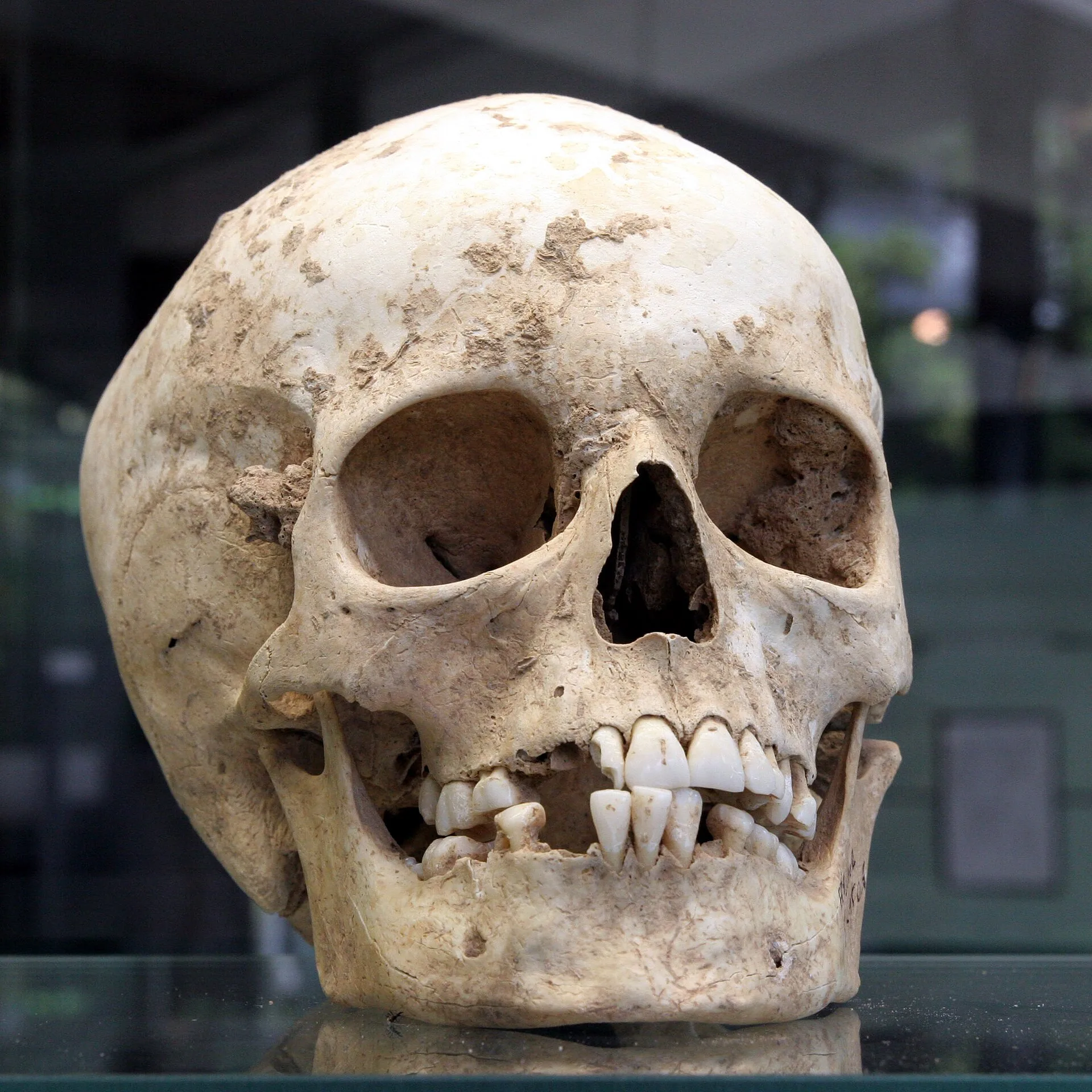
Herxheim bei Landau is a wine-country town in the southern Palatinate, about twenty kilometers west of the Rhine. In the mid-1990s, as ground was prepared for an industrial park on its western edge, local people noticed human bones turning up in the loess, skulls among them. The state archaeology service in Speyer began a rescue excavation in 1996. What it found is one of the strangest deposits of the European Neolithic: the deliberately broken remains of hundreds of people, laid in pits around a village of no more than a handful of houses.
What was found
The village belonged to the Linear Pottery culture, the first farming society of central Europe, named for the incised bands on its pots. Around it ran what looked at first like two concentric ditches. Closer work showed they were chains of oval pits, dug and recut over several centuries. In the last phase of the village, dated by its pottery to roughly 5000 to 4950 BC, those pits received an extraordinary fill. Excavations in 1996–99 and again in 2005–08, the second campaign led by Andrea Zeeb-Lanz and Fabian Haack, recovered the bones of at least 500 people, men, women and a large share of children. Only about half the enclosure has been dug, so the excavators expect the true total to exceed 1,000.
Almost none of these people were buried in the normal way, crouched on one side, as a few skeletons inside the village were. Their bodies had been taken apart. Skulls were split, the faces smashed, and the vaults trimmed into neat caps; some caps were arranged in clusters with broken pottery, stone adzes, shell ornaments and the bones of dogs. Long bones were broken while still fresh. The pottery thrown in with them was of very high quality and had been smashed on purpose, and its decoration copied regional styles from as far off as the Paris Basin and the Elbe valley, some 400 kilometers away.
The cannibalism argument
In December 2009 Bruno Boulestin, a French anthropologist at the University of Bordeaux, published an analysis in the journal Antiquity with Zeeb-Lanz, Haack and others. His team had pieced together 217 bones from a single deposit representing at least ten people and found damage matching the way animals were butchered at the same site: heads skinned before the skullcap was removed, cuts on the jaw consistent with taking out the tongue, ribs separated from the spine, marrow scraped from split limb bones, and what they read as human tooth marks on the ends of hand and arm bones. Boulestin said similar traces appeared on almost every individual examined. With so many dead over so short a span, the team ruled out both famine and normal funeral customs and proposed sacrificial cannibalism, possibly of captives or slaves brought in by visitors from distant communities. A 2015 book-length study of the Herxheim bones by Boulestin and Coupey restated the case and rejected the burial alternatives.
The other readings
Jörg Orschiedt and Miriam Haidle, who had studied the bones from the first campaign, disagreed. In a statement to Science News they argued that the same marks fit a rite in which people who had died elsewhere were dismembered and defleshed, and their bones then brought to Herxheim for final deposit. They pointed to missing lower jaws and skull bases as signs of selection, and said that proving ancient people had actually eaten human flesh is close to impossible. The Oxford archaeologist Rick Schulting called cannibalism on this scale very surprising if confirmed.
Isotopes have since sharpened the question of who the dead were. Strontium in the tooth enamel of more than 45 individuals, reported by Rouven Turck and colleagues, showed that many had spent their childhood on crystalline bedrock typical of upland areas rather than on the loess plains where Linear Pottery farmers lived. Oxygen values analyzed by Thomas Tütken suggest that perhaps 30 to 50 percent were not from the Herxheim area, and at least one person drank water consistent with a much warmer or coastal region. Whether these were captives, pilgrims or the remains of the dead carried in from far away, the isotopes cannot say.
Where it stands
The excavators link Herxheim to a wider crisis at the end of the Linear Pottery world, when massacre sites such as Talheim and Schletz appear and the culture fragments into regional groups before disappearing, though the British archaeologist Nick Thorpe has questioned whether such a general crisis existed. Finds from the pits are now displayed at the town museum. That hundreds of people were processed there within a few decades is beyond doubt. Whether they were sacrificed, eaten or reburied, and why a tiny farming village became the center of it, has never been settled.