
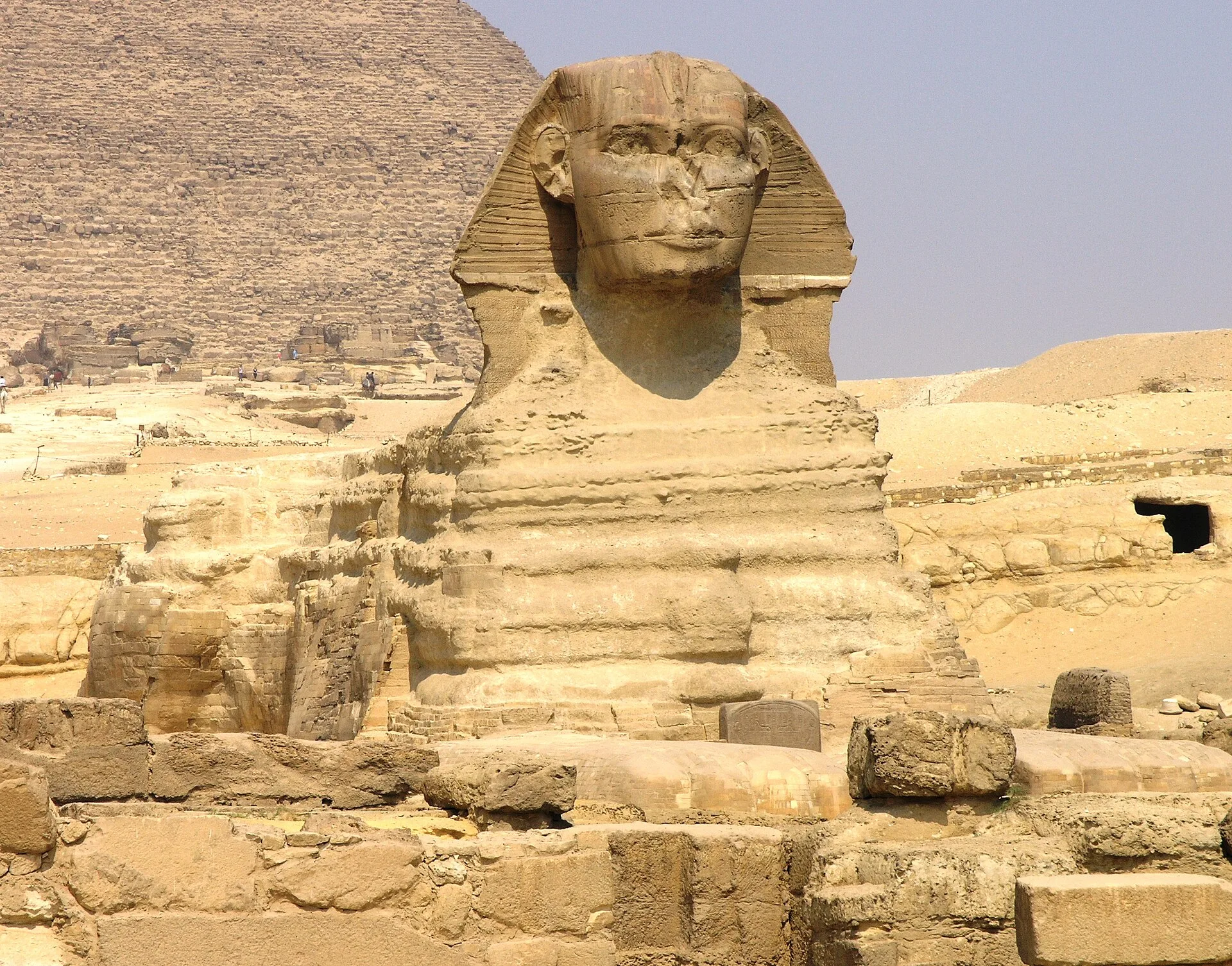
Of all the predictions credited to the Virginia Beach psychic Edgar Cayce, few have drawn more money and machinery than the Hall of Records. In trance readings given in the 1930s and 1940s, Cayce described a hidden chamber at Giza holding the history of Atlantis, sealed away by refugees before their homeland sank. For half a century afterward, believers, independent geologists and well-funded expeditions pointed radar, seismic sounders and electrical probes at the bedrock around the Great Sphinx in the hope of finding its door.
The prophecy
The organization Cayce founded, the Association for Research and Enlightenment, still sets out the claim much as he gave it. Foreseeing their destruction, the Atlanteans placed identical records in three locations: in the sunken land itself near Bimini, in the Yucatán, and in Egypt, where one reading speaks of a passage leading from the Sphinx to the hall of records. The association dates the final catastrophe to around 10,000 B.C. Other readings promised that the hall would eventually be opened and its record of Atlantis made known. Because Cayce linked the discovery to a coming period of great change, many followers expected it before the end of the twentieth century.
The drill holes of 1978
The association went looking. Under Cayce’s son Hugh Lynn Cayce, it asked a geophysics team from SRI International, already working at Giza on a larger privately funded project, to study the ground around the Sphinx in the spring of 1978. According to the project leader, Lambert Dolphin, the team mapped the Sphinx platform and the floor of the Sphinx Temple with electrical resistivity and a high-frequency seismic sounder, then drilled five four-inch holes into the largest anomalies, two in the bedrock around the statue and three in the temple below it, with the cooperation of the Egyptologists Zahi Hawass and Mark Lehner. A television camera lowered into each hole showed only small natural cracks. Dolphin concluded there were no rooms, voids or even filled cavities beneath the Sphinx, and he recalled that Hugh Lynn Cayce seemed satisfied and remarked that his father’s real gift had been healing rather than archaeology.
The surveys of the 1990s
The question revived in the 1990s. In 1991 the Boston University geologist Robert Schoch, the geophysicist Thomas Dobecki and the writer John Anthony West ran seismic surveys around the monument, chiefly to support Schoch’s argument that its weathering pointed to an earlier date. Their results also included cavities in front of the left forepaw and along the south flank. An ARE member, Joseph Schor, joined as an observer, and the findings featured in a 1993 television documentary that mentioned the Cayce prophecy. Popular books soon tied the supposed older Sphinx to Atlantis and adopted Cayce’s date.
Not everyone found the same thing. In 1992 two scientists from Egypt’s National Research Institute of Astronomy and Geophysics carried out a shallow seismic study and reported layered rock with no faulting and no cavities. In April 1996 Florida State University, working for Schor’s expedition, spent three weeks on remote sensing around the Sphinx and elsewhere on the plateau and announced rooms and tunnels in front of and behind it. A Japanese team from Waseda University had already reported a possible north-south tunnel in 1987.
The explanations
Hawass, by then in charge of the Giza monuments, answered the claims in 1997. Such instruments, he pointed out, do not see chambers. They record anomalies, which have to be interpreted, and faults, fissures and pockets of water produce anomalies too. He refused to allow digging or drilling into the Sphinx on the strength of them while the statue was being conserved, and he rejected the charge that Egypt was hiding evidence of an older civilization. The 1978 boreholes had already tested exactly this kind of signal and found cracks. The Supreme Council of Antiquities did allow one test drilling near the Great Pyramid in 1998, which hit a natural cavity, and in 1999 Hawass had the flooded shaft tomb known as the water shaft pumped out and explored. It proved to be a tomb of the Late Period, cut nearly two thousand years after the Sphinx, not an archive.
Where it stands
No passage, chamber or record of the kind Cayce described has been found at Giza, and the period in which his followers expected its discovery has passed. Unexplained anomalies remain on the survey maps, and some writers still argue that they deserve a closer look. But the one time the strongest anomalies were drilled and filmed, they turned out to be fractures in the rock, and that remains the strongest evidence on record.