
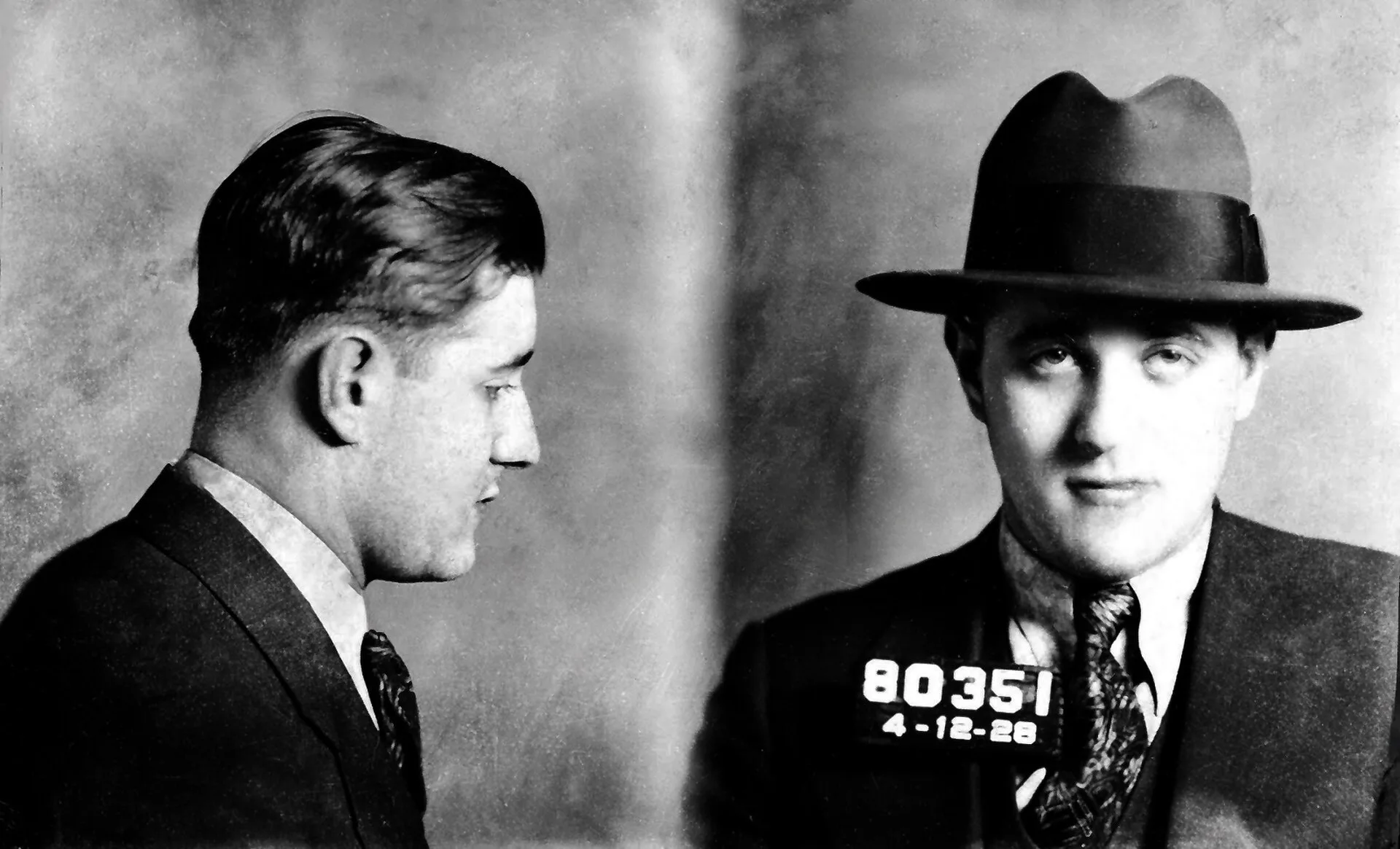
Benjamin Siegel grew up poor in Brooklyn and rose with his boyhood friend Meyer Lansky through bootlegging, gambling and murder for hire. In the late 1930s the New York syndicate sent him to Southern California, where he ran gambling and the racing wire, mixed with film stars, and was linked to several killings. After the war he turned to a bigger venture: the Flamingo, a luxury hotel and casino on the highway outside Las Vegas, financed in large part by Mob money. Its construction ran over budget and over schedule, and it opened at the end of December 1946 to poor business. By spring it had begun to turn a profit, but large construction bills were still unpaid.
What happened
On Friday, June 20, 1947, Siegel flew into Los Angeles. His companion, Virginia Hill, had left for Paris after one of their many fights, and he was staying at the house he had leased for her at 810 North Linden Drive, Beverly Hills. That evening he went out to dinner with his friend Allen Smiley, Hill’s brother and her secretary, then returned to the house. He and Smiley settled on a sofa in the living room, beside a large window, to talk and skim the papers.
A little before 11 p.m. a gunman who had rested a .30-caliber military carbine on a lattice outside the window opened fire from a few yards away. According to the Mob Museum’s reconstruction, nine rounds were fired; two struck Siegel in the face, one of them tearing out his left eye, and two hit his chest. Accounts of the count vary, with some saying three shots struck his head. Smiley ducked; a bullet passed through his sleeve without wounding him. Neighbors heard a car speed away. Siegel was 41.
The investigation
Beverly Hills police and the Los Angeles County district attorney’s office worked the case together. Early on, Deputy District Attorney Ernest Roll told reporters that a hundred different people might have wanted Siegel dead, and before long he admitted the shooter might never be found. No arrest followed. What the record does show is coordination. That night at the Flamingo, men from the showroom moved to the cashier’s cage and front desk during the evening show, and moments after the shooting Siegel’s partner Moe Sedway walked in with two associates, Gus Greenbaum and Morris Rosen, to announce that they were taking over. Smiley’s own call to Las Vegas that night, reporting Siegel dead, went to a man who was secretly informing for the FBI.
The explanations
The best-known theory holds that Lansky, Lucky Luciano, Frank Costello and others decided Siegel’s fate at a meeting of Mob leaders in Havana, held either in December 1946 or early 1947, because he had squandered or skimmed their investment. In most tellings they handed the job to Jack Dragna, the Los Angeles Mafia boss, and authors disagree about whom Dragna chose; the mobster Frankie Carbo is the name most often given. Clark Fogg, a former Beverly Hills police forensic specialist, argued in a 2013 book that the wounds suggested two gunmen, and proposed Tony Brancato and Tony Trombino, known as the Two Tonys, hired on behalf of Joe Adonis.
Other accounts make the motive personal. A 1947 FBI informant reported that Lansky had suggested someone close to Hill shot Siegel for mistreating her; another version, relayed by the author Gus Russo, had the Cleveland underworld figure Moe Dalitz, a former lover of Hill’s, approving the hit. In 2014 Los Angeles Magazine published the claims of Sedway’s widow, Beatrice, that Siegel had been planning to kill her husband for reporting the Flamingo’s debts to Lansky, and that Sedway struck first with Lansky’s blessing, using a gunman she named as her own lover.
Where it stands
The murder has never been solved, and almost everyone who might have known the answer died long ago. The competing theories share a likely backdrop, money owed on the Flamingo and Siegel’s volatile temper, but each depends on informants, memoirs or family stories that cannot now be tested. It remains one of the best-documented unsolved killings of the twentieth century, documented in everything except the identity of the man at the window.