
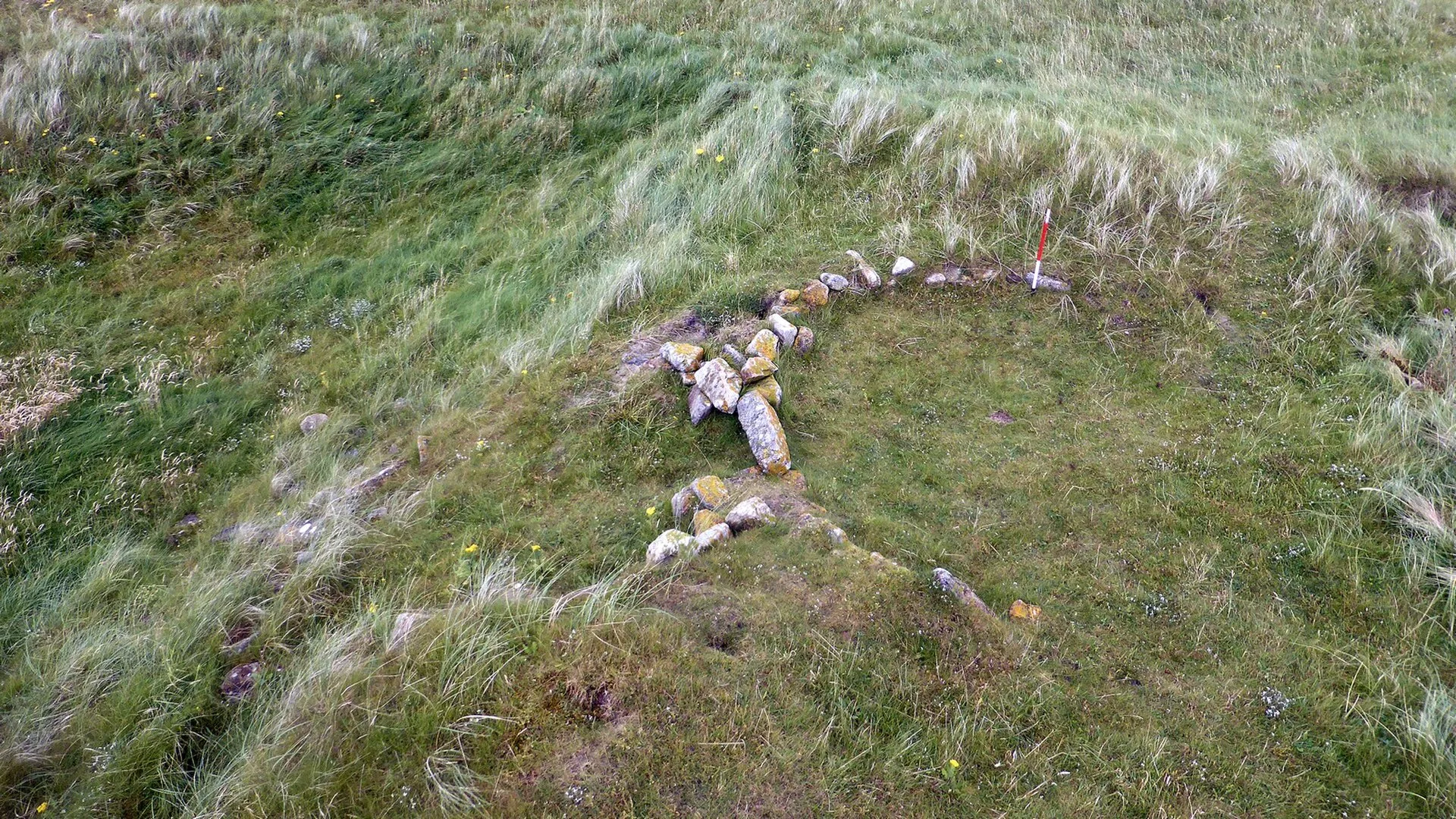
On the west coast of South Uist in the Outer Hebrides, the sandy grassland called machair has buried and preserved a prehistoric village at Cladh Hallan, near Daliburgh. Archaeologists from the University of Sheffield, led by Mike Parker Pearson, dug there from 1988 to 2002. What they found under the floors of its houses is still the only good evidence for mummification in prehistoric Britain, and the bodies turned out to be stranger than mummies.
The burials under the floors
The heart of the site is a terrace of three roundhouses joined side by side, built in the late Bronze Age, around the eleventh century BC, and rebuilt many times over the following centuries. In 2001, digging below the lowest floors, the team found human remains placed as foundation deposits: a small child of about three under the southern house, an adolescent under the middle one, and under the northern house an adult man and an adult woman, plus an infant buried during a later rebuild. The two adults lay on their sides in very tight crouches, knees pulled up hard against the chest, as if they had been bound or wrapped.
At first they looked like ordinary skeletons. Radiocarbon dating changed that. The adults had died long before the houses were built, the man roughly five centuries earlier and the woman three or four, yet their skeletons were still fully articulated. Bones lying loose for hundreds of years would have scattered. Something had held these bodies together in the meantime.
The case for mummification
The team looked inside the bone. When a corpse rots, gut bacteria tunnel through the skeleton and leave microscopic damage. The Cladh Hallan adults showed very little of it, which meant decay had been stopped soon after death. Changes to the mineral near the bone surfaces pointed to a spell in an acidic environment, and the excavators proposed that the bodies had been sunk in a peat bog for something like a year, then lifted out before the acid could dissolve the bones, and kept somewhere above ground. They published the case in Antiquity in 2005.
More evidence followed. The woman’s left knee had been snapped off with a dry break, the kind that happens to bone that has already lost its collagen, long after death. The missing pieces turned up still joined together in a pit filled with peat ash just outside the door, dug while the house was going up. To the excavators, that meant the body had been handled as a preserved, curated object before it went into the ground.
Built from several people
The man came apart under examination. His skull had lost its upper cheek teeth years before death, yet the lower jaw buried with it had a full set whose wear and tartar show it had worked against a functioning upper row. Nitrogen isotopes from the skull and jaw did not match those from the shin. The excavators concluded the skeleton combined parts of three men, and dating suggested the head and jaw were a century or two younger than the body.
The woman’s jaw also sat badly in her skull. Geneticists at the University of Manchester, led by Terry Brown and working with Parker Pearson, sampled her jaw, skull, arm and leg bone. In a 2012 paper in the Journal of Archaeological Science, Jayd Hanna and colleagues reported that the samples came from different people with no shared maternal line. Later analysis describes the skeleton as a female-male composite. Between them the two mummies held parts of at least six individuals. The press called them Frankenstein mummies.
The explanations
Why the parts were combined is unknown. Brown has allowed a practical reading, that a curated body lost its head and a substitute was found. Parker Pearson favors a deliberate one: that the islanders assembled ancestors who joined several lineages into one figure, kept them among the living, and perhaps consulted them, as some societies elsewhere have done with their dead, before finally burying them as foundations for new houses.
Whether Cladh Hallan was unique is a separate question. In 2015 Thomas Booth, Andrew Chamberlain and Parker Pearson applied the same bone-decay test to Bronze Age skeletons from across Britain. Sixteen of thirty-four samples, from sites between Kent and the Scottish Highlands, showed the same arrested decay. Some may simply reflect waterlogged ground, and skeletons from the Isle of Sheppey showed signs of smoking rather than bog immersion, but the authors concluded that Bronze Age communities across Britain mummified a share of their dead.
Where it stands
The bodies themselves are now skeletons; no soft tissue survives, so mummification is inferred, not seen. But the dating, the bone microstructure, the broken knee and the DNA all point the same way. People on South Uist preserved some of their dead for centuries and rebuilt at least two of them from several people before laying them under their houses. The full site report appeared in 2025. The mechanics are reasonably well understood; the reasons remain a matter of interpretation.