
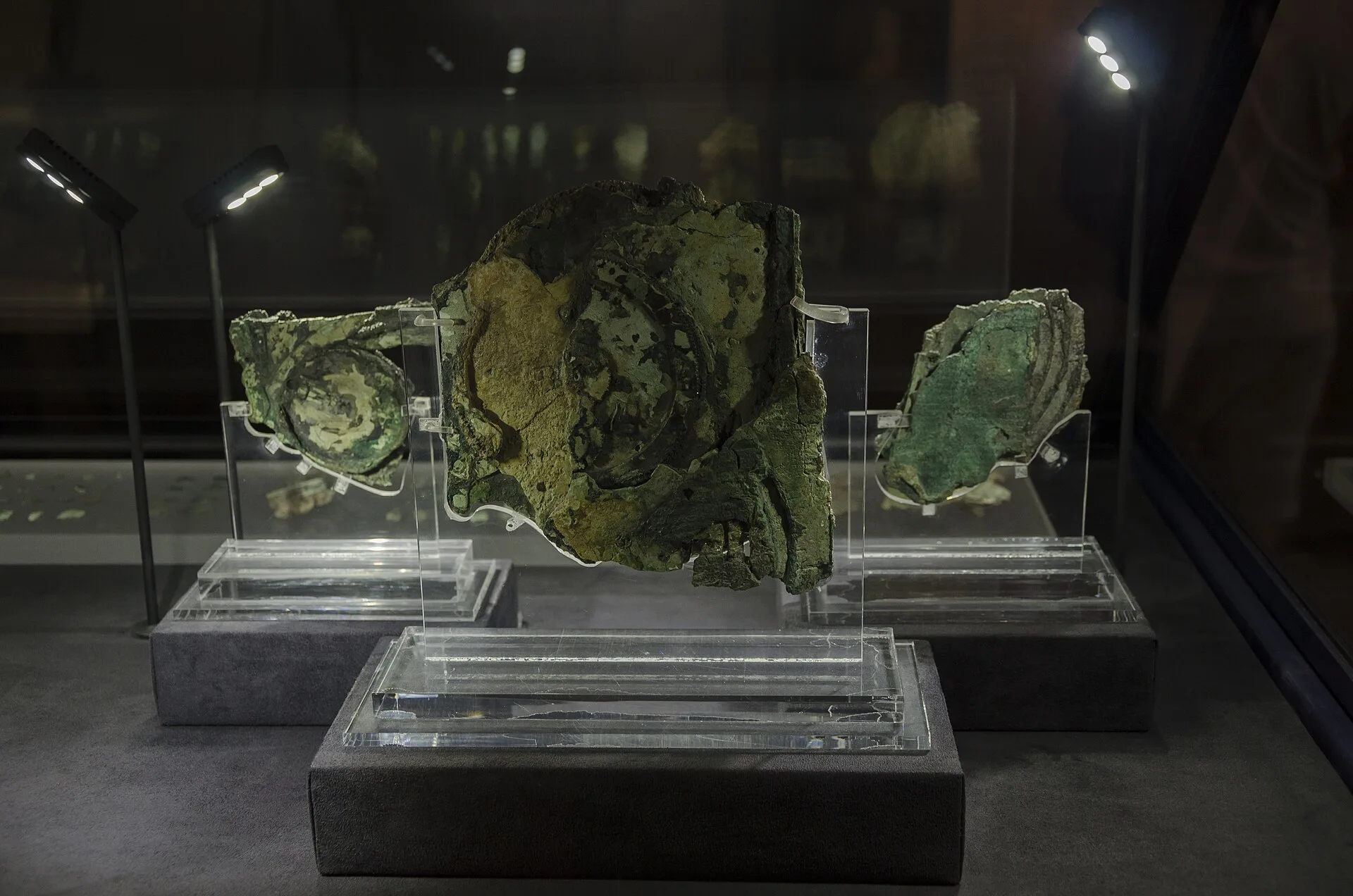
Antikythera is a small, rocky island between Kythera and Crete. In 1900 a crew of sponge divers from the island of Symi, led by Captain Dimitrios Kontos, found the wreck of a large ancient ship off its coast, its cargo strewn with bronze and marble statues. The vessel had gone down around 70 to 60 BCE. Salvage work with the support of the Greek state continued into 1901, and the finds went to the National Archaeological Museum in Athens. Among them was an unremarkable lump of corroded bronze and wood.
What happened
On May 17, 1902 the archaeologist Valerios Stais, looking over material from the wreck, noticed a gear wheel embedded in one of the pieces. The object survives today as 82 fragments, perhaps a third of the original, including 30 corroded bronze gears. The largest gear is about 13 centimeters across and originally had 223 teeth. Greek inscriptions cover many of the surfaces.
For decades the fragments were hard to interpret, because nothing comparable survived from the ancient world. The physicist and historian Derek de Solla Price examined the fragments through radiographic imaging over many years, and in 1974 published an account of the mechanism as a geared calendar device that tracked the heavens. His model was incomplete, but it established what kind of object this was.
The investigation
The decisive work began in 2005, when the Antikythera Mechanism Research Project, an international team working with the museum and the Greek Ministry of Culture, imaged every fragment. Hewlett-Packard recorded the surfaces with a lighting technique that brings out faint lettering, and X-Tek Systems brought a microfocus X-ray tomography scanner to Athens that could see through the corrosion at a resolution better than a tenth of a millimeter. The team’s 2006 paper in Nature, led by Tony Freeth and Mike Edmunds, reconstructed how the surviving gears worked and doubled the number of deciphered inscriptions. It showed that the device predicted lunar and solar eclipses using Babylonian cycles, and that one gear pair, with a pin running in a slot, mechanically reproduced Hipparchus’s theory of the Moon’s varying speed across the sky. The inscriptions also indicated that the lost front once displayed the planets. A second Nature paper in 2008 described more of the dials on the back.
In 2021 Freeth and colleagues at University College London published a model of that missing front in Scientific Reports. Working from the X-ray data and from an inscription that serves as a kind of user’s guide, they proposed a display of the Sun, the Moon and every planet visible to ancient Greek astronomers on nested rings, driven by gear trains built around planetary cycles, including period relations for Venus and Saturn derived from numbers preserved in the text. The authors stated plainly that they could not claim their model was a replica of the original. In 2024 two University of Glasgow astronomers, Graham Woan and Joseph Bayley, applied statistical techniques developed for gravitational-wave research to the surviving holes of the front calendar ring. They found it very probably had 354 holes, matching a lunar year rather than the 365-day Egyptian calendar, and that the holes had been placed with remarkable precision.
The explanations
The mechanism is often presented as an impossible object, evidence of lost technology or outside help. The research points the other way. Its astronomy is Babylonian and Greek, assembled from eclipse and planetary cycles that Babylonian astronomers had recorded for centuries and from Greek theories such as Hipparchus’s model of the Moon. Ancient writers, among them Cicero, describe bronze models of the heavens associated with Archimedes and others, so the idea was known even if no other example has survived. What is exceptional is the level of miniaturised gearing. The 2006 study judged it more complex than any known device for at least a thousand years afterward, and nothing similar appears in the surviving record until the astronomical clocks of medieval Europe.
Where it stands
The fragments are on display at the National Archaeological Museum in Athens, which has also built a digital guide to them, and research continues. Open questions include who made the device, in which city, and when; proposed dates for its construction range across the second century BCE and into the early first. Divers have returned to the wreck in a series of new excavations since 2014. The Antikythera mechanism is genuine, ancient and extraordinary, and it is fully explained as the work of Greek astronomers and craftsmen. The real mystery is how many others like it once existed and why none of them survived.