
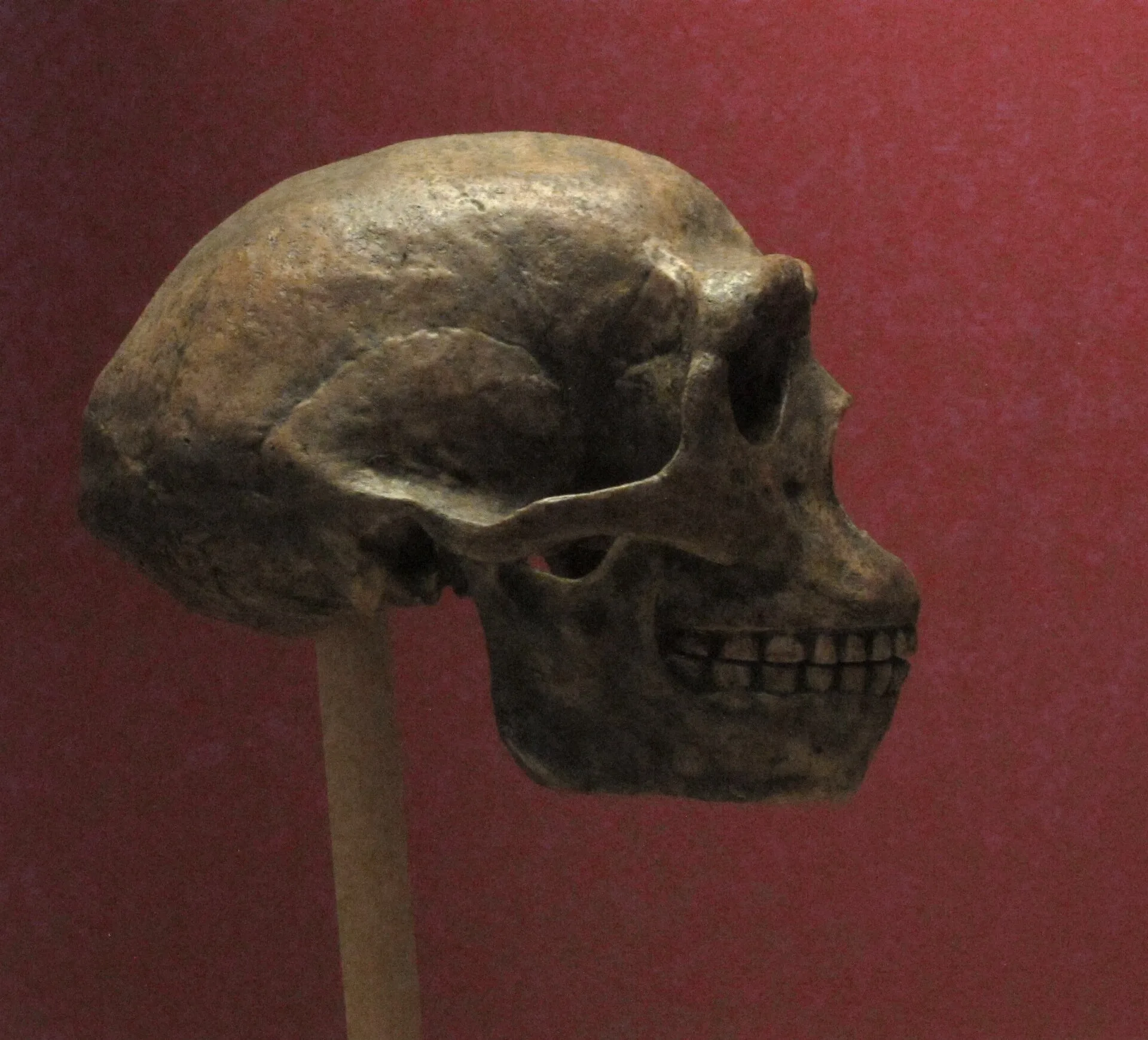
Between 1921 and 1937, excavations in a limestone quarry at Zhoukoudian, southwest of Peking, produced the richest collection of early human remains then known outside Europe: skullcaps, jaws, teeth and a few limb bones from more than 40 individuals, dated today to between about 780,000 and 400,000 years ago and classified as Homo erectus. The specimens were called Sinanthropus pekinensis at the time and Peking Man in the newspapers. In December 1941 they left the building where they were kept and have never been seen since.
What happened
The fossils were held at the Peking Union Medical College, where the anatomist Franz Weidenreich had succeeded Davidson Black as the scientist in charge after Black’s death in 1934. Weidenreich understood what war might cost: he had technicians make plaster casts, and he commissioned measurements, X-rays and detailed drawings for his monographs. In 1941 he left for New York, joining the American Museum of Natural History and taking the casts and his notes with him.
The originals stayed. The agreement under which the material had been excavated forbade removing it from China, but by September 1941, with a Japanese-American war looking likely, the Geological Survey of China and the Rockefeller Foundation had persuaded the United States embassy to authorize a transfer. The plan was for the fossils to be packed into two wooden footlockers, taken by US Marines to the port of Qinhuangdao near their base at Camp Holcomb, loaded onto the liner SS President Harrison, and delivered to New York. The ship never arrived: pursued by Japanese warships as hostilities began, it was run aground.
The last reliable record is the crates leaving the Peking Union Medical College on December 4, 1941. Everything after that is contested.
The search
Rumors have never been in short supply. The crates have been said to lie in a sunken ship, possibly the Japanese transport Awa Maru; to have been buried near the medical college; to have been shipped to Japan or to the United States; to have been ground up and sold as traditional medicine. Both the Chinese and American governments have offered substantial rewards. Nothing verifiable has ever surfaced.
Japanese military police investigated for eighteen months from December 1941 and submitted a report to their Shanghai headquarters in May 1943. The Japanese historian Hidenori Harunari analyzed that report alongside Chinese and American documents in a 2005 paper, concluding that although the Japanese army and Japanese scholars formed an important part of the background, no direct connection to the disappearance could be shown.
The most specific modern lead came from a former US Marine. In April 2010 Lee Berger of the University of the Witwatersrand received an email from Paul Bowen, whose father Richard M. Bowen had been a corporal with the First Marine Division in northern China. In the spring of 1947, during the siege of Qinhuangdao by Communist forces, Bowen’s unit dug foxholes nightly beside the stone barracks. In one hole they struck a box full of bones, filled it in, and dug elsewhere. Working with Wu Liu and Xiujie Wu of the Institute of Vertebrate Paleontology and Paleoanthropology in Beijing, Berger located the barracks using 1931 and 1939 maps of the camp, three surviving landmarks and the recollections of a local historian; the triangulated positions agreed to within 200 meters. The site, they reported in the South African Journal of Science in 2012, is now built over, under roads, a warehouse and a parking lot. No excavation followed.
A challenge to the whole story
In 2021 Michael Roberts, Elizabeth DeVisser and Joel Marrant of Linfield University published two papers in PaleoAnthropology attacking what they call the Standard Scenario: the assumption that the fossils ever reached American hands. They found the personal accounts of the people involved inconsistent with each other and sometimes with themselves; documents cited by serious authors were missing from the archives where they should be; and they located a State Department record they argue makes a handover to the Marines or the embassy unlikely.
They also re-examined the photograph that has anchored the American version since 1972, when the businessman Christopher Janus, asked by Chinese officials to search in the United States, was shown an image of a Marine footlocker full of bones, one of them apparently a Peking Man skull. After a detailed inventory of its contents, the Linfield team concluded the picture was a deception: modern anatomical specimens plus a teaching cast. Their proposal is to start over with a different assumption, that the fossils never left Peking at all, and to look at places nobody has checked, such as the bank vaults where Weidenreich had stored them earlier in the war.
Where it stands
The loss is permanent in practice and modest in scientific terms. Zhoukoudian was excavated so carefully, and the material so thoroughly cast, measured and photographed, that research on Peking Man continued without the originals; four teeth from the early digs remain at Uppsala University in Sweden. What is missing is the bone itself, and with it any chance of extracting the kind of molecular information nobody in 1941 knew to want.