
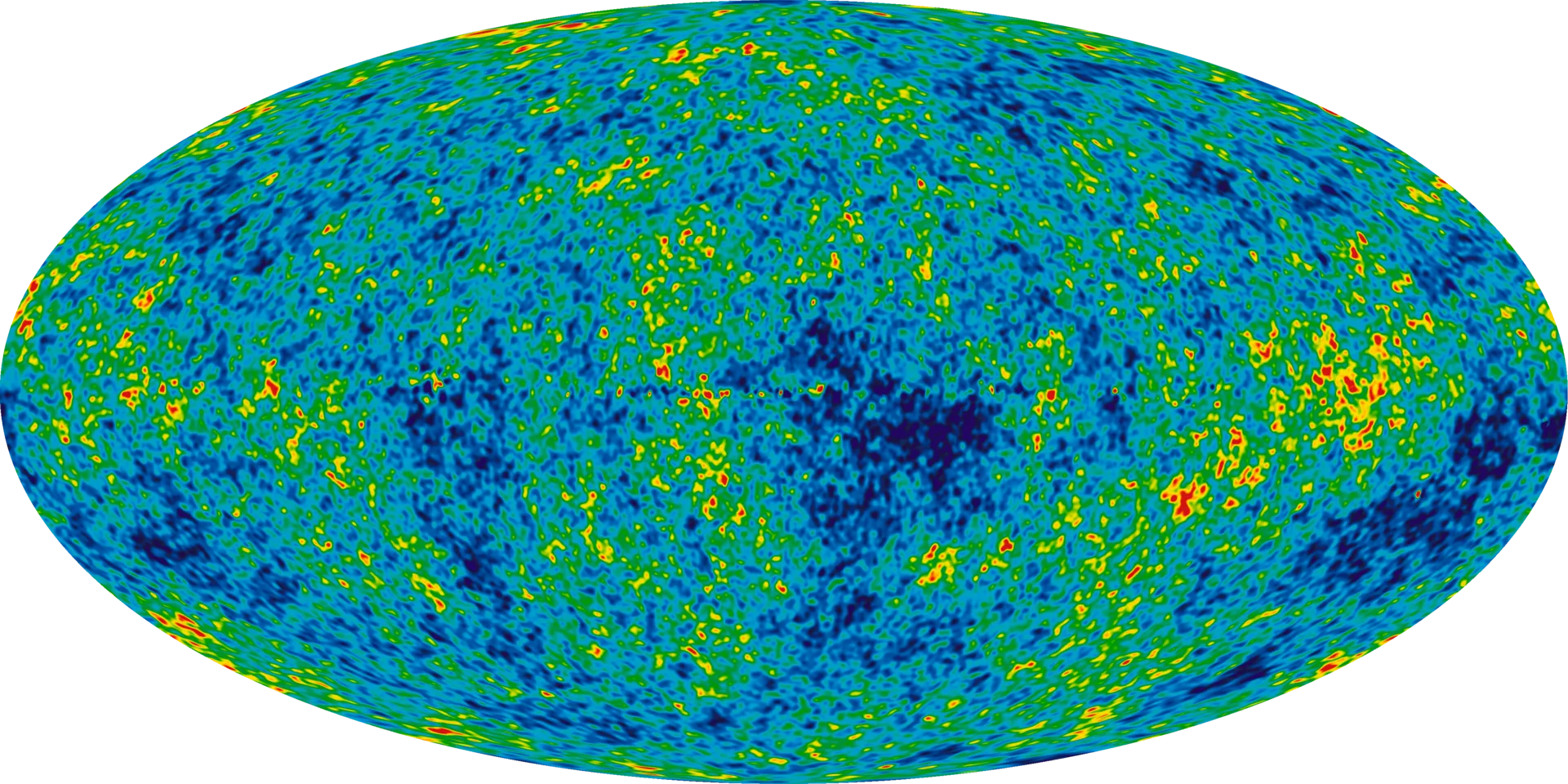
The cosmic microwave background is the oldest light anyone can see: radiation released when the young universe first became transparent, now cooled to about 2.73 degrees above absolute zero and arriving from every direction at once. Its temperature is almost perfectly even. The tiny ripples in it, a few parts in 100,000, are the seeds of every galaxy, and the standard model of cosmology predicts their statistics closely. One patch in the southern sky does not fit those statistics comfortably. It is known simply as the Cold Spot.
How it was found
In October 2003 a team led by Patricio Vielva ran the first-year maps from NASA’s Wilkinson Microwave Anisotropy Probe, WMAP, through a mathematical filter called a spherical Mexican hat wavelet, which picks out features of a chosen size. At a scale corresponding to roughly ten degrees on the sky, about twenty times the width of the full Moon, the southern half of the map showed a non-Gaussian signal: something colder and larger than random fluctuations should usually produce. The team checked that it appeared in each of WMAP’s receivers and at every frequency, which ruled out a fault in one instrument or a smear of dust from the Milky Way. The paper, published in 2004, put the chance of such a signal arising in an ordinary sky at about 0.4 percent. The feature sits toward the constellation Eridanus and is, on average, around 0.00015 degrees colder than its surroundings.
Many astronomers suspected an artifact of WMAP’s processing. That view became hard to hold in March 2013, when the European Space Agency released the first cosmological results from its Planck satellite. ESA’s announcement listed the Cold Spot among a handful of anomalies, alongside an unexplained difference in average temperature between opposite halves of the sky, and Planck scientists said that the new measurements left no room to dismiss them as instrumental errors.
The void explanation
The most down-to-earth explanation is that the spot is not in the early universe at all but in front of it. When microwave photons cross a very large region nearly empty of galaxies, the accelerating expansion of space stretches that void while the light is inside it, and the photons emerge with slightly less energy than they entered with. This is the integrated Sachs-Wolfe effect, and it would leave a cold imprint on the background.
In April 2015 István Szapudi of the University of Hawaii’s Institute for Astronomy and colleagues reported just such a region, using galaxy surveys from the Pan-STARRS1 telescope on Maui and NASA’s WISE satellite. Their supervoid was about 1.8 billion light-years across, and Szapudi described it as possibly the largest single structure humans had identified. Even his team said the void could not account for the whole temperature dip, only that the alignment was too close to be chance.
The test came from Durham University. Ruari Mackenzie, Tom Shanks and colleagues measured precise redshifts, and so distances, for about 7,000 galaxies across the core of the Cold Spot, using a spectrograph on the Anglo-Australian Telescope that could take some 300 at a time. Earlier searches had relied on galaxy colors, a much rougher distance gauge. The 2017 survey found three voids at different depths, broken up by clusters, and a comparison field elsewhere in the sky looked much the same. Neither the voids nor their combined effect was large enough to explain the spot under standard cosmology. In the Royal Astronomical Society’s release Shanks noted that simulations put the odds of the spot arising by chance at about one in 50, and floated a more exotic alternative.
Colliding universes
That alternative comes from eternal inflation, a family of theories in which our observable universe is one bubble in a much larger inflating space where other bubbles also form. If a neighboring bubble ever brushed against ours early on, it could have left a round, disc-shaped mark on the microwave sky. In 2011 Stephen Feeney, Hiranya Peiris and co-authors searched the seven-year WMAP data for such marks and found that the data did not require any; they set an upper limit of fewer than about 1.6 detectable collisions across the whole sky and called for better Planck data to test the idea properly. A collision remains possible, not demonstrated.
Where it stands
The void has since been mapped more carefully. In 2022 the Dark Energy Survey confirmed the Eridanus supervoid as a real and prominent underdensity in the Cold Spot’s direction, but agreed that under the standard model its imprint can produce only about a tenth to a fifth of the observed cooling. The authors argued that the two rare structures are probably connected and noted hints that very large voids elsewhere leave stronger imprints than theory predicts. The Cold Spot is therefore a measured feature with several partial explanations: a fluctuation with odds of about one in 50, a foreground void that does part of the work, gaps in the theory of how voids affect light, or physics beyond the standard model. None has closed the case.