
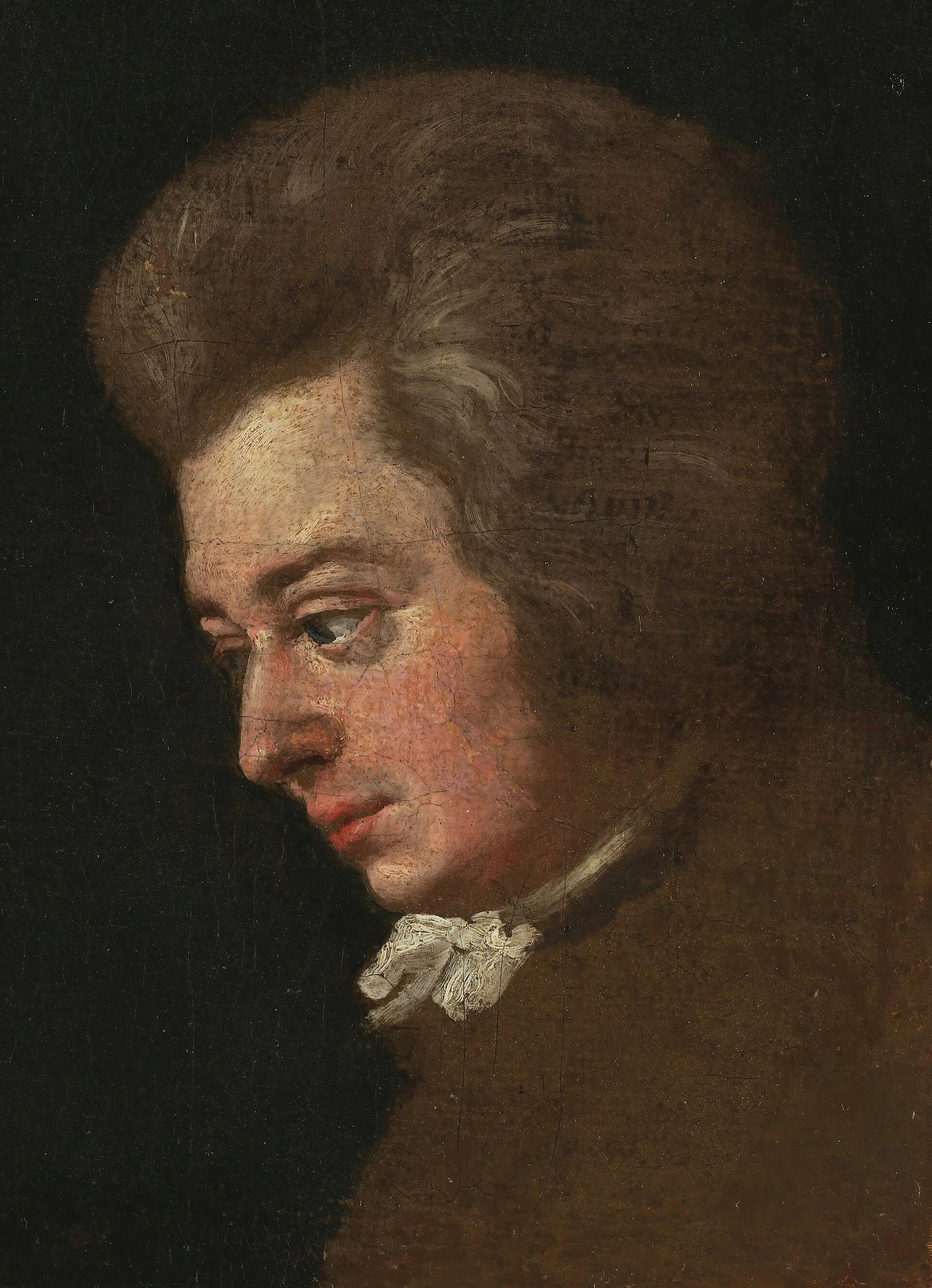
Wolfgang Amadeus Mozart died at home in central Vienna a few minutes before one o’clock on the morning of December 5, 1791. He was 35, at the height of his powers, and the speed of his decline left friends and later admirers looking for an explanation. One was supplied, in effect, by Mozart himself. He had told his wife he believed someone had poisoned him, and three decades later that fear acquired a suspect: Antonio Salieri, the Italian composer who had led music at the imperial court.
What happened
The autumn of 1791 was among the busiest of Mozart’s life. The Magic Flute opened on September 30 and drew full houses, he finished the Clarinet Concerto, and he was working on a Requiem commissioned by a messenger who would not name his employer (a nobleman who planned to pass the piece off as his own). On November 18 he conducted a short cantata for the opening of his Masonic lodge’s new temple. Within two days he was in bed. Those around him described swelling that began in his hands and feet and spread until he could barely move, along with fever, pain and vomiting. His doctors, Thomas Closset and Mathias von Sallaba, treated him with bloodletting, standard care at the time. He died about a fortnight later. The parish register gave the cause as severe miliary fever, a term that names a rash rather than a disease. He was buried in an ordinary grave at the St. Marx cemetery, as Viennese rules of the day required for anyone not of noble rank; the familiar idea of a pauper’s burial is a myth.
The poison idea came from the family. Constanze Mozart later told the biographer Franz Xaver Niemetschek, whose book appeared in 1798, that during a drive in the Prater that autumn her husband had wept, said he was writing the Requiem for himself, and insisted he had been given poison. Historians treat the story with care. It was recorded years after the event by a widow who depended on benefit concerts and public sympathy, and Mozart’s own letters from November are mostly cheerful.
The Salieri story
Salieri was not named for decades. In 1823, aged and in poor health, he was taken into a Vienna hospital, and gossip held that he had confessed to killing Mozart. The musicologist Kristin Franseen traced how the rumor traveled: by April 1824 Paris papers, the Gazette de France among them, were reporting a supposed deathbed confession while openly doubting it and noting that the old man’s mind had failed. Salieri was still alive and denied the charge to visitors; he died in 1825. A former Vienna health official, Eduard Guldener von Lobes, wrote at the time that Mozart’s illness had been a fever then going around the city, and called the accusation a slander. Alexander Pushkin’s short verse play Mozart and Salieri (1830) turned the rumor into literature, Rimsky-Korsakov set it as an opera, and Peter Shaffer’s Amadeus, a play in 1979 and an Oscar-winning film in 1984, fixed it in popular memory. Shaffer presented his envious Salieri as drama, not history.
The medical explanations
With no body to examine and only a few pages of eyewitness testimony, doctors have proposed a long list of natural causes: rheumatic fever, kidney failure, a blood-vessel disorder called Henoch-Schönlein purpura, a parasite from undercooked pork, and an overdose of mercury given for syphilis, which there is no good evidence he had. A skull held in Salzburg and once said to be Mozart’s has been used to argue for a head injury, but its identity is disputed.
The most data-driven attempt appeared in the Annals of Internal Medicine in August 2009. Richard Zegers of the University of Amsterdam, Andreas Weigl of the Vienna municipal archives and Andrew Steptoe of University College London went through the city’s official death register for November 1791 to January 1792, and the same three months in the years either side: 5,011 adult deaths in all. Tuberculosis was the leading cause, wasting and malnutrition came second, and oedema, the swelling at the center of Mozart’s illness, came third. Deaths from oedema rose sharply among younger men in the weeks around his death compared with the neighboring years, a small outbreak the authors thought may have started in the military hospital. They concluded that a streptococcal infection, of the kind that causes strep throat, followed by kidney inflammation fits the evidence best, with scarlet fever a less likely variant. They described this as consistent with the record rather than proven.
Where it stands
The cause of Mozart’s death remains a matter of inference, and probably always will. The poisoning story, though, has nothing beneath it except a frightened man’s remark and a rumor that circulated among strangers thirty years later. Contemporaries reported nothing unusual, the course of his illness matches diseases common in Vienna that winter, and the man most often accused denied it until his death.