
What happened
In late January 1959 ten students and graduates of the Ural Polytechnic Institute in Sverdlovsk set out on a ski trek to Mount Otorten in the northern Urals, a winter route of the highest difficulty grade. One, Yuri Yudin, fell ill at the last settlement and turned back. The nine who went on were led by Igor Dyatlov, 23. On February 1 they climbed out of the forest onto the open shoulder of Kholat Syakhl, a bare dome whose Mansi name is usually rendered as Dead Mountain, and pitched their tent on its eastern slope in worsening weather, cutting a platform into the snow for shelter from the wind. The last frames on their cameras show them digging it.
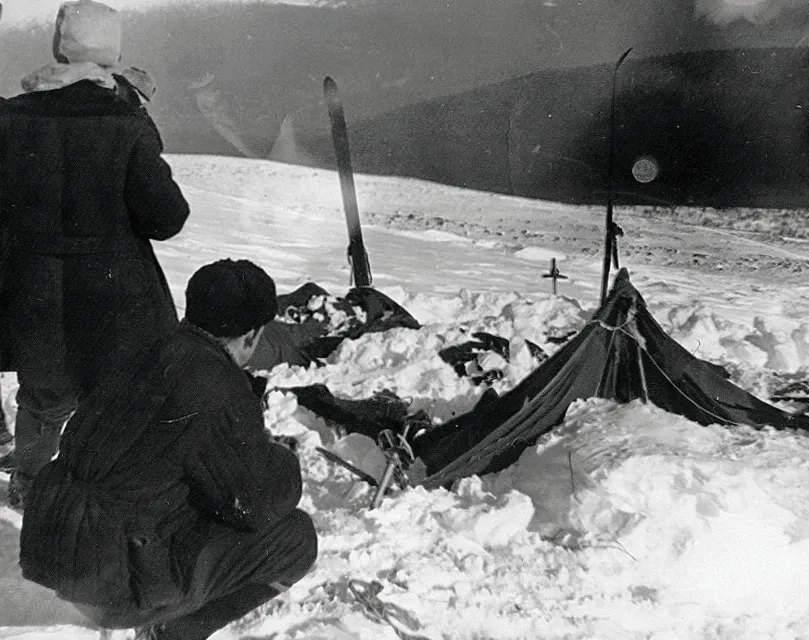
When no telegram arrived from the end of the route, a search was mounted. On February 26 a student search party found the tent half buried, its downhill side slashed open from the inside, with boots, coats and food still in it. Footprints in socks and bare feet led downhill toward the tree line more than a kilometer away. Under a large cedar there the searchers found Yuri Doroshenko and Yuri Krivonischenko in their underwear beside the remains of a fire. Dyatlov, Zinaida Kolmogorova and Rustem Slobodin lay between the cedar and the tent, apparently trying to get back; Slobodin had a skull fracture. The temperature that night had been below minus 25 Celsius, with a strong wind.
The last four were not found until May, in a ravine beyond the cedar under several meters of snow. Nikolai Thibeaux-Brignolle had a crushed skull. Semyon Zolotaryov and Lyudmila Dubinina, 20, had multiple fractured ribs. Dubinina’s eyes and tongue were missing. The pathologist compared the force involved to a car crash. Some clothing on these four bodies showed radioactive contamination when tested, which was never explained.
The investigation
The Sverdlovsk prosecutor’s office closed the case on May 28, 1959, with a finding that the group had died from an unknown compelling force, a formula that satisfied nobody. The files were sealed, the area was closed to hikers for three years, and the pass acquired Dyatlov’s name. Over the following decades the case drew every explanation available: an avalanche, an attack by Mansi hunters, escaped prisoners, a secret weapons test, infrasound, the fireballs seen in the sky that month, a yeti. The 1959 files were released in the 1990s and have since been translated and published in full.
In February 2019 the Russian Prosecutor General’s Office reopened the matter, limiting itself to three natural possibilities: an avalanche, a snow slab or a hurricane-force wind. On July 11, 2020, Andrei Kuryakov of its Urals directorate announced the result. A slab of snow had come down on the tent; the hikers, some already injured, had cut their way out and retreated downhill to wait it out; in visibility of about 16 meters they could not find the tent again and froze. Kuryakov argued that the chest and skull injuries of the three found in the ravine were of the kind seen in climbers caught by avalanches, and that the other six had died of hypothermia.
The explanations
The avalanche theory had always faced four objections: the slope at the tent is about 28 degrees, below the usual threshold; the searchers saw no avalanche debris; the slab would have had to release some nine hours after the hikers cut into the slope; and avalanche victims generally suffocate rather than suffer crushed chests. In January 2021 Johan Gaume of the Swiss Federal Institute of Technology in Lausanne and Alexander Puzrin of ETH Zurich published a model in Communications Earth & Environment that addressed each. Katabatic wind pouring down the mountain that night would have loaded fresh snow onto the slope above the cut, so the release could be delayed for hours. The terrain is locally steeper than the average. A small slab a few meters across would leave little trace by the time searchers arrived three weeks later. And a block of dense snow striking people lying on a rigid base of packed skis and frozen ground would produce the rib and skull fractures recorded, severe but not immediately fatal. The simulation used snow-mechanics code adapted from the Disney film Frozen and cadaver-impact data from 1970s General Motors crash tests. The authors said they had shown the avalanche hypothesis to be plausible, not proven.
Where it stands
The avalanche account now has the backing of the Russian state and of the best physical modeling done on the case, and it explains the sequence without invoking anything exotic. It does not explain everything: the radioactivity, the missing soft tissue (most plausibly scavengers and months in meltwater), and why nine experienced people did not go back for their boots. In June 2026 relatives of the dead, through their lawyer, demanded a new criminal case, pointing out that the chemical and tissue analyses that should accompany the 1959 autopsies are absent from the file. The verdict here is unproven: the deaths and the official explanation are documented, the explanation is credible, and the record still has holes.